
Full text of Ray Dalio's latest interview: Debts must be repaid! Is there a bubble in AI? When will the bubble burst? (In-depth summary)

Ray Dalio was exclusively interviewed on Nicholas Thompson’s channel on October 14. In this conversation, The Atlantic CEO Nicholas Thompson and Dalio expounded upon the five great forces shaping history, explained why the AI boom remains resilient despite tariffs and shocks like the Iran War, and shared his advice for young people entering the coming AI era.
Dalio examines the AI bubble, debt crisis, and geopolitics through the frameworks of the "economic machine" and "long cycles," stressing that technological revolution does not change the laws of debt, bubbles, politics, and human nature; AI is important, but is currently financialized, leveraged, and concentrated—risks lie not in the technology itself, but in pricing, cash flows, debt, and political feasibility.
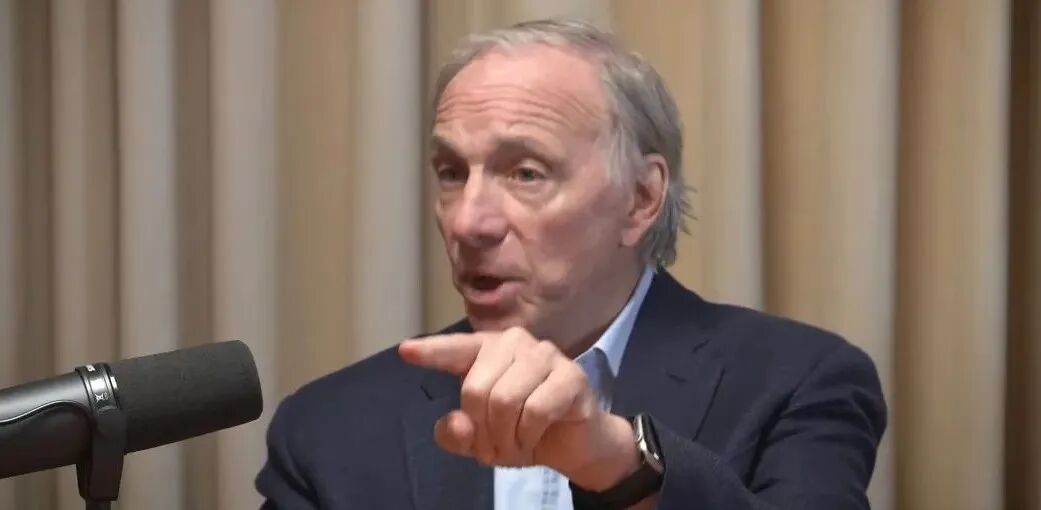
I. General Overview: Five intertwining forces—everything has mechanical causality
Dalio believes that history is driven by five great forces: Debt & money, internal politics, geopolitics, natural forces, technological creativity.These five are not isolated but intertwined, with the first three being most cyclical. AI falls under the fifth force but must be understood within the other four: how much money it gets, whether it can make a profit, and what political and geopolitical consequences it brings. Dalio’s core methodology is “mechanical causality”: all things have cause and effect—understanding the operating mechanisms lets one see the essence;the logic of debt does not change because of AI—debt must be repaid, bonds must be repaid, and bubbles must face cash needs.
II. Judging the AI Bubble: All bets are on one track, risks are exponentially amplified
Dalio’s judgement is not the simple “AI is a bubble,” but: at present, all bets are highly concentrated on AI alone—its share of GDP, wealth, the stock market, and its impact on the bond market, trade, geopolitics, war, and employment. When resources and expectations are so concentrated, the risk of bubble bursting is greatly amplified. He distinguishes between "excellent technology" and "quality investment": great technology does not equal great investment; competition compels companies to invest, possibly excessively; financing and valuation generate a large amount of book wealth, but wealth does not equal money—converting book wealth to cash requires asset sales or borrowing, which must eventually be repaid with cash. The key definition of a bubble is not “will it pay off in the end,” butwhether, while waiting, it will collapse due to cash needs, wealth taxation, IPO monetization, or strong-hand/weak-hand games. He compares the current bubble’s scale to that of 2000 and 1929; 2008 was mainly a real estate and debt bubble, with different underlying causes; overall fervor, 1929 was the largest. The wisest move for individuals isnot to bet all chips on a single high-volatility, high-leverage item.
III. The Mechanism of Bubble Bursting: Book Wealth, Cash Demands, and “Strong vs. Weak Hands”
Dalio illustrates with an example: if you raise $50 million at a $1 billion valuation, you instantly create $1 billion of book wealth, but in actual cash only $50 million.Book wealth’s growth far outpaces the growth of money supply—once people need cash (to buy assets, pay taxes, consume, or make margin calls), they must sell. Wealth taxes, IPO employee cash-outs, rescuer capital raising, or leveraged investors having to cover positions are all potential “pins” to pop the bubble. Whether assets are in "strong hands" or "weak hands" is crucial: those who can withstand cycles vs. those who panic or urgently need cash—these decide the dynamics of the bubble burst.
IV. Debt Crisis: The US economy is like arteries clogged with plaque, eventually leading to “economic heart attack”
Dalio sees the debt problem as the biggest current systemic risk. US government annual spending is about $7 trillion, revenues about $5 trillion,deficit $2 trillion, spending about 40% more than revenues; total debt is six times revenues; interest is about $1 trillion, half the deficit; every year about $10 trillion debt matures and must be refinanced. The rising cost of debt service, like plaque buildup in arteries, will eventually trigger “economic heart attack.” Meanwhile, debt supply and demand is deteriorating: foreign buyers account for about a third, with China and Japan the largest, yet demand has dropped due to growing debt, global conflict, and sanction risks. Increasing supply and weak demand is a classic problem. He likens it to a doctor looking at X-rays: you can't count on luck just because the heart attack hasn't started yet.
V. Can an AI Productivity Miracle Solve the Debt Problem? The key is income, tax, politics, and time
The host raised an optimistic rebuttal: AI productivity may rise tenfold, resolving the debt issue. Dalio responded: Mechanistically, if income grows enough, of course it could—but we must consider probability, conditions, and timing.A productivity miracle doesn’t automatically translate to government income—market competition makes products cheaper; tax system, political consensus, and timing are all key. Currently, wealth gaps are widening—differences between stock owners and others; the average US household bears about $280,000 of government debt. The core three questions: How does wealth transfer? Can productivity gains be timed to yield enough revenue to cover debt? Can government collect the revenue in a politically feasible and timely manner? If the productivity miracle doesn’t benefit the majority, society must be on high alert about wealth gaps and potential crisis.
VI. Policy Solution: The 3% Deficit Bottom Line and Political Constraints
Dalio proposes the "3% solution": the fiscal deficit must be reduced to less than 3% of GDP to prevent compound interest and plaque buildup in debt. He doesn’t care about left or right politics, only about the risk of hitting rocks; he suggests raising taxes 4–5% and cutting spending 4–5%, adjusting proportionally. But both parties’ bottom lines are" absolutely no tax hikes, absolutely no welfare cuts," making reform politically constrained. He believes the nation must operate for the benefit of all; taxes must be a tool for majority benefit, otherwise even AI will not succeed; taxes are not limited to AI but funds are still insufficient. On the “government taking equity in AI companies to collect taxes” debate, he stresses mechanisms: government still needs cash or borrowing; stocks are not cash, can’t be used as “shell currency” to buy food; he opposes outright seizure, only analyzing who gives what to whom, and how to operate reasonably.
VII. Government and AI Strategy: Free Market Not Enough; Intervention Needs Mechanisms
Dalio believes the world has entered a new order with fierce international competition,complete free markets may not optimize strategic resource allocation; the AI race relates to the economy, military, and global leadership—government intervention is necessary in some respects, but it can’t be black and white. He supports schemes like the “Trump account” (giving people equity), but it depends on implementation—citizens must understand equity; government can provide guidance but must clarify funding mechanism.
VIII. Divergence Between US and China on AI: China Sees AI as Infrastructure, Manufacturing Edge, and Winning Factor
Dalio summarizes three points on how China views AI: First,AI is regarded as basic infrastructure, like electricity, water, or building roads and bridges—profit is not the main goal, improving efficiency and universal access are key; Second,AI is integrated into manufactured goods and world market competition—the leading-edge models are not where the greatest benefit lies, but rather embedding simpler, cheaper AI in manufacturing products is more important; China produces 32% of global manufactured goods, more than the US, Germany, and Japan combined; Third,AI is the key to victory in economic and military competition. The US’s profit-driven system contrasts with China’s approach of infrastructure and manufacturing integration.
IX. Personal Advice & Legacy: Stand at the Crest of the AI Wave, but Follow Life Principles
Dalio’s advice to young people is:you must stand at the cutting edge of the AI boom, or you'll be swept away; but life principles remain the same: know your own nature; the highest principle is to learn;pain + reflection = progress; align work with passion, but also pursue financial returns; life is an adventure, so go on adventures. His mission is popularizing AI and investment insights, enabling everyone to create and execute thoughtful standards as he does; he started at age twelve, proving there’s no need for institutions or costly resources—the key is standards and follow-through in your mind.
In a nutshell: Dalio is not simply bearish on AI, but warns that: no matter how great the AI technological revolution is, it cannot cancel the laws of the economic machine; when all chips are on AI, book wealth far exceeds cash, debt “plaque” builds up, and politicians fear raising taxes or cutting welfare, the real risk is the resonance of bubble burst with debt cycles.
Complete Dialogue Between Ray Dalio and Nicholas Thompson
I. Introduction: All Bets Placed on AI Alone
Host Nicholas Thompson: In my view, we are facing a series of complex dynamic changes…
Ray Dalio:It’s like so many big needles aiming at a bubble. I’ve reached the same conclusion. Moreover,all the chips are highly concentrated on this one thing. In other words, it accounts for GDP, wealth, the proportion of the stock market, its impact on the bond market, trade, geopolitics and war, its implications for jobs—everything is tied to this.
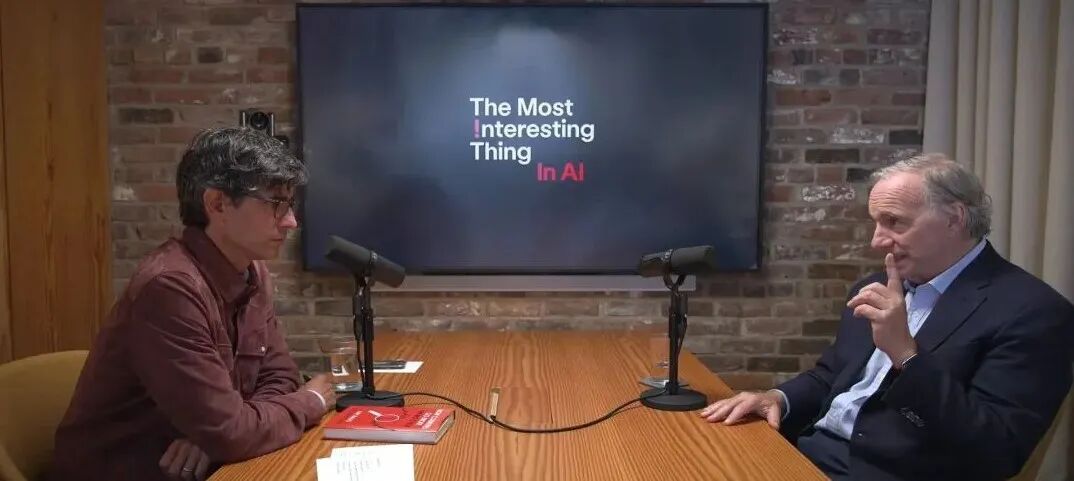
Host Nicholas Thompson: Hello, everyone. I’m Nicholas Thompson, CEO of The Atlantic, and welcome to the "Most Interesting Things in AI" podcast. A few weeks ago, I invited Azeem Azhar to discuss one of the biggest questions in AI: Are we in a bubble? The technology is truly amazing, but that doesn’t mean the economic model works. If you heard that episode, you’ll know Azeem’s answer was: No, it’s not a bubble. We had a spirited debate—I argued it is a bubble, but he rebutted every point. Of course, not everyone agrees with Azeem. Ray Dalio is one of the most notable skeptics. He’s the founder of Bridgewater, the world’s largest hedge fund. Ray accurately predicted the 2008 financial crisis, so when the housing bubble burst and the economy melted down, Bridgewater’s investments actually rose in value. In fact, since he started the fund, he’s pulled off a track record of nearly annual outperformance. He left the company last year. Now, he shares his insights via the "Principles Observer" newsletter and books like "Why Nations Fail." If you want deep takes on markets, investing, and what happens when asset valuations get too high, Ray is the guy to know. For the past year, he’s been warning about AI. He says it’s a bubble, but for reasons that may surprise you. So I sat down with Ray to discuss why—and how we might avoid a repeat of 2008. This podcast is made by The Atlantic’s business team, independently of our editorial team. Here’s my conversation with Ray Dalio. Ray, welcome to the show. I’m excited.
Ray Dalio: Glad to be here.
Disclaimer: The content of this article solely reflects the author's opinion and does not represent the platform in any capacity. This article is not intended to serve as a reference for making investment decisions.
You may also like
Stellar RWA Market Reaches $3.54 Billion

US-Iran deal hopes support Bitcoin’s push toward $90,000, oil prices fall

Gold Analysis: Can Safe-Haven Demand Offset the Drag from a Stronger Dollar?

French unrest impacts financial markets: stocks and bonds both slump, euro declines
Social unrest in France continues to intensify, with the central government requiring some local authorities to impose curfews. Prime Minister Sebastien Lecornu has not ruled out the possibility of declaring a state of emergency. The yield on France's 10-year government bonds surged by 15 basis points in one day to 4.93%, marking the largest single-day increase in nearly a month. The CAC 40 index fell by 1.5%, leading declines among major European markets. The euro dropped 0.2% to 0.3% against the US dollar, the British pound, and the Japanese yen.

Crypto prices
More


