
Gold Analysis: Can Safe-Haven Demand Offset the Drag from a Stronger Dollar?

FX168 Financial News, October 19— For retail traders who fully understand gold’s current trading range and driving factors, this precious metal’s current volatility zone remains attractive for trading. Although gold prices are relatively range-bound, recent market signals indicate that some large institutional investors believe gold may already be oversold. However, the shift in market sentiment caused by widespread global anxiety has undoubtedly kept overall market trading cautious. At the same time, this cautiousness could also be brewing new price momentum.
For retail traders who fully understand gold’s current trading range and driving factors, this precious metal’s current volatility zone remains attractive for trading. Although the gold price range is relatively narrow, recent market signals indicate that some large institutional investors believe gold may already be oversold. However, the shift in market sentiment caused by global tensions has undoubtedly kept overall market trading cautious. At the same time, this cautiousness could also be brewing new price momentum.
Recently, gold prices have repeatedly tested the upside without experiencing sharp declines, managing to hold short-term levels—this phenomenon is worth noting. The gold market is rife with speculative trading, as large institutions compete for short-term profits, betting on gold’s movements. As always, many gold market participants firmly believe in gold’s safe-haven attributes.
With global equities and government bonds fluctuating, once market sentiment turns cautious, gold becomes a favored asset. Interestingly, in recent weeks, the US dollar has strengthened significantly, causing gold prices to retreat, but strong support has remained intact. In the past few trading sessions, there have also been indications that some large participants in the gold market believe upward momentum may further increase.
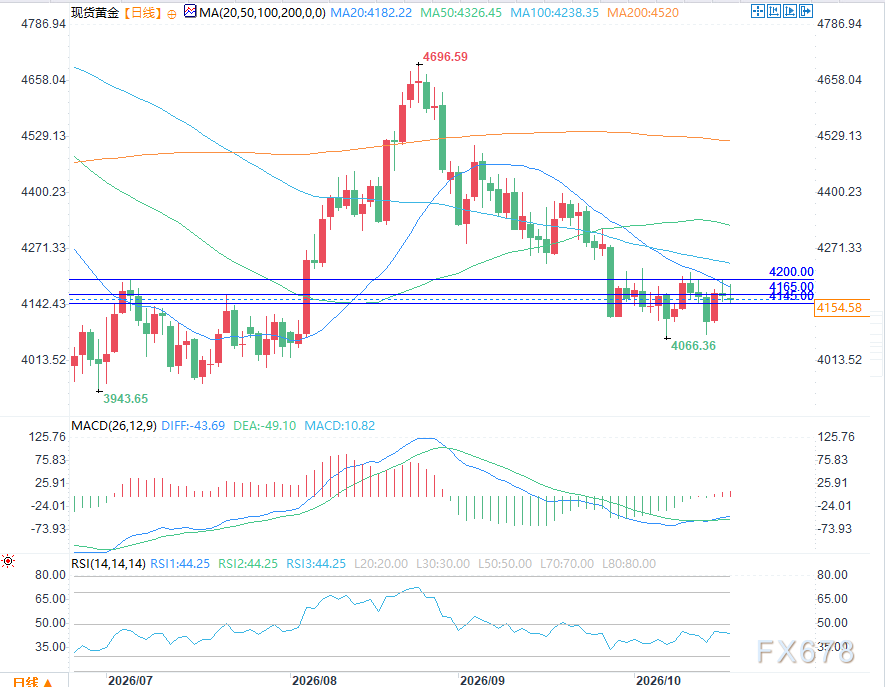
In the past two days, buying momentum has rebounded somewhat, but it's important to note that the $4,200 resistance remains tough to break consistently and effectively. Last Friday, gold prices surged to near $4,198, touching the week's earlier high, but the ensuing pullback was milder than before. From a technical perspective, support has gradually shifted higher, with $4,160 being a key level.
However, at present, the dollar’s safe-haven demand remains an obstacle for gold’s upside. Last Friday, a rapid decline in US stocks pushed the dollar higher in late trading, likely leading to passive selling in gold. In the short term, choppy market conditions are likely to continue. The medium-term direction remains unclear, which is unfavorable for trend-following traders. Technical patterns are fluctuating frequently, with large investors and financial institutions exhibiting indecisiveness, making intraday trading continuously challenging.
Technical traders need to closely monitor whether gold’s support can hold. Short-term trading should use the dollar and global equities as indicators of market sentiment. If the US dollar remains strong in the foreign exchange market amid a risk-averse atmosphere, gold is likely to maintain its current consolidation.
However, behind the continual loss of overall market confidence lies a paradoxical possibility: should market sentiment not only remain fragile but tip into panic, gold would become the asset everyone scrambles to allocate into. If the $4,160-$4,150 support zone proves effective, it will serve as a key signal, indicating that buying pressure is gradually building. However, before this, gold needs to break above and stabilize above $4,200 to attract more bullish investors.
Gold remains full of trading opportunities, and a bullish outlook on gold prices is entirely reasonable. Historically, gold has long had investment value. However, from a speculative trading perspective, the persistent and formidable impact of a strong US dollar can’t be ignored. This means gold prices will continue to see sharp volatility, and day traders who are ill-prepared may suffer from large market swings.
In recent days, gold has held at high levels, displaying upward momentum. But if US stocks see another round of short-term sell-offs, the effects will be felt in the forex and bond markets, further heightening short-term uncertainty for gold prices. Traders looking to capitalize on technical reversals may find the current environment full of opportunities, but must remain vigilant with risk controls.
(Spot Gold Daily Chart Source: FX168)
Gold is currently trading above $4,150; despite persistent US dollar strength, the recent rebound structure remains intact. If prices continue upward and break through $4,185, the next target will be $4,205, increasing the likelihood of retesting the $4,200 resistance. Conversely, a confirmed break below $4,165 would weaken the short-term technical setup, focusing attention on $4,145. The struggle between US dollar demand and global safe-haven allocations may determine which price level is broken first.
Disclaimer: The content of this article solely reflects the author's opinion and does not represent the platform in any capacity. This article is not intended to serve as a reference for making investment decisions.
You may also like
Uniswap UNI futures launch gives institutions a regulated way to hedge the token

Stellar RWA Market Reaches $3.54 Billion

US-Iran deal hopes support Bitcoin’s push toward $90,000, oil prices fall

French unrest impacts financial markets: stocks and bonds both slump, euro declines
Social unrest in France continues to intensify, with the central government requiring some local authorities to impose curfews. Prime Minister Sebastien Lecornu has not ruled out the possibility of declaring a state of emergency. The yield on France's 10-year government bonds surged by 15 basis points in one day to 4.93%, marking the largest single-day increase in nearly a month. The CAC 40 index fell by 1.5%, leading declines among major European markets. The euro dropped 0.2% to 0.3% against the US dollar, the British pound, and the Japanese yen.

Crypto prices
More


