
BlackRock is bullish on gold's long-term prospects: Debt and deficits erode the purchasing power of fiat currencies, and gold mining stocks are expected to amplify gains in gold prices.

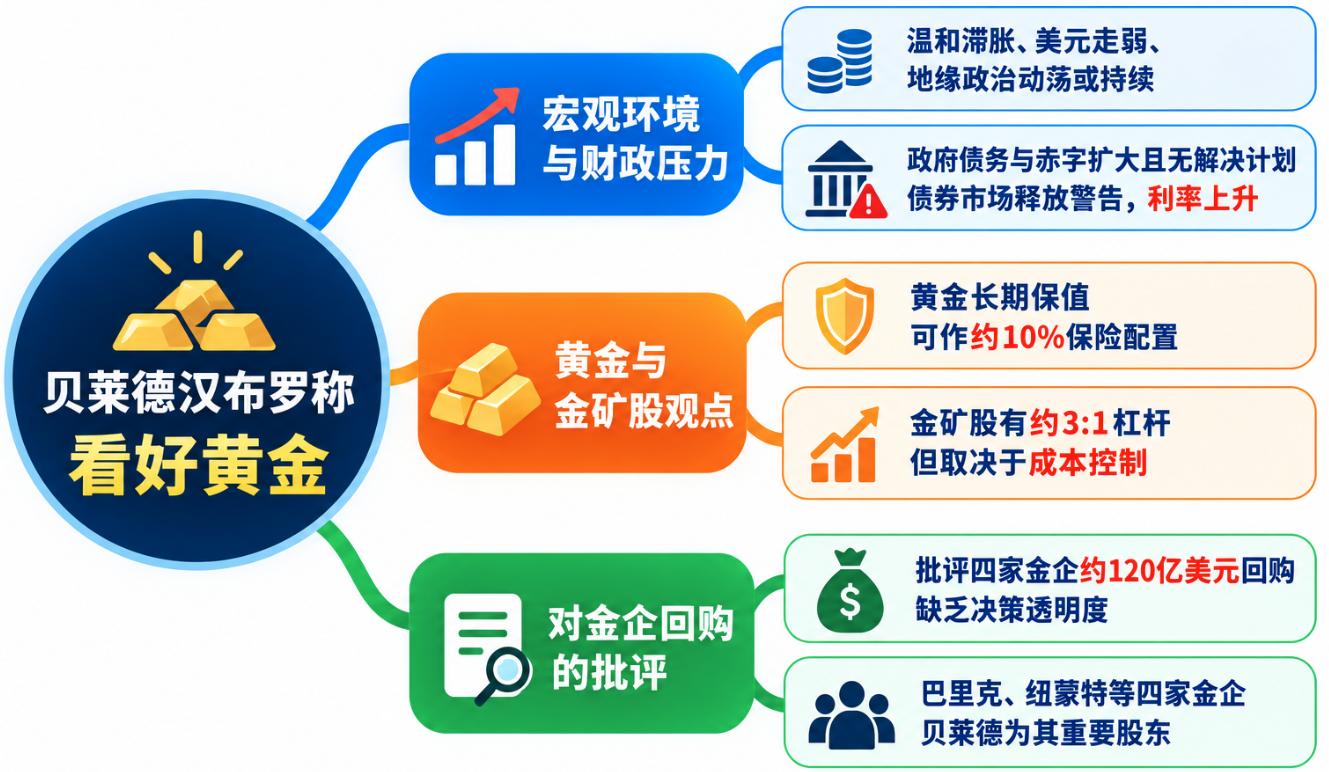
Evy Hambro, Head of Global Thematic and Sector Investing at BlackRock, said in an interview with MoneyWeek that the current market environment characterized by mild stagflation, a weakening dollar, and geopolitical turmoil may persist. He believes that the bond market, especially the government bond market, is continuously sending signals of increasing fiscal stress.
Hambro pointed out that government debt levels are huge and annual fiscal deficits are still expanding, yet governments have not proposed plans that can effectively solve these issues. This not only increases funding pressure, but also causes investors to reevaluate the risks of holding government bonds and fiat currencies.
He said: "I think this will continue. If we look ahead, and try to see clearly what is happening in the market, then in my view, one thing is very clear, at least for some: the bond market—especially the government bond market—is flashing warning signals. It is telling you that things are not healthy. Interest rates are rising, while debt levels are already huge. The annual fiscal deficits that governments need to fund are also constantly expanding, putting enormous pressure on the entire financial system."
In Hambro's view, concerns over monetary purchasing power are one reason why funds are shifting toward physical assets.
He said: "People will say that ten years ago, or even earlier, one pound, one dollar, or one euro bought you much more than today, and they don't want to bear that risk. This is one of the factors."
He also criticized the inefficiency of some government spending, arguing that when governments continue running fiscal deficits without a clear plan for repayment, investors may demand higher interest rates to compensate for potential risks.
Hambro stated: "These governments carry massive fiscal deficits and huge debts, yet have no plan to solve the problem, and the situation only looks set to get worse. If they want my money, they'll have to pay interest rates that are much higher than before."
Gold Becomes a Key Asset for Hedging Debt and Currency Risks
Faced with ballooning government debt, widening fiscal deficits, and declining purchasing power, Hambro believes that physical assets can serve to protect purchasing power in the long term.
He said: "Physical assets can be infrastructure, commodities, or gold. In the long run, these assets can protect purchasing power. When I started this business over 30 years ago, copper cost 60 cents a pound; now it's $6. At that time, gold was $400 an ounce; now it's over $4,000 an ounce."
Hambro emphasized that gold's long-term value does not depend solely on any single cycle of interest rates. He believes gold can store value over extended periods, though its performance may fluctuate significantly in different phases.
He said: "Gold enthusiasts like to joke that for 2,000 years, one ounce of gold has always been able to buy a man's suit. So, in large part, gold is an asset that can store value for the long term. In history, sometimes it performs well, sometimes it doesn't; in some periods, its purchasing power exceeds expectations, in others, it's below expectations. But overall, in the long run, gold has always been an excellent asset. I think people are rediscovering this."
Hambro also noted that the way investors allocate to gold is changing. In the 1990s, wealth management institutions would usually allocate a certain proportion of gold in client portfolios, but by the early 21st century, such allocations gradually disappeared. Today, gold is coming back into focus, though the overall percentage is still relatively low.
He said: "People often say a gold allocation should be around 10% because it is essentially insurance. If you don't buy insurance, once something goes wrong, the loss can be devastating. If you buy insurance every year and nothing happens for ten years in a row, you might feel as if the money was wasted. But on the day something really does go wrong, you get all that money back."
In Hambro's view, the role of gold in a portfolio is similar to insurance, not to outperform other assets in every phase. Investors may need to endure periods when gold underperforms, but can use profits from other better-performing assets to maintain their gold allocation.
He added: "Holding gold in a portfolio inevitably means there will be times it underperforms. If gold isn't doing well, you can take some profits from assets that are doing very well—these are often nine or ten times the size of your gold position, maybe even more. Then, you can reinvest a portion of that profit in gold, thus always maintaining your insurance allocation in the portfolio."
Hambro believes that the warning signals from the bond market are reminding investors to diversify their allocations and avoid over-reliance on a single asset class.
He said: "Diversification is essential. Don't put all your eggs in one basket. Because, ultimately, how will governments deal with their debts? The least painful way is to let inflation gradually reduce the real value of debt. This means that governments and central banks might not be as strict about reaching inflation targets as they should be. In fact, they have already consistently failed to meet these targets."
He further stated: "In my view, this is very clear. I believe the gold price will reflect the pain being felt in other areas. If the situation deteriorates, gold will reflect this; if things improve, gold will react accordingly. And it's hard to imagine the current circumstances will improve particularly quickly."
Gold Mining Stocks Provide Leverage—The Key Is Cost Control
In addition to physical gold, Hambro is also optimistic about gold mining companies. He believes that gold mining stocks provide leveraged investment opportunities that physical gold itself does not possess, but this advantage depends on mining companies' cost management and profit margin changes.
Hambro stated that historically, the share price of commodity producers generally maintains about a 3:1 relationship with commodity prices, especially in the gold sector.
He said: "Historically, share prices of commodity producers, especially in gold, usually have about a 3:1 relationship with commodity prices. That is, for every 1% movement in commodity prices, the related company’s equity value moves about 3%. This relationship has been quite stable over many years."
He compared this relationship to options, arguing that whether mining companies can maintain leverage depends on whether operating costs can be controlled. If costs rise faster than gold prices, profit margins cannot expand, and stock prices' amplification effect on gold prices may weaken.
Hambro pointed out that in the past, there were instances where gold prices rose but gold mining stocks fell, one reason being cost pressure. But in recent years, this relationship has recovered.
He said: "I'm pleased to see that in recent years, this relationship has fully recovered. Not just this year, but the past few years as well: commodities themselves performed very well, and related shares saw multiplied returns. Copper and many other commodity sectors have also seen this."
He believes that cost inflation at mining companies has not kept pace with the rise in gold prices, so profit margins have continued to expand, driving relevant stocks to deliver better returns.
When choosing gold investment vehicles, Hambro emphasized that investors should decide on allocation based on their own risk tolerance. For those who want direct exposure to gold prices but don't want to bear mining company risks, he suggests considering gold ETFs backed by physical gold; for those seeking more price elasticity, gold mining stocks may be an option.
He said: "People always ask, what is the best way to get gold exposure? It depends on how much risk you can take. If you just want exposure to gold prices, then you should choose a gold ETF—and it should be backed by physical gold. If you want more excitement, then allocate some gold mining stocks. If you want even more acceleration, then invest directly in gold mining stocks."
Hambro also noted that gold bars themselves do not pay dividends or actively expand in value, while mining companies can generate cash flow and dividends, and also create additional value through mergers and acquisitions.
He stated: "I've always been bullish on gold mining stocks because gold bars don't pay dividends or grow on their own. Gold mining companies can provide dividends and create additional value through M&A and other activities. If you manage these risks through diversification, then your returns should outpace the underlying commodity price increases."
However, the leverage effect of mining stocks is not guaranteed. If a company's costs are out of control, profit margins shrink, or operations have problems, mining stocks may underperform even if gold prices rise.
Hambro Criticizes $12 Billion Buyback Plans, Questions Capital Allocation of Mining Giants
Hambro's optimism for gold mining companies does not mean he endorses all capital allocation decisions within the industry.
Last week, he criticized several major mining companies' stock buyback programs at the Financial Times Mining Summit in the UK, arguing that these firms are committing huge sums to buybacks without sufficient decision-making processes, which he considers "reckless capital allocation."
Hambro stated: "In the past approximately 18 months, one thing has greatly disappointed us—reckless capital allocation on stock buybacks by gold companies. We've seen these companies commit huge amounts of money to buybacks without truly sufficient decision-making procedures."
He especially compared stock buybacks to investment decisions for new mine development. Hambro believes that when mining companies decide to invest $1 billion in building a new mine, they usually carry out a lot of research, but when investing the same scale in buying back their own shares, not as much analysis goes into it.
He said: "If you look at how much work companies do when deciding to invest $1 billion in building a new mine, you'll find that the research done for these decisions far exceeds the work done when they decide to use $1 billion to buy back their own shares."
Currently, four major gold mining giants have announced stock buybacks totaling about $12 billion, namely Barrick Mining, Newmont, AngloGold Ashanti, and Gold Fields.
Hambro also criticized the lack of transparency in these buyback plans. He believes companies should explain the valuation judgments behind buyback decisions, and clarify why they choose to carry out large-scale buybacks at certain price levels.
He said: "When stock prices are at their peak, companies announce large-scale buybacks, which is extremely disappointing to us. Yet, when gold prices fall back to $4,000 an ounce and shares are 40% cheaper, they stop buying—so what kind of calculation did companies do when making the original buyback decision?"
In his view, rather than committing to fixed-scale buybacks, mining companies should retain more capital flexibility for investment when truly attractive opportunities arise in the market.
Hambro also represents BlackRock's position. BlackRock is a significant shareholder in these mining companies, currently owning 12% of Newmont, 10% of AngloGold Ashanti, and 6% of Gold Fields.
Therefore, his criticism of share buybacks concerns not only industry governance but also how major institutional investors assess mining companies' capital allocation efficiency, and whether management truly acts in the long-term interest of shareholders.
Debt and Fiscal Deficit Support Gold's Long-term Logic, But Short-term Volatility Remains Likely
Despite criticizing mining companies' capital allocation, Hambro remains optimistic about gold's long-term prospects. He believes that with global government debt at high levels and fiscal deficits still expanding—and no credible plans by individual governments to solve these problems—investors will continue to seek physical assets.
Hambro stated: "Looking around the world today, you see governments carrying staggering debt levels, with many countries continuously running huge fiscal deficits. You don't see national governments proposing plans to solve these problems, only repeating the same actions again and again. In my view, this means the purchasing power of paper currency will keep declining."
He believes that fiscal pressure may ultimately show up via inflation and other channels, making gold one of the major beneficiary assets in such an environment.
Hambro said: "The end result is higher physical asset prices, and gold is likely to be one of the biggest beneficiaries."
However, he also acknowledges that gold prices may still experience short-term volatility. Market expectations for monetary policy, interest rates, and economic growth are constantly shifting, and can influence investors' trading decisions.
He said: "These factors will create short-term volatility, but in the long term, the trend is still with you."
In Hambro's view, the key to gold's long-term logic lies in the fact that global debt and fiscal issues have yet to be resolved, while both official reserves and private portfolios are reassessing the role of physical assets. Gold mining stocks, if gold prices rise and costs are kept in check, may offer greater return elasticity.
But for mining companies, whether they can effectively manage operational costs, allocate capital reasonably, and improve the transparency of buybacks and investment decisions, will also determine how much ultimately accrues to shareholders.
Disclaimer: The content of this article solely reflects the author's opinion and does not represent the platform in any capacity. This article is not intended to serve as a reference for making investment decisions.
You may also like
IBM Q3 Software Revenue Grows 8% Boosting Performance, AI Consulting Share Increases | Financial Report Update
IBM reported revenue of $17.1 billion in the third quarter, up 5% year-on-year, with adjusted earnings per share of $2.95, both exceeding Wall Street expectations. The software business performed strongly with revenue of $7.8 billion, up 8% year-on-year, while the consulting business saw stagnant growth, with revenue of $5.3 billion remaining flat. Free cash flow in the first nine months totaled $8 billion, marking a record high for the same period. The company raised its full-year guidance for software growth and free cash flow expectations.

Crypto prices
More


