
EUR/USD Price Forecast: Weakens below 1.1600, further consolidation cannot be ruled out

The EUR/USD pair loses traction to near 1.1575 during the early European session on Wednesday. The US Dollar (USD) strengthens against the Euro (EUR) amid hawkish Federal Reserve (Fed) stance and escalating Middle East geopolitical tensions. Traders will keep an eye on the Eurozone Retail Sales and US employment data, which are due on Friday.
Iran’s Islamic Revolutionary Guard Corps (IRGC) claimed it has launched a “heavy” ballistic missile attack on Prince Hassan airbase and a US Marine base in Jordan in response to earlier US strikes that killed civilians.
The US military said that its forces completed a wave of strikes against Iranian targets on Tuesday after what it said were attempted attacks by Iran against commercial shipping and American service members. Signs of rising tensions in the Middle East boost the safe-haven flows, supporting the Greenback and creating a headwind for the major pair.
Furthermore, Fed Chair Kevin Warsh’s hawkish remarks at the Jackson Hole symposium might contribute to the USD’s upside. Warsh warned last week that policymakers may need to tighten again if inflation fails to move convincingly towards 2%. Traders raise their bets on a September rate hike after Warsh’s comments.
Expectations of a September Fed rate hike rose to 68%, up from below 40% before the speech, according to the CME FedWatch tool.
Eurozone inflation risks keep ECB bias tilted toward further tightening
BNY’s Geoff Yu highlights that ECB officials remain wary of the inflation outlook, noting that one policymaker “warned that prolonged disruption could sustain inflation pressure even without a wage-price spiral.” According to Yu, “that framing reinforces the path toward another ECB hike in September”: in his view, “policymakers appear increasingly unwilling to wait for second-round effects before acting,” with the ECB “more assertive than its peers” in leaning against the risk that price pressures become entrenched.
Technical Analysis: EUR/USD retains a neutral outlook in the near term
In the daily chart, EUR/USD sits just above the 100-day simple moving average (SMA), which lends immediate support, but it remains below the 20-day Bollinger middle band, leaving spot marginally capped within its recent range. The Relative Strength Index (RSI) at 49.8 is effectively neutral, suggesting directionless momentum as price consolidates between nearby support and overhead resistance bands.
On the topside, the immediate resistance level is located at 1.1600, representing the Bollinger middle band and the psychological level. A more significant barrier is seen at the upper Bollinger band near 1.1710, where recent rallies would likely face supply.
On the downside, immediate support is defined by the 100-day SMA at 1.1565. A break below this level would expose the lower Bollinger band around 1.1490, opening the door to a deeper pullback within the broader consolidation.
Disclaimer: The content of this article solely reflects the author's opinion and does not represent the platform in any capacity. This article is not intended to serve as a reference for making investment decisions.
You may also like
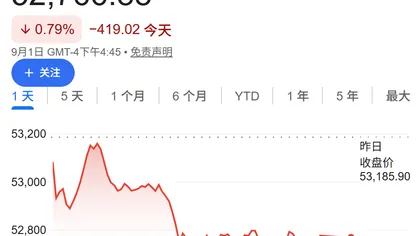
The Dow Jones falls below the 50-day moving average for the first time in five months, sending a technical warning signal
The Dow Jones has fallen below its 50-day moving average for the first time in nearly five months, with the S&P 500 and Nasdaq also on the verge of breaking below this level, signaling a technical turning point where short-term market momentum could shift from positive to negative. The core drivers of this correction are long-term US Treasury yields approaching the 5% mark, heightened oil prices due to the Middle East situation leading to inflation concerns, and rate pressures stemming from rising debt expansion. In the short term, the breach of moving averages may trigger selling pressure from quantitative and technical traders, significantly increasing market volatility risks.
HDFC Bank Dollar Bonds Hit Record Low: Here is the Terrifying Credit Market Signal Indian Traders are Ignoring
Bitcoin falls to $76,762 as US military strikes Iran, Strategy buys 4,603 BTC
Crypto prices
More


