
UK Lib Dems call for probe into Farage over $2.7M Stack BTC promotion

UK Liberal Democrats have urged the Financial Conduct Authority (FCA) to investigate Nigel Farage’s ties to Bitcoin treasury company Stack BTC after it disclosed a 37 Bitcoin purchase and published promotional material featuring the Reform UK leader, who is also a shareholder.
In a letter to the FCA, Liberal Democrat deputy leader Daisy Cooper asked the regulator to investigate whether Farage breached market rules by appearing in a promotional video for Stack BTC while holding a financial stake in the company.
“The FCA must investigate whether Farage’s plans to cash in on Crypto could potentially amount to market abuse and a conflict of interest,” she wrote, adding that “we cannot allow political leaders to treat the financial markets like a personal piggy bank to potentially line their own pockets.”
Stack BTC said Monday that it purchased 37 Bitcoin (BTC) for roughly $2.7 million as part of its treasury strategy. In a video tied to the purchase, Farage said that a Bitcoin treasury company cannot exist without holding Bitcoin.
The scrutiny adds to questions over the intersection of crypto and UK politics as Farage deepens his involvement with Stack BTC and lawmakers push for tighter rules on digital-asset donations to political parties. An FCA spokesperson told Cointelegraph that they will “review the letter and respond directly.”
Cointelegraph reached out to Stack BTC for comment, but had not received a response by publication.
Related: UK sanctions $20B scam market by cutting ‘legitimate’ crypto ties
Farage deepens ties to Stack BTC
Farage, leader of Reform UK, has recently deepened his relationship with Stack BTC. In March, he disclosed a $286,000 equity investment in the company, acquiring a 6.31% stake in the company through his media vehicle Thorn In The Side.
Stack BTC, chaired by former UK Chancellor Kwasi Kwarteng, holds over 68 BTC purchased at an average cost of $72,400 per coin.
Cooper’s letter also references the record 9 million British pounds (about $12 million) donation to Reform UK from early crypto investor Christopher Harborne and Farage’s push for crypto-friendly policies.
“Taken together, these facts beg the question whether Mr Farage is promoting cryptocurrencies through his political platform in order to inflate crypto values for his own financial benefit, as well as that of his party and his inner circle of donors,” she wrote.
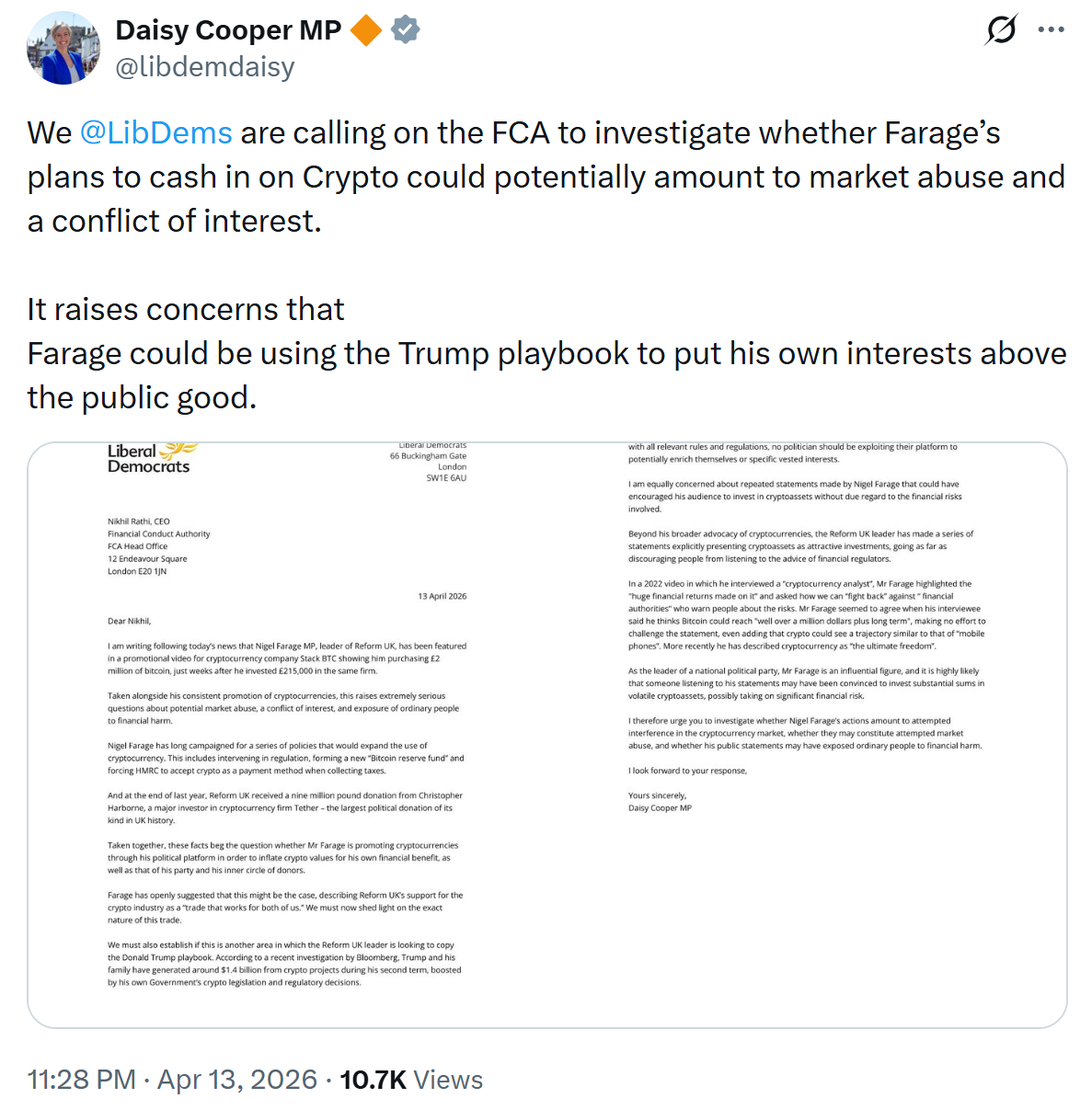 Source:
Daisey Cooper
Related: UK lawmakers seek moratorium on crypto donations to political parties
UK moves to ban crypto political donations
Last month, the Rycroft Review recommended a moratorium on cryptocurrency donations to political parties, warning they could open the door to foreign financial interference in UK elections. The UK government moved forward with the proposal, with Prime Minister Keir Starmer stating the government will impose a temporary ban on crypto donations until stronger safeguards are in place.
Several members of parliament, including the chair of the security committee, have been pushing for a full ban this year.
Magazine: How crypto laws changed in 2025 — and how they’ll change in 2026
Disclaimer: The content of this article solely reflects the author's opinion and does not represent the platform in any capacity. This article is not intended to serve as a reference for making investment decisions.
You may also like
After endorsing CoreWeave, now investing in Firmus—Nvidia becomes the "AI Central Bank"
After publicly supporting CoreWeave but seeing its stock price plummet by 11.9%, Nvidia now plans to inject hundreds of millions of dollars into Australian AI cloud service provider Firmus Grid, whose IPO attempt failed. Nvidia is intervening in the AI infrastructure financing crisis in a manner increasingly reminiscent of a central bank, driven by a straightforward logic: every dollar invested by Jensen Huang enables customers to buy one more Nvidia chip. Currently, neocloud serves as a critical line of defense for Nvidia against tech giants developing their own chips.

Positive response to Changxin 4F2 breakthrough, Micron CTO: 3D DRAM is "long-term more scalable and cost-effective"
The global storage chip market has recently experienced valuation fluctuations, and debates over technological approaches are intensifying. Scott DeBoer, President of Micron, stated that although the company internally evaluated the 4F² architecture for a long time, it will stay committed to the 6F² roadmap and move directly to 3D DRAM, citing a lack of sustainable scalability for the vertical channel transistors in the 4F² design. In contrast, ChangXin Memory Technologies previously announced plans to launch 4F² DDR5 products by the end of the year, and Samsung is also considering introducing the architecture in 2028.

Excess Supply of Hashrate!?

What did Nvidia say at the Berlin GTC? Here’s Goldman Sachs’ summary
After attending Jensen Huang's GTC keynote, Goldman Sachs released a research report highlighting three key points: Nvidia's supply chain is undergoing significant expansion across multiple segments, suggesting a larger-scale GPU shipment is imminent; DSX POD compresses data center deployment cycles from several months to just two weeks; physical AI revenue reached $11 billion in the first half of FY27, accounting for about 30% more than the entire FY26, with a clear trend toward diversified revenue streams. The report also announces the release of the OpenShell architecture to address enterprise AI security concerns.

Crypto prices
More


