Hermès Q3 revenue rises 4.3%, missing expectations; slowing growth in Asia Pacific weighs on results | Earnings Watch

The third-quarter results announced by Hermès fell short of market expectations, with sales growth in the Asia-Pacific region (excluding Japan) flat at a fixed exchange rate, reflecting the impact of shrinking consumer spending on this top luxury group. As a result, the company's share price fell as much as 7% intraday.
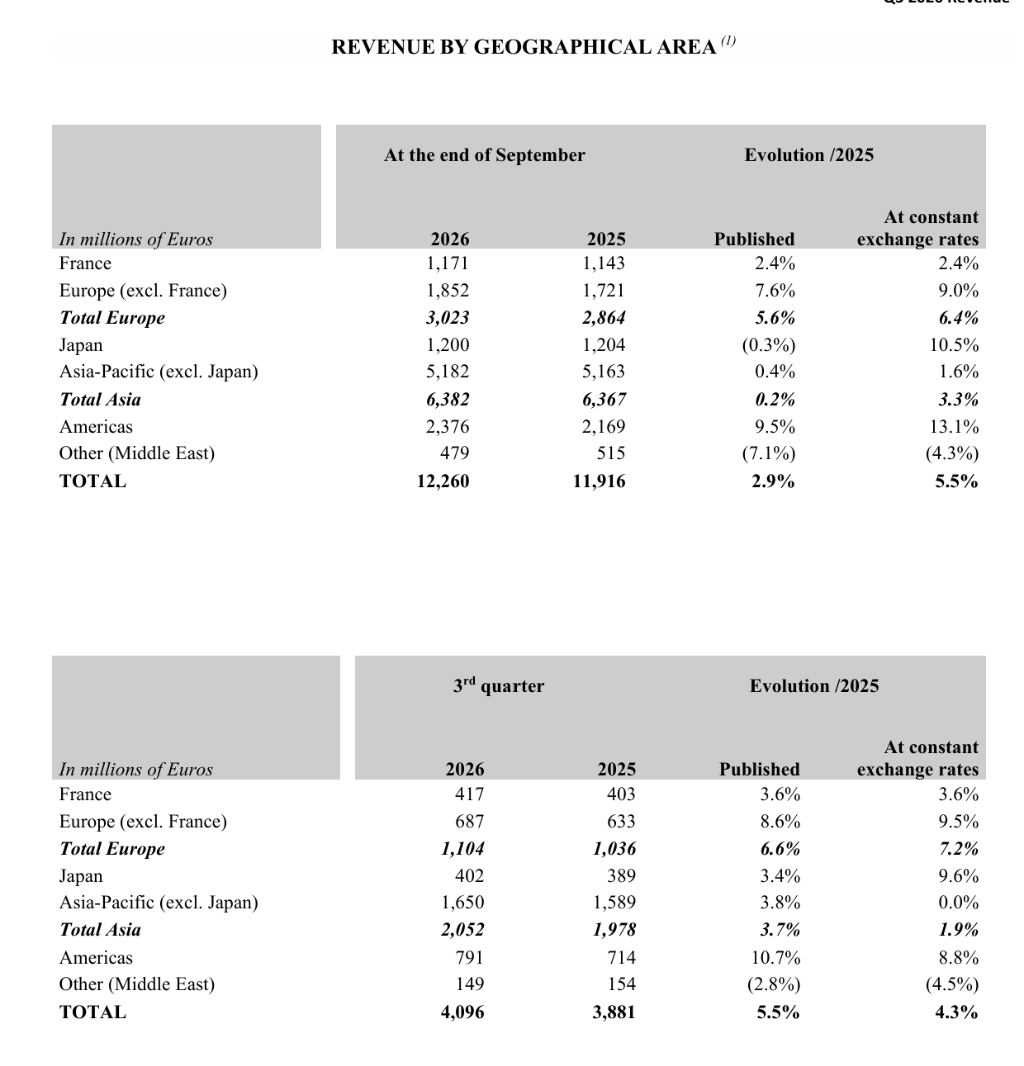
Hermès reported third-quarter revenue of €4.10 billion, an increase of 4.3% at constant exchange rates, both below analysts' expectations of €4.13 billion and a 5.29% growth rate. Of this, the Asia-Pacific region (excluding Japan), which accounts for about 42% of the Group’s total revenue, saw zero growth at constant exchange rates, significantly trailing the market expectation of a 1.55% increase. Chief Financial Officer Eric du Halgouët stated that the macro environment in Asia-Pacific (excluding Japan) remains under pressure, which is weakening the spending willingness of high-net-worth customers.
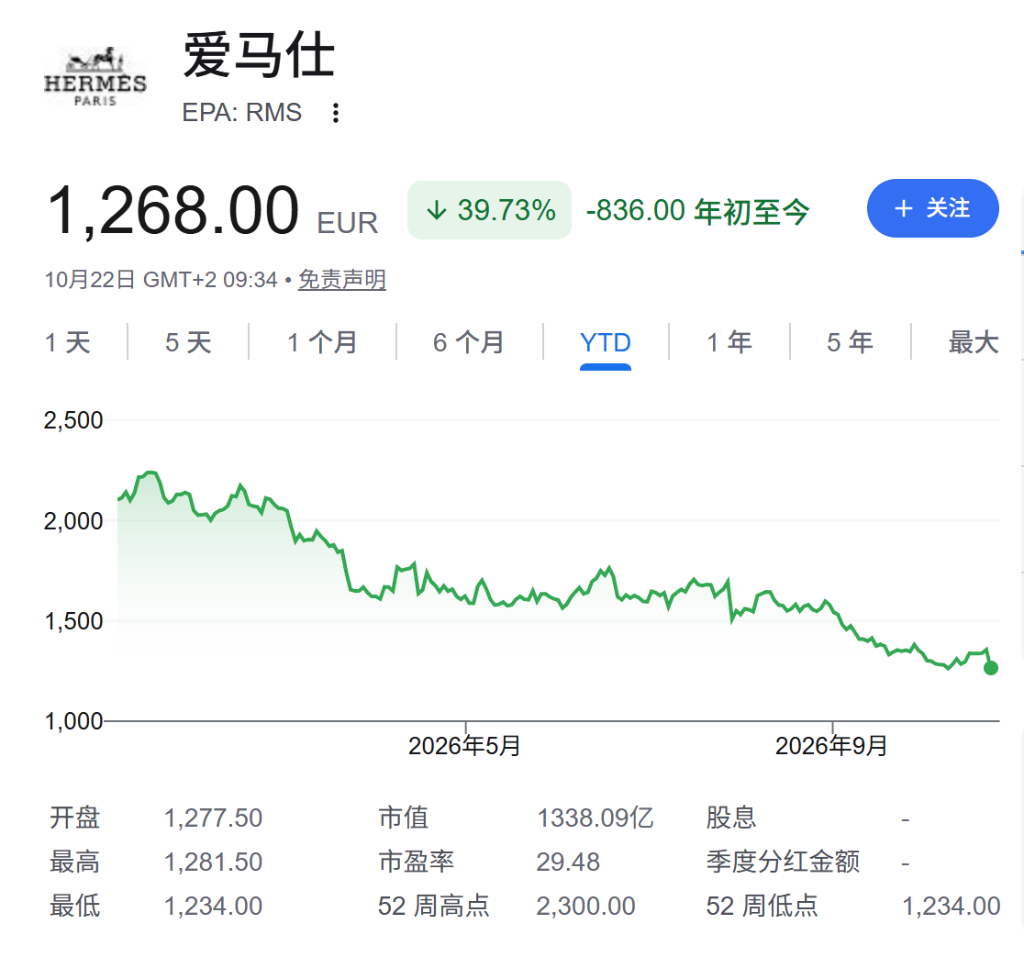
The above performance disappointed investors. Jefferies analyst James Grzinic wrote in a research note that these results "could make for an extremely painful day for the market." Hermès’ share price has declined around 40% so far this year, and if this annual drop is maintained, it would mark the company’s worst yearly performance since its IPO in 1993.
Asia-Pacific Under Pressure, Strong Sales Momentum in Japan
The Asia-Pacific region (excluding Japan) is Hermès’ largest single market, with third-quarter revenue of €1.65 billion, flat year-on-year at constant exchange rates. Hermès noted in its announcement that the robust performance of the Korean market partly supported the entire region.
In contrast, Japan's market grew by 9.6% at constant exchange rates in the third quarter, with revenue reaching €402 million, driven by persistent local consumer demand and maintaining strong momentum.
For the first three quarters cumulatively, revenue in Asia-Pacific (excluding Japan) was €5.182 billion, up just 1.6% at constant exchange rates, clearly lagging behind other regions.
Americas and Europe as Growth Engines
With growth stalling in the Asia-Pacific region, the Americas and Europe (excluding France) became the core drivers of the Group's growth. Third-quarter revenue in the Americas reached €791 million, up 8.8% at constant exchange rates, with strong performance across countries and categories including the US and Brazil. During the quarter, Hermès reopened its renovated San Diego store and opened new stores in Chicago and Williamsburg, New York, as well as a new store in Rio de Janeiro.
Europe (excluding France) grew 9.5% at constant exchange rates in the third quarter, with Southern European markets performing particularly well. The UK market also achieved strong growth, driven by the opening of a new flagship at 166 New Bond Street in London. Domestic growth in France reached 3.6%, with seaside stores and local customers providing stable support.
Hermès also faced additional disruption from unrest in France. Eric du Halgouët said that the company's Marseille store had been robbed and "will not reopen in the short term." Store windows in Nantes, Lyon, and Avenue George V in Paris were damaged during the unrest, and the company has since strengthened security measures.
"It is too early to assess whether this incident will impact foreign tourists’ consumption in the coming weeks," he added. This uncertainty adds a variable to the short-term outlook in the European market.
Outstanding Performance in Leather Goods, Pressure on Multiple Categories
By category, leather goods and saddlery were the Group's biggest highlight in the third quarter. Revenue from this segment reached €1.912 billion in Q3, growing 10.8% at constant exchange rates, outperforming the market expectation of 10%. Both new and classic bags maintained strong demand. The group continued to expand production, opening its 25th leather workshop in Loupes, Gironde in April, with plans to open three more workshops in France in the coming years.
In contrast, ready-to-wear and accessories dropped by 2.0% at constant exchange rates in Q3, while watches fell by 6.0%. Perfume and beauty products recorded a year-on-year increase of 7.5%, but still saw a slight cumulative decrease in the first three quarters.
For the first three quarters, the group’s consolidated revenue was €12.26 billion, an increase of 5.5% at constant exchange rates. Executive Chairman Axel Dumas stated that Hermès continues to achieve profitable growth in a complex environment and will persist with a long-term strategic approach.
Outlook: Mid-term Targets Unchanged, Uncertainty Remains
Hermès reiterated that despite continued uncertainty in the global economy, geopolitics, and exchange rates, the group remains committed to ambitious revenue growth at constant exchange rates in the medium term. Currency fluctuations have negatively impacted revenue by about €310 million over the first three quarters.
Competitor LVMH’s quarterly sales data released last week also disappointed the market. The consecutive performances of these two luxury giants have heightened concerns about the recovery prospects for high-end consumption in the Asia-Pacific region.
Disclaimer: The content of this article solely reflects the author's opinion and does not represent the platform in any capacity. This article is not intended to serve as a reference for making investment decisions.
You may also like
XRP Ledger postpones fixCleanup3_4_0 update to November 4 after node glitch

Meta’s Future Spending Commitments Surge to $825 Billion, Credit Risk Indicators Hit Historical High
Meta disclosed that as of the end of September, its future expenditure commitments had surged to approximately $825 billion, a significant increase from $700 billion in July. This includes data center lease agreements totaling $355.7 billion and cloud computing contracts amounting to $454.5 billion. The five-year CDS price has risen to about 119.3 basis points, marking the highest level since Meta's listing, and its bonds have sharply underperformed compared to US Treasuries. CDS prices for Oracle, Microsoft, and Broadcom have also risen in tandem, reflecting a continued spread of market concerns over debt risks within the technology sector.

Bitcoin Threatens Gold’s Scarcity Through Cheaper Energy
Whale invests $7.22 million in 9 altcoins, LIT leads gains