Gold Fails to Break Through; Goldman Sachs Reveals Battle Between Short-Term Interest Rate Pressure and Long-Term Reserve Demand

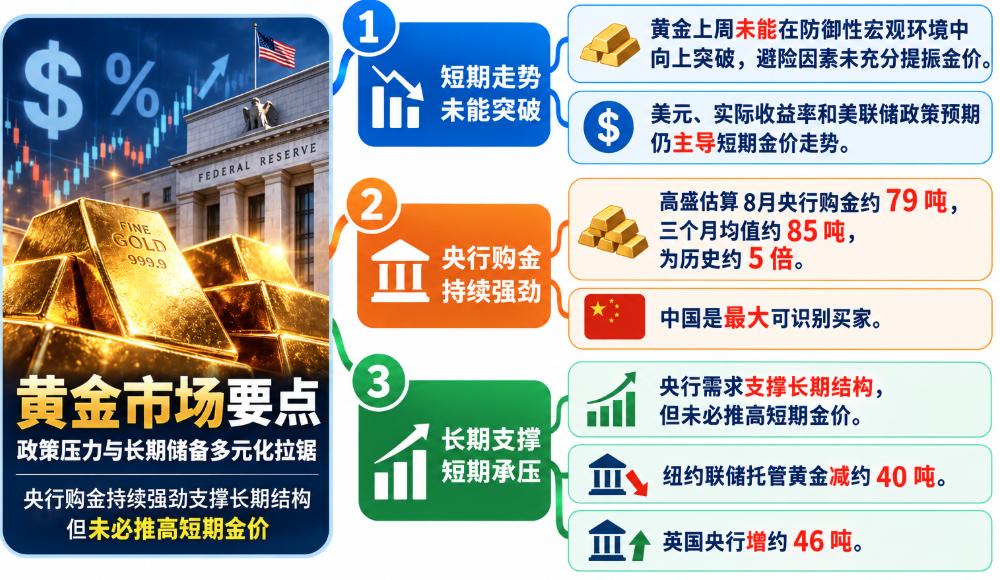
Last week, gold failed to make an upward breakthrough despite a macro environment turning more defensive, drawing attention to its short-term trend. Risks from artificial intelligence financing are beginning to spill over into the credit markets, investors are reassessing economic growth prospects, and fiscal and political risks on both sides of the Atlantic are rising—factors that would traditionally benefit gold as a safe haven.
However, the gold price did not fully respond to these changes, suggesting that speculative capital has yet to fully embrace an investment logic that places greater emphasis on geopolitics, sovereign balance sheets, and reserve safety. The US dollar, real yields, Federal Reserve policy expectations, and the opportunity cost of holding non-interest-bearing gold still dominate much of the gold price's short-term fluctuations.
Meanwhile, a separate force is changing the underlying structure of gold demand. Central banks worldwide are increasingly prioritizing the security and diversification of official reserves, no longer basing asset allocation decisions solely on short-term interest rate changes.
Goldman Sachs commodity researchers Lina Thomas and Daan Struyven pointed out in their “Precious Metals Review” published on October 19 that as of August, official sector gold buying remained unusually robust. Even as speculative capital lacks confidence and gold prices struggle to break key resistance, global central banks continue to provide significant support to the market.
Average Monthly Central Bank Gold Purchases Reach Around 5 Times Historical Benchmark
Goldman Sachs’ latest estimates show that global central banks bought around 79 tons of gold in August, whereas the historical monthly average before 2022 was just 17 tons.
Based on a seasonally adjusted three-month average, central banks’ current average monthly gold purchase stands at about 85 tons—roughly five times the historical benchmark level.
Monthly data is inevitably volatile, and Goldman Sachs’ real-time estimate does not represent a complete accounting of all official sector activity. Compared to the fluctuations in single-month purchases, the sustained scale of buying better illustrates the changes happening in the current market.
Compared with the period before 2022, global central banks are increasing their gold holdings at a significantly faster rate. This indicates that the factors driving diversification of official reserves are becoming embedded in long-term portfolio decisions, rather than merely reflecting short-term market sentiment.
Goldman Sachs continues to view this type of demand as an important structural support for gold, especially for emerging market central banks. These central banks’ current gold allocation ratios remain low relative to reasonable long-term portfolio targets.
However, central bank gold buying does not mean gold prices will necessarily rise immediately. Reserve management institutions typically have longer investment horizons; their decisions are not necessarily dependent on the next US Federal Reserve rate adjustment, nor do they change automatically with short-term US Treasury yield fluctuations.
This makes central bank buying behavior different from that of private investors. Even if some private investors are selling gold, or are hesitant to chase higher prices due to a strong dollar, official institutions may still follow through with long-term gold purchase plans.
Therefore, robust central bank demand is more likely to reshape the gold market’s demand structure and performance during downturns, rather than guarantee a persistent short-term rally in gold prices.
Rising Importance of Reserve Security
China continues to play an important role in the global reserve diversification process. Goldman Sachs estimates that China was August’s largest identifiable official gold buyer, making a significant contribution to total global official sector purchases.
However, the factors driving central bank gold purchases are not limited to China. As geopolitical relations become more complex, countries are increasingly concerned about financial sanctions risks and the potential dangers of official reserves being overly concentrated in currencies issued by the G7.
Nevertheless, increasing gold reserves does not mean the international monetary system is on the verge of a fundamental collapse, nor does it suggest the US dollar will lose its dominant position anytime soon. Reserve diversification is typically a gradual process, and gold is unlikely to quickly replace the dollar’s role in global financing, payments, and collateral markets.
What is more noteworthy is that the composition of gold demand is changing. While central banks are increasing gold allocations, they are also re-examining the locations where official reserves are stored, the ease of asset acquisition, and whether custodial arrangements can meet their long-term security needs.
Goldman Sachs’ research shows that in August, foreign central banks’ gold reserves stored at the New York Fed decreased by about 40 tons, while gold held in custody at the Bank of England increased by about 46 tons.
These data do not prove that the same batch of gold was directly transferred from New York to London, nor are they sufficient to identify the exact motives behind central bank adjustments to custody arrangements. But these changes do coincide with rising concerns about reserve security among countries.
The importance of the location where official gold reserves are stored touches on trust between central banks, liquidity needs, ease of access to assets, and custodial arrangements. When geopolitical risks and financial infrastructure could be affected by policy decisions, the importance of these issues also increases.
The long-term investment logic for gold is therefore no longer limited to hedging inflation or responding to monetary easing, but also involves how countries manage sovereign assets, reduce reliance on specific financial systems, and ensure that reserve assets can be used when needed.
Short-Term Rate Pressure Remains; Central Bank Buying Does Not Equate to Guaranteed Price Gains
Despite solid long-term demand, gold’s failure to make an upward breakthrough last week remains an important short-term signal to watch.
When market risk sentiment deteriorated, gold failed to show the expected upward response—suggesting that traders have not clearly abandoned the traditional pricing framework based on the US dollar and real yields. While geopolitical instability, fiscal sustainability, and reserve security are gaining importance, they have not yet fully replaced traditional monetary policy factors as determinants for price action.
Rising inflation expectations, high energy prices, and potential risks of tighter monetary policy could still put pressure on gold. If real yields remain attractive, investors must consider the opportunity cost when holding non-interest-bearing gold.
Therefore, even in a worrying geopolitical environment, one cannot assume gold prices will rise purely because of increased risk. The relationship between the US dollar, real yields, and the price of gold still needs to be confirmed in market trading.
Whether gold can decisively break upwards in the future will be an important indicator for observing shifts in these two competing forces. If the price can break through key resistance, the real yield environment becomes less unfavorable, gold strengthens against major currencies, and official sector demand remains steady, it could suggest that long-term structural demand is beginning to attract more private investors.
On the other hand, if the US dollar continues to strengthen, real yields rise, and gold prices remain sluggish, then even central bank gold buying at historically high levels may not eliminate short-term downward price pressure.
Understanding gold’s current market performance requires distinguishing between its short-term role as a traditional safe haven asset and its long-term function as a hedge against sovereign fiscal and reserve security risks.
During sudden shifts in risk tolerance, gold’s short-term performance may be highly sensitive to market liquidity and US Treasury yield changes. As a long-term reserve asset, gold’s appeal depends more on how central banks assess the composition of official reserves, asset safety, and the credibility of government balance sheets.
Goldman Sachs’ latest research shows that gold’s long-term demand base remains resilient. Global central banks continue large-scale purchases, China remains an important buyer, and official reserve custodial locations and security are drawing greater attention.
However, whether private markets will assign greater weight to these structural factors remains to be seen. Gold’s failure to break out last week reminds investors that short-term trends do not always align with long-term fundamentals; at the same time, consistently high central bank demand suggests that one cannot conclude gold’s long-term support is waning based solely on short-term price movements.
Currently, the gold market remains caught in a tug-of-war between short-term monetary policy pressure and long-term reserve diversification demand. Central bank buying provides significant support, but whether gold prices can move higher depends on when private investors become willing to assign greater weight to reserve security, geopolitical, and fiscal risks in their pricing logic.
Disclaimer: The content of this article solely reflects the author's opinion and does not represent the platform in any capacity. This article is not intended to serve as a reference for making investment decisions.
You may also like
Host Digital closes up 47.4%, yet its daily trend remains bearish
WISeSat.Space stock jumps 100.59%, but the daily trend remains mixed
Visa and Mesh to Expand Crypto and Stablecoin Payment Options