
Jensen Huang’s GTC Berlin Keynote Ends: AI Officially Enters Factories and Shop Floors — These 4 US Stocks Are Being Repriced by Physical AI
 Bitget2026/10/21 11:50
🔥 US Stock Hotspot Radar is Live! Content: 3 major themes + 6 selected stocks + 7 key events. Where are this week’s opportunities? Click the link to see all 22 trading directions in one chart →
I. From Chatbots to Shop-Floor “Digital Twins”: What This Keynote Actually Changed
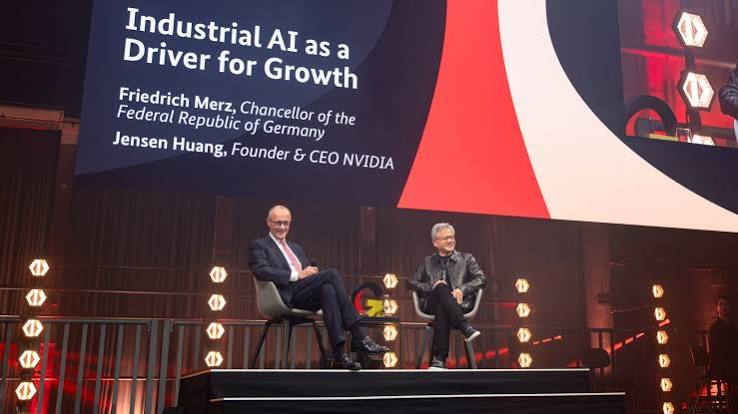
NVIDIA’s GTC Berlin (October 20–22) has just wrapped up. Jensen Huang’s keynote shifted the focus from pure large-model training to Physical AI + Agentic AI + AI Factories.
He repeatedly emphasized one core idea: in the future, every company will have two factories — one physical factory and one nearly indistinguishable digital-twin factory, both driven by software and AI. The next wave is no longer just chat and content generation; it is robots, autonomous driving, industrial manufacturing, heavy industry, and other scenarios that interact with the physical world.
The event also launched DSX Pod (a modular AI factory that can be deployed in as little as 14 days), the OpenShell secure agent reference architecture, and strengthened Sovereign AI (Europe controlling its own compute and data).
Huang compared the AI economy to a five-layer cake (energy, compute, AI factories, models, applications) and noted that the compute layer is currently almost entirely dominated by NVIDIA. Notably, he told the German Chancellor that “electrons will never replace atoms,” meaning companies that understand manufacturing have an advantage in the AI era. While it sounded like encouragement for industrial giants, the real message to the market was that compute demand is moving from the lab to the production line.
II. Compute + Physical AI Dual Engines: These US Stocks Are Being Directly Fed
The keynote further reinforced the sustained compute multiplier effect from inference + agents + Physical AI. The most direct beneficiary remains NVIDIA (NVDA) — the AI Factory platform, the Vera Rubin roadmap, and content value per GW continuing to rise (from roughly $18 billion toward $40 billion+), while deeply tied to German industry (Siemens and others), European Sovereign AI, and the Isaac robotics platform.
On the supporting chain, Broadcom (AVGO) benefits from high-speed interconnect, custom chips, and data-center networking demand; Micron (MU) continues to capture the HBM and high-end memory dividend; TSMC (TSM), as the core of advanced process technology, takes on advanced packaging and capacity expansion for NVIDIA and its ecosystem.
On the Physical AI side, US stocks related to industrial automation, robotics, and automotive will also benefit indirectly, but the hardest near-term beneficiaries remain compute infrastructure.
The logic is clear: agents staying online continuously and digital-twin factories running simulations and decisions 24/7 turn one-time calls into sustained loads. Combined with Physical AI deployment, compute demand does not grow linearly — it accelerates.
Huang has also repeatedly emphasized that the bottleneck has shifted from chips to power, land, and factory buildings. This means whoever can deliver complete AI Factory capabilities will capture higher value-add.
III. Summary: Don’t Just Watch the Keynote Hype — The Real Opportunity Is Who Can Get AI into the Shop Floor and Keep It Running Fast and Safely
This Berlin keynote advanced the narrative from “model competition” to “industrial deployment.” AI is no longer just a toy for internet companies; it is becoming a new production tool for manufacturing, automotive, and energy.
For investors, prioritize names most deeply tied to NVIDIA’s AI Factory and Physical AI platforms (NVDA as the core, with AVGO, MU, and TSM as supporting plays), while tracking actual order flow from European Sovereign AI and industrial partnerships.
Short-term performance may be affected by macro rates, power supply, and data-center approval timelines, but the logic of “every company has two factories + agents continuously working” is more solid than simply watching revenue from one or two model companies.
In one sentence: previously humans asked AI questions; now AI is entering the shop floor as the shift supervisor. Whoever supplies power, GPUs, and security frameworks to these digital factories stands at the center of this Physical AI wave.
Jensen Huang GTC Berlin Beneficiary US Stock List
| NVIDIA | NVDA | AI Factory platform + Physical AI + sustained agent workloads directly drive compute demand and content value per GW | Core platform (DSX Pod, Isaac robotics, Vera Rubin roadmap); deep cooperation with European Sovereign AI and German industry; dominant position in the compute layer |
| Broadcom | AVGO | High-speed interconnect, custom chips, and data-center networking demand rise in step with AI Factory expansion | Core supplier in networking and custom ASIC; benefits from modular AI factories and optical interconnect upgrades |
| Micron | MU | HBM and other high-end memory demand grows with GPU shipments and continuous inference / digital-twin workloads | Core AI memory supplier; Physical AI and agent scenarios amplify memory bandwidth needs |
| TSMC | TSM | Advanced process and advanced packaging capture NVIDIA and ecosystem capacity expansion | Primary foundry and CoWoS packaging partner for NVIDIA; directly benefits from AI Factory hardware deployment |
Disclaimer: The content of this article solely reflects the author's opinion and does not represent the platform in any capacity. This article is not intended to serve as a reference for making investment decisions.
You may also like
Elon Musk Says SpaceX, Tesla Exploring Merger; Satellite Company's Shares Rally

Ledger crypto loans bring stablecoin borrowing to its wallet, with liquidation risk

Host Digital closes up 47.4%, yet its daily trend remains bearish
WISeSat.Space stock jumps 100.59%, but the daily trend remains mixed


