
NEAR used DeepSeek to solve 600 math problems and is pushing on-chain code audits to become “dirt cheap”.

Author: Chang'an, Deep Tide TechFlow
Deep Tide Brief: 672 top North American university-level math competition problems were all solved by the NEAR AI team using Agents. The total cost was about $111, averaging $0.17 per problem. The NEAR AI team completed this test by invoking the Chinese open-source model DeepSeek V4. This is not just a large language model intelligence competition; behind the computing power bill is an infrastructure business attempting to make the expensive "formal verification" of smart contracts accessible to ordinary people.
Testing data from an open-source codebase has revealed the cost base of large model problem-solving.
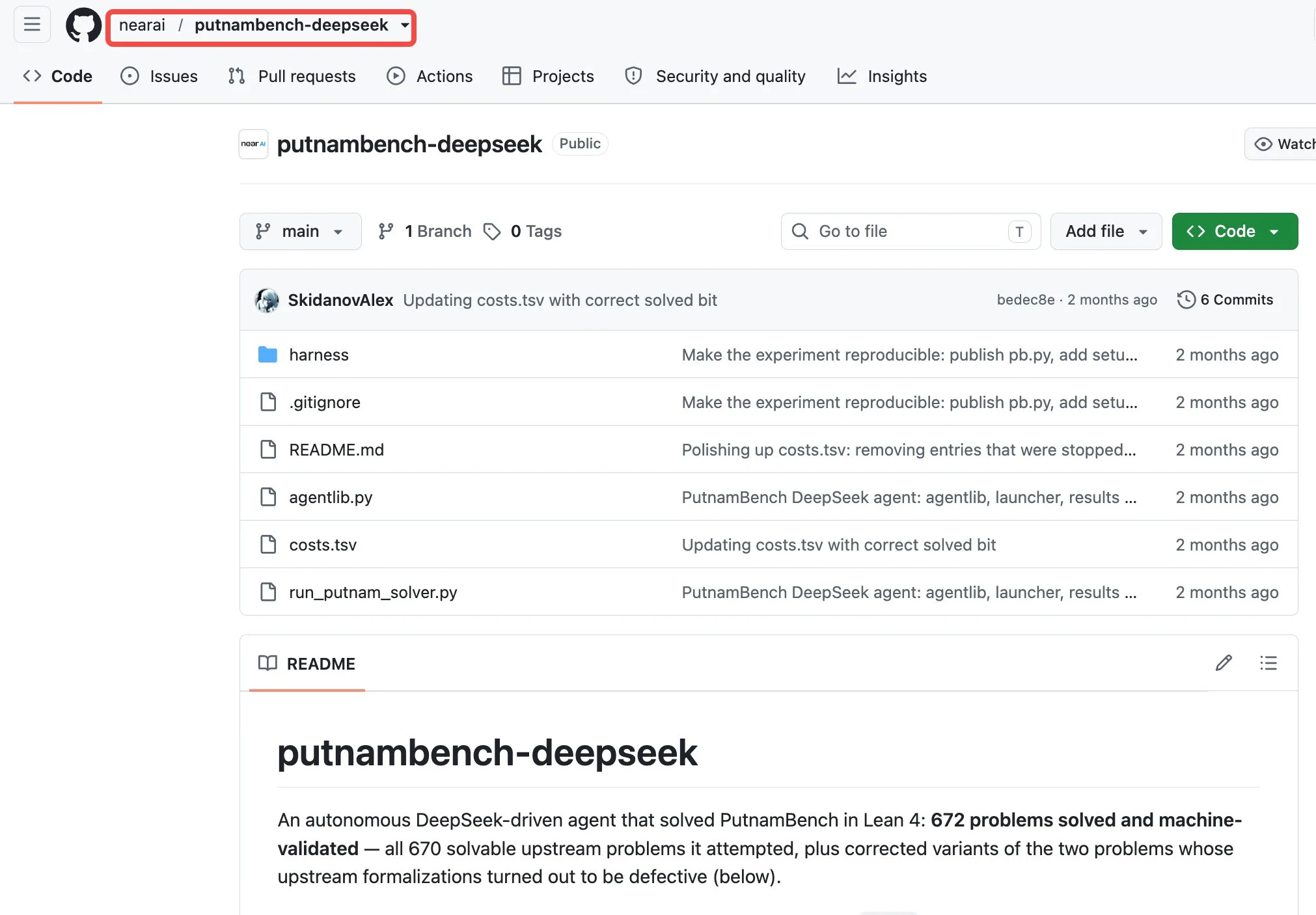
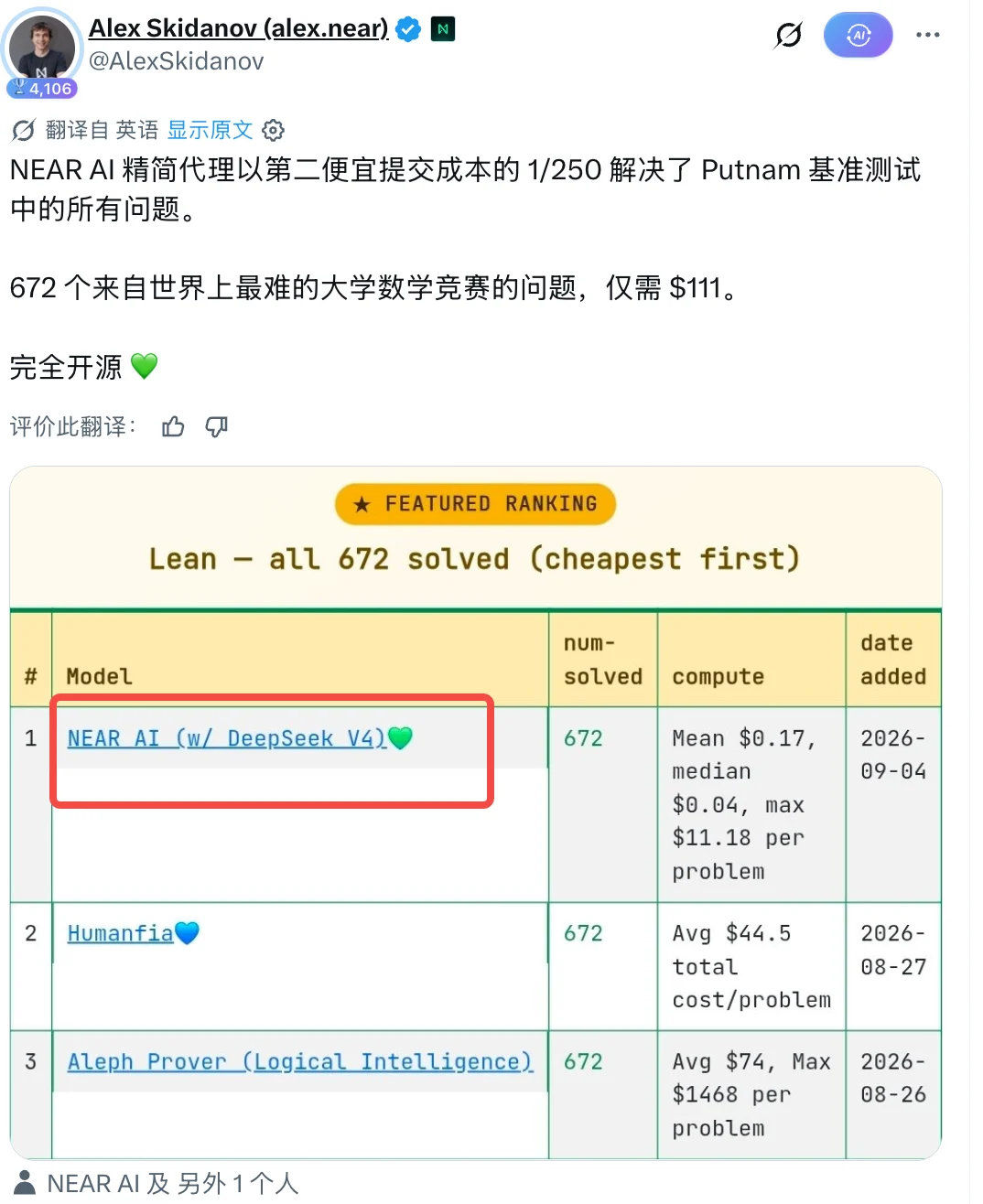
Recently, according to data released by NEAR Protocol co-founder Alex Skidanov and the official side, NEAR AI's Agent has solved all 672 math problems on PutnamBench.
For readers unfamiliar with it, PutnamBench is not an ordinary problem set—it's a benchmark based on formalizing the questions from the William Lowell Putnam Mathematical Competition for top North American undergraduates.
In plain terms, it means getting AI to perform rigorous mathematical reasoning to see if it can independently solve problems. To complete all answers, NEAR AI spent about $111.85. On average, the cost per problem was $0.17.
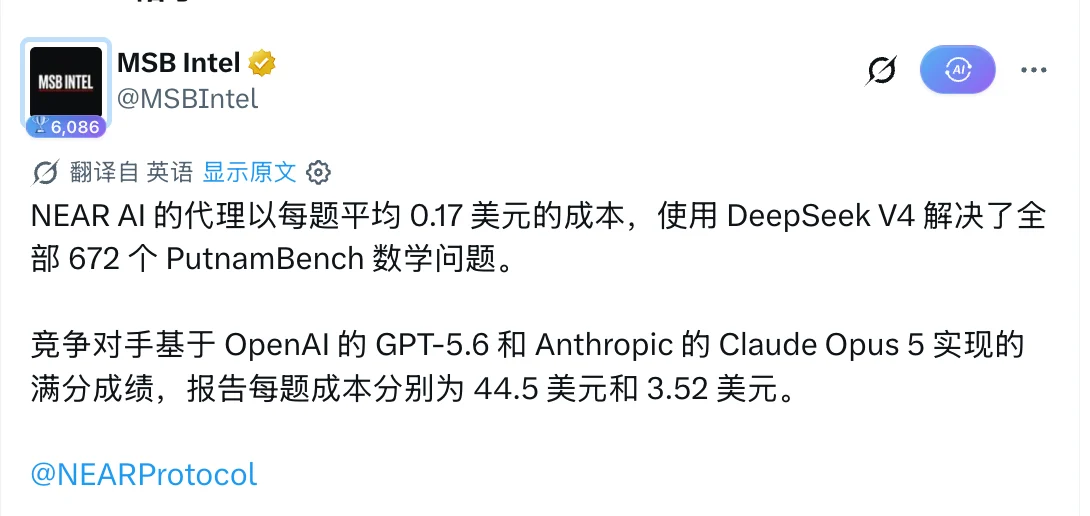
For comparison, other full-score solutions are much more expensive.
According to data compiled by MSBIntel, using OpenAI's GPT-5.6, the average cost per problem is as high as $44.5; using Anthropic's Claude Opus 5, each problem requires $3.52.
In this particular test, NEAR used the DeepSeek V4 solution, reducing the cost to one two-hundred-fiftieth that of GPT-5.6.
Public chain solving math problems: The real intention is elsewhere
When a public chain team puts effort into solving math problems, it's not targeting the education market.
The core requirement of the PutnamBench test is machine verifiability: the answer generated by AI can't just be a written response; it must be a rigorous proof code written in Lean 4 (a mainstream proof assistant language).
This code cannot have syntactic flaws, cannot skip derivation steps, and must be 100% machine-verified. At the same time, this corresponds to a key technology in computer science: formal verification.
Connected to the crypto industry, smart contracts carry hundreds of millions or even billions of dollars in funds. Traditional code auditing relies on manually finding vulnerabilities, while formal verification uses rigorous mathematical logic to prove, line by line, that code will not go wrong in any possible state.
For a long time, the fatal flaw of formal verification has been that it's expensive and slow. It requires top security experts and lengthy timelines, something usually only well-funded leading projects can afford.
This NEAR AI test proved the feasibility of using open-source AI models to batch-generate reliable mathematical proofs and further verified its low cost.
Accessible infrastructure for on-chain security
Lowering the threshold for formal verification to a few cents is what NEAR is actually building for.
Currently, this set of code that bridges DeepSeek and Lean 4 has been fully open-sourced. The next step officially announced by NEAR is to directly apply this low-cost tool to the security verification of NEAR Protocol itself and its core smart contracts.
So you could think of this as a technical empowerment, or in more colloquial terms, as the project team getting things done—and it's related to the AI narrative.
If open-source AI can steadily output machine-verifiable code security proofs, it means that, in the future, ordinary developers and small project teams can run a formal verification for just a few cents before deploying a contract, reducing the risk of smart contract errors.
However, objectively speaking, this has no direct correlation with the short-term price fluctuations of the NEAR token. But in the fundamental competition among public chains, spending a few dozen cents to prevent issues is far more commercially valuable than spending millions on post-incident remediation.
Disclaimer: The content of this article solely reflects the author's opinion and does not represent the platform in any capacity. This article is not intended to serve as a reference for making investment decisions.
You may also like
UBS: Rising AI financing costs are revealing increasing risks

Codelco, BHP launch $40M copper hunt in northern Chile
Crypto prices
More


