
The "Most Stable" McDonald's Drops 30%? A Once-in-a-Lifetime Buying Opportunity? If You Don't Understand This, Don't Rush to Buy the Dip!


👆Click on the blue text to follow us
Over the past few weeks, I went back to China to visit family, so I couldn't record videos for everyone, and had to use AI voice, hope you all understand. However, updates to our channel won’t stop. This video is an episode I recently posted on MeiTou Pro, focusing on McDonald's stock, which has gotten great feedback. I’m sharing it here for all our viewers.
When people mention McDonald's as a stock, the first thing that usually comes to mind is stability, safety, and being a top choice among defensive stocks. That was absolutely true—until about half a year ago. Because in the past half year, McDonald's share price surprisingly fell by around 30%, from about $335 at the end of February to just $235 now, hitting new 52-week lows almost daily.
As the largest fast-food chain in the world, it was thought to be one of the most defensive stocks. Yet now it has plunged this much—so what exactly happened? More importantly, lots of people have commented on MeiTou Pro asking: after such a price drop for McDonald's, is this a once-in-a-lifetime buying opportunity? That question has gotten a lot of attention, so today, we’re dedicating an entire video to McDonald's to explore whether it’s a once-in-a-lifetime buy at its current price.
The Gradually Worsening Fundamentals
Before we dive in, let's quickly clarify: below we mainly analyze McDonald's US operations. Why? Isn't McDonald's international business important?
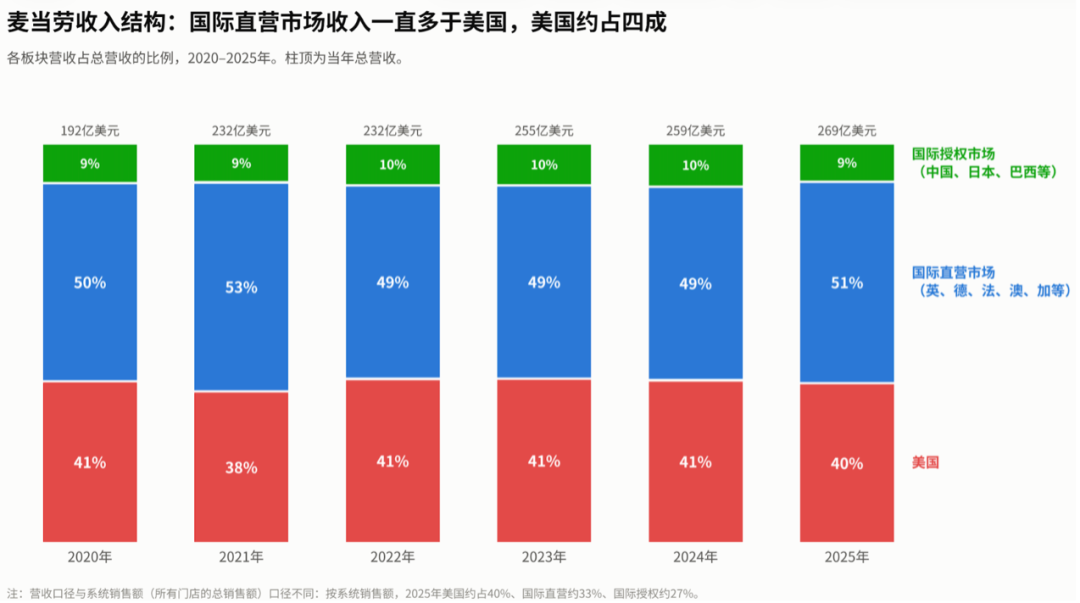
Not at all. Over the past few years, McDonald's international revenue share has been stable at around 60%, while the US only accounts for 40%—international's share is actually larger. However, for the past two years, international business has been relatively steady, while problems have emerged in the US business.
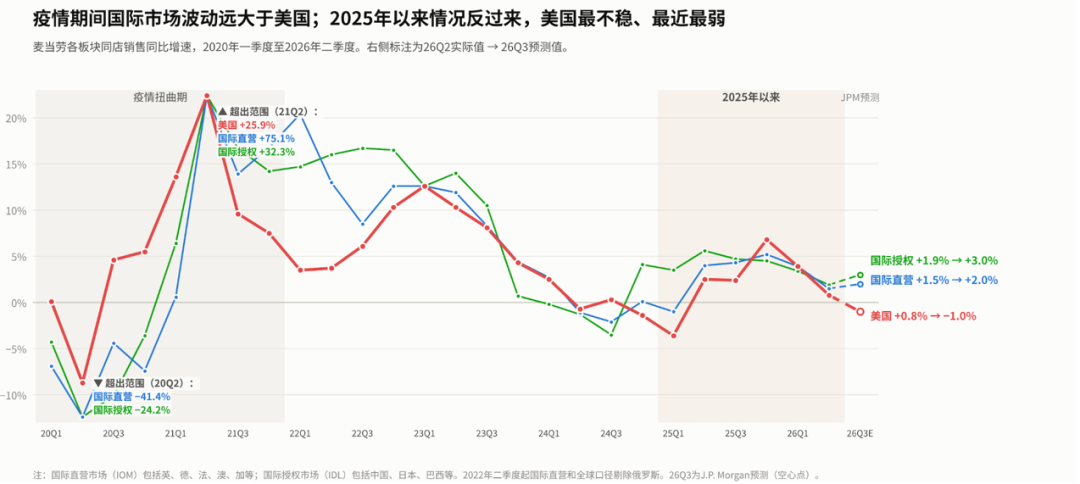
So what’s the problem? Let’s look at one metric: same-store sales growth. This only counts stores open for at least 13 months, stripping out growth from new stores, and is the best indicator for whether existing stores are doing better or worse. Let’s compare same-store growth rates for the US and international divisions.
As shown in the chart below, US and international same-store growth rates trended similarly for the past few years. But since 2025, the US growth rate has fluctuated wildly between -3.6% and +6.8%, with Q2 this year at just +0.8%. International markets have been much steadier: company-operated international markets were +1.5% in the same period, licensed international markets +1.9%, and every quarter in the past year and a half for licensed markets has been positive growth. JPMorgan forecasts that in Q3 this year US same-store sales may drop about 1%, while international markets can still see 2%-3% growth.
So, while international operations are important, their performance is currently stable. The following analysis focuses on McDonald's challenged US operations.
When we previously analyzed Starbucks, we mentioned that brand is the moat for most mass consumer products. That ultimately comes down to two indicators: volume and price. For most consumer goods, volume is much more important than price. First, pricing is decided by the company, but volume is determined by the market; second, volume growth brings long-term compounding effects, while price hikes usually only have a one-off effect.
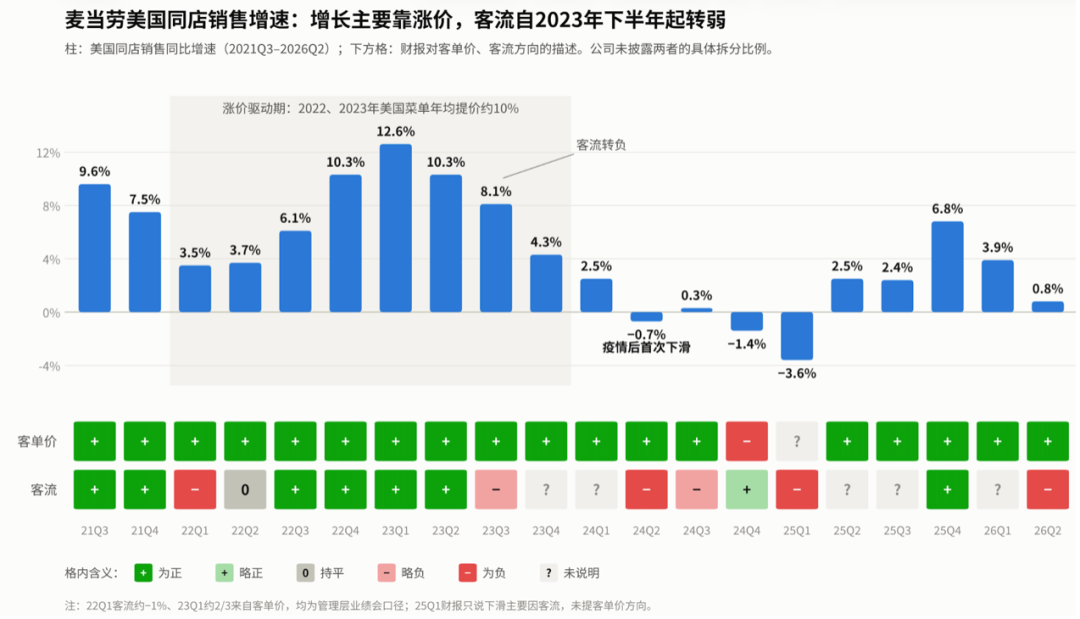
Looking back at US same-store sales growth in recent years, growth was mainly driven by raising prices, with customer traffic contributing far less than price increases did.
In both 2022 and 2023, McDonald's US menu prices rose nearly 10% annually, while customer traffic was barely positive—and actually negative in Q1 2022. By 2024, the average menu price was about 40% higher than in 2019.
Q3 2023 was a turning point. In that quarter, traffic turned negative, and since then, same-store sales have slowed. Q2 2024 saw the first decline in US same-store sales since the pandemic; Q1 2025 even dropped to -3.6%. Both downturns were due to declining customer traffic.
In the past 10 quarters, customer traffic was clearly positive only twice. Q4 2024 traffic was slightly positive, but average ticket size fell—this was due to value deals like the $5 meal. Q4 2025 saw both traffic and ticket size positive, thanks to major promotional campaigns. So, nearly all traffic increases have depended on offering deals or promotions, rather than any organic rebound driven by the products themselves.
Traffic decline and same-store growth relying solely on higher ticket prices is not unique to McDonald's—it’s a trend across the entire US fast food industry.
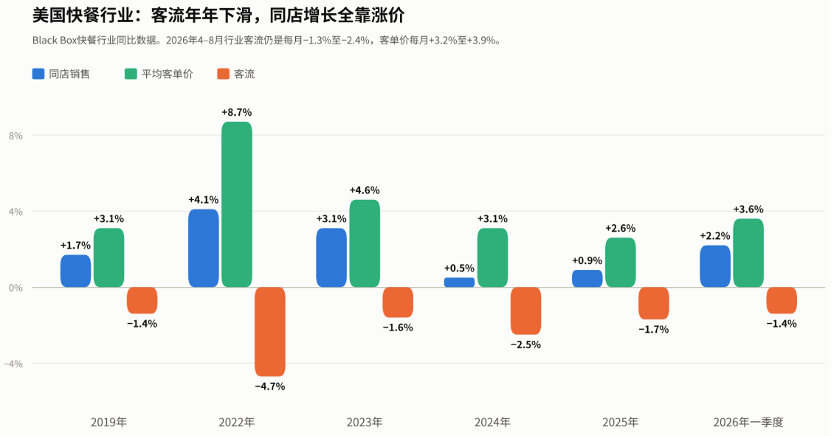
According to Black Box data on US fast food, customer traffic has been negative each year from 2019 as well as 2022-2025. In 2022, average ticket size for the industry rose 8.7%, then the pace of price increases gradually narrowed, same-store growth weakened accordingly. By 2026, nothing has improved: industry traffic was -1.4% in Q1 and between -1.3% and -2.4% each month from April to August.
In other words, the US fast food sector’s same-store sales growth in recent years has been built almost entirely on price hikes, while actual numbers of visiting customers have kept falling. Raising prices may make revenue numbers look good, but it continues to drive away price-sensitive customers—especially among low-income groups. Even McDonald's own management acknowledges that as long as inflation stays elevated, industry traffic will be hard to grow.
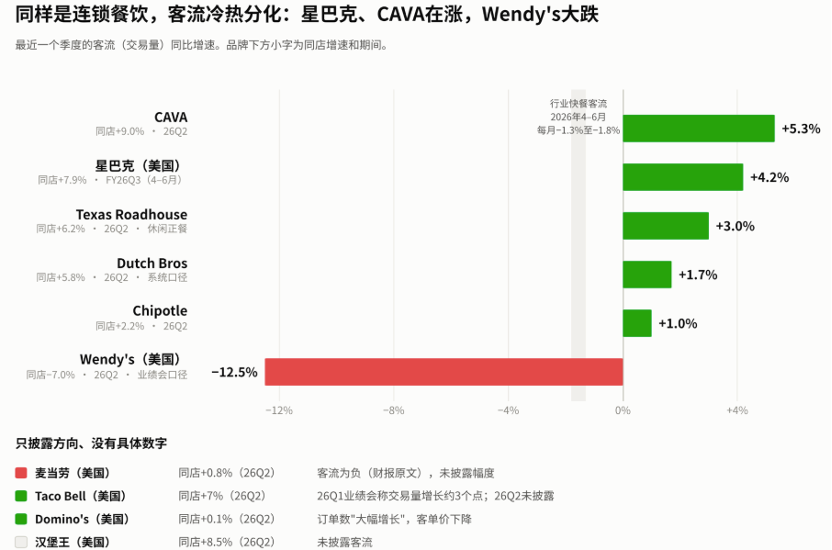
But a bad environment doesn’t mean every company is doing badly.
Let’s compare recent quarterly traffic of several major restaurant chains. Mediterranean fast-casual chain CAVA saw traffic rise 5.3%, Starbucks US traffic rose 4.2%, Texas Roadhouse (steak chain) up 3.0%, Dutch Bros (coffee chain) up 1.7%, and Chipotle just flipped positive at 1.0%. Meanwhile, industry-wide traffic declined 1.3–1.8% per month in that period. In other words, these chains gained customers even as the sector was losing them. On the other hand, Wendy’s hiked average ticket by 5.6%, but traffic fell 12.5% for a same-store drop of 7%—price hikes alone can’t support growth anymore.
Our previous research on Starbucks is particularly relevant. Just over a year ago, Starbucks’ US transaction volume was down 4%, facing a situation similar to McDonald's now. Starbucks’ “Back to Starbucks” plan mainly focused on improving service and in-store experience, not on cutting prices. As a result, transaction volume turned positive at the end of 2025, and for the past two quarters, has been up over 4%. The share price rebounded too, from a low of around $79 in October 2025 to roughly $106 in August this year.
Now back to McDonald's: in Q2, US same-store sales grew just 0.8%, and traffic was still negative. So what McDonald's faces is a tough environment, but it also hasn’t outperformed the industry or captured share. This is what the market is unhappy about. Previously, investors were happy to give McDonald's a premium valuation because they believed it could outperform peers no matter the climate. That belief is now being questioned.
Apart from deteriorating fundamentals, macro conditions are also suppressing McDonald's valuation. The 10-year US Treasury yield was around 5.2% at the end of September, and hit 5.35% intraday on October 8—multi-year highs, with the Fed still in a rate-hike cycle. McDonald's has long been considered a bond-like defensive stock, but its roughly 3.3% dividend yield has now dropped below the risk-free rate, compressing its valuation further.
Thus, this round of McDonald's declines is mainly because growth prospects for the fundamentals have disappeared, and macro headwinds are compressing valuations—it’s these two factors that have caused the steep drop this year. We won't expand on macro factors here, and will focus on McDonald's fundamentals.
Two years ago, Starbucks managed to reverse its fortunes through various means and deliver traffic growth. Could McDonald's pull off a Starbucks-like turnaround? Let’s see what McDonald's is doing to address its challenges.
McDonald's Major Moves
Let’s examine what McDonald's has actually done.
To win back traffic, McDonald's has rolled out cheaper value menus, featuring items for under $3. But to offer such low prices long-term, store costs must come down. Thus, McDonald's simultaneously launched a new round of store renovations—featuring new kitchen design, drive-through lanes, and AI operation systems to reduce labor expenses and boost efficiency.
There's a problem here, though: value menus and store renovations can conflict to a degree. 95% of McDonald's stores are franchises, and the cost increases associated with cheaper value menus fall on franchisees. Since January this year, McDonald's introduced new franchising standards, aiming to unify value pricing nationwide. According to franchisees, their pricing power has been sharply restricted—they have to support under $3 menus and offer discounts, even as ingredient costs rise. Franchisee group NOA's survey showed that 95% saw store profits fall in Q1, and nearly 80% said cash flow wasn’t sufficient to support further investment.
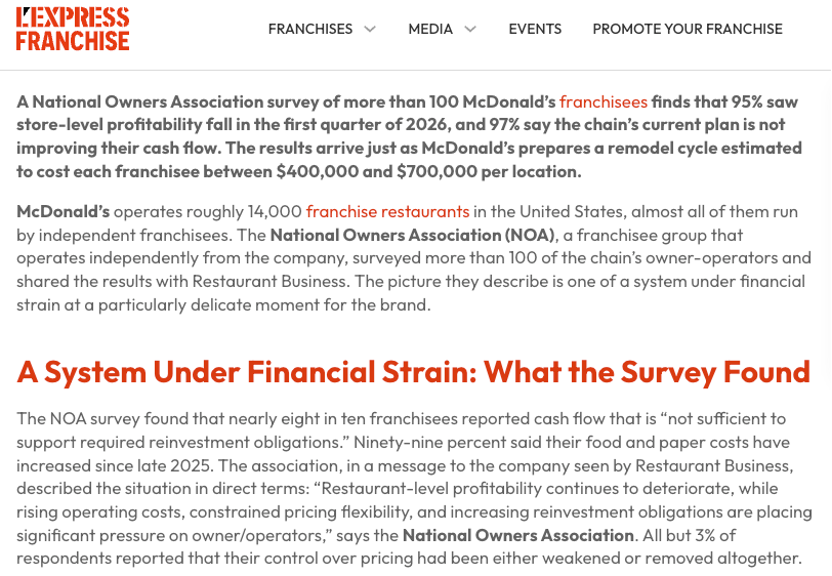
So, franchisees are short on cash—partly due to McDonald's strategy, but store renovations nonetheless require franchisees to foot the bill. A typical US drive-through store will require about $1 million for the latest upgrade. Naturally, franchisees are reluctant to push McDonald's renovation plans.
To address these issues, McDonald's announced at Investor Day on September 23 that it would deploy about $8.5 billion to support franchisees by 2036, with around $5 billion to be spent before 2030. Of this, about $1.5–2 billion will directly pay for renovations, the remaining $3–3.5 billion will be rent reductions and refurbishment subsidies. By McDonald's estimates, with these subsidies, franchisees will recover their investment in about 4 years per remodel, and each US store will generate approximately $100,000 extra cash flow annually thereafter.
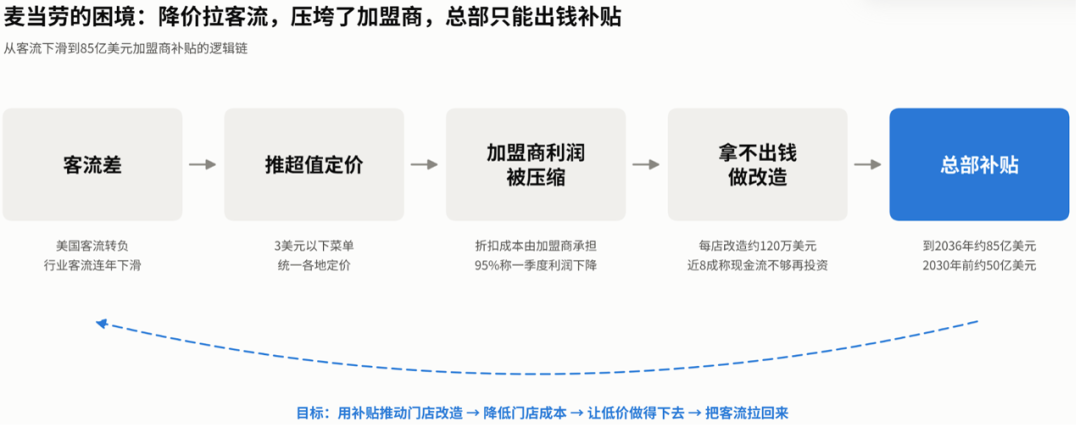
Let's summarize McDonald's problems and solutions: At the macro level, US dining prices have been rising persistently, oil prices are up a lot this year, and low-income consumers face intense pressure. From 2019 to 2024, McDonald's US menu prices rose about 40%, so its traffic is weaker than the industry. To win back traffic, McDonald's offered cheaper value menus—yet the associated costs mainly fall on franchisees, whose profits are squeezed by rising ingredient costs. With thinner profit margins, franchisees can't afford million-dollar store remodels. However, renovations are crucial for McDonald's to cut costs and sustain lower prices in the long run. To get this moving, HQ had to fork out $8.5 billion in subsidies for franchisees.
In short, McDonald's wants to use this investment to create a virtuous cycle—subsidies drive store renovations, renovations cut costs, lower costs allow sustainable value pricing, which ultimately attracts traffic back.
However, the market isn't impressed—on Investor Day, the stock fell 5%. Mainly for two reasons.
First, short-term profit growth will slow. Most of McDonald's profit comes from rent collected from franchisees—their highest-margin income—which will be reduced due to rent cuts. As these subsidies are rolled out from 2027, annual profits will be hit. For example, JPMorgan cut their 2027 EPS forecast about 9% after Investor Day, now expecting just 1.8% EPS growth that year.
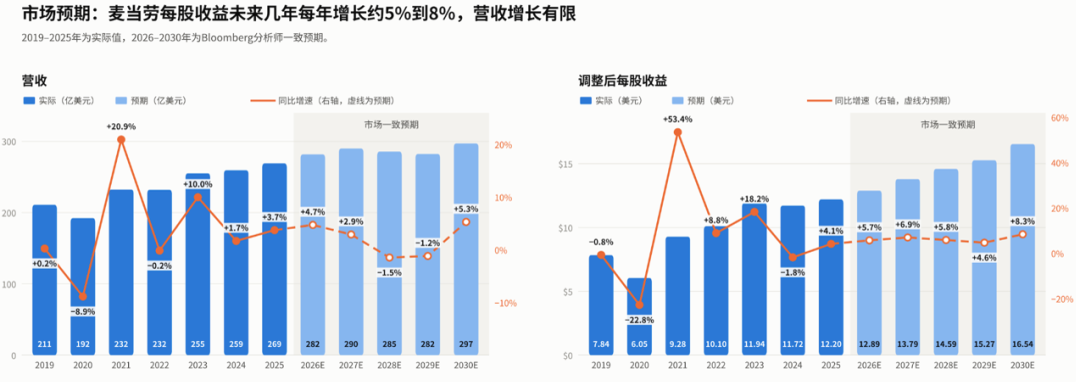
Second, long payback period. For franchisees, payback (with subsidies) is about 4 years; for McDonald's itself, the CFO puts the payback at 5–6 years—even longer than for franchisees. That means it may be around 2030 before McDonald's sees returns from current investments. According to consensus, McDonald's EPS is expected to grow just 5%–8% annually over the next five years.
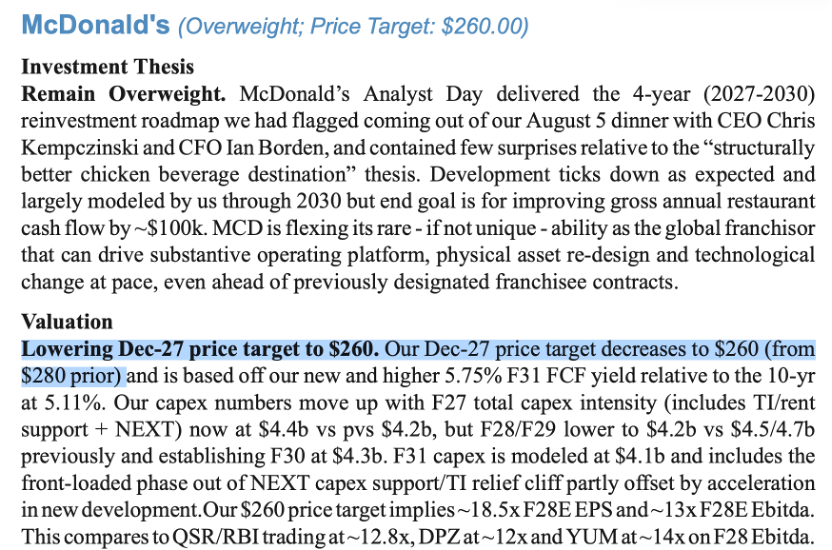
Because of these negatives, several investment banks have cut their price targets—JPMorgan lowered its target from $280 to $260.
But in my view, this investment is truly necessary—McDonald's has to help franchisees get through hard times.
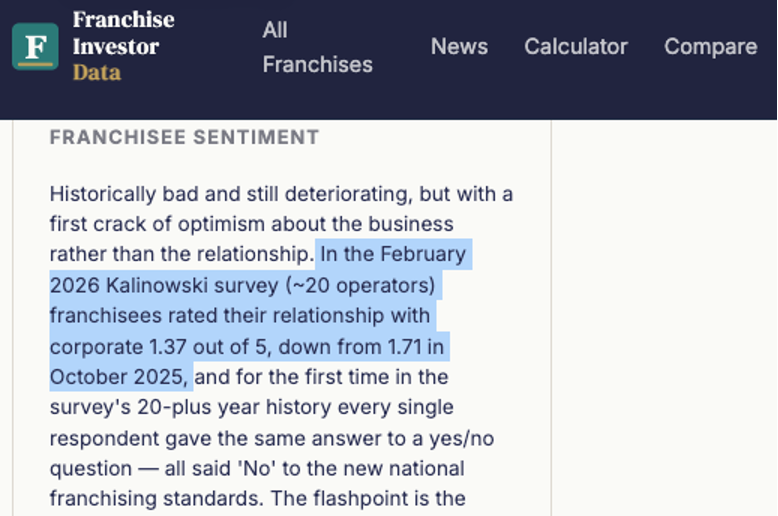
Wall Street research firm Kalinowski surveyed 20 McDonald's franchisees in January this year; they rated their relationship with HQ just 1.37 out of 5 (down sharply from 1.71 in October last year). Since 95% of McDonald's stores are franchised, if the company doesn't help franchisees weather difficulty first, both the value menu and store remodels will be hard to implement. On the flip side, if renovations succeed, McDonald's estimates they will add around $100,000 in cash flow per US store annually. With more cash on hand, franchisees can afford long-term value pricing, which could revive traffic and same-store sales. And same-store sales growth is the most crucial link if McDonald's is to reach its 2030 target of raising operating margin to the low/mid-50%s. So, this $8.5 billion support plan is essential.
Investment Viewpoint
However, this $8.5 billion plan only solves the problem of whether franchisees have enough money to renovate, with about $5 billion to be spent by 2030—so it’s a medium- to long-term issue. But in the short term, two questions matter for investors: can traffic come back, and will this spending continue to drag on performance?
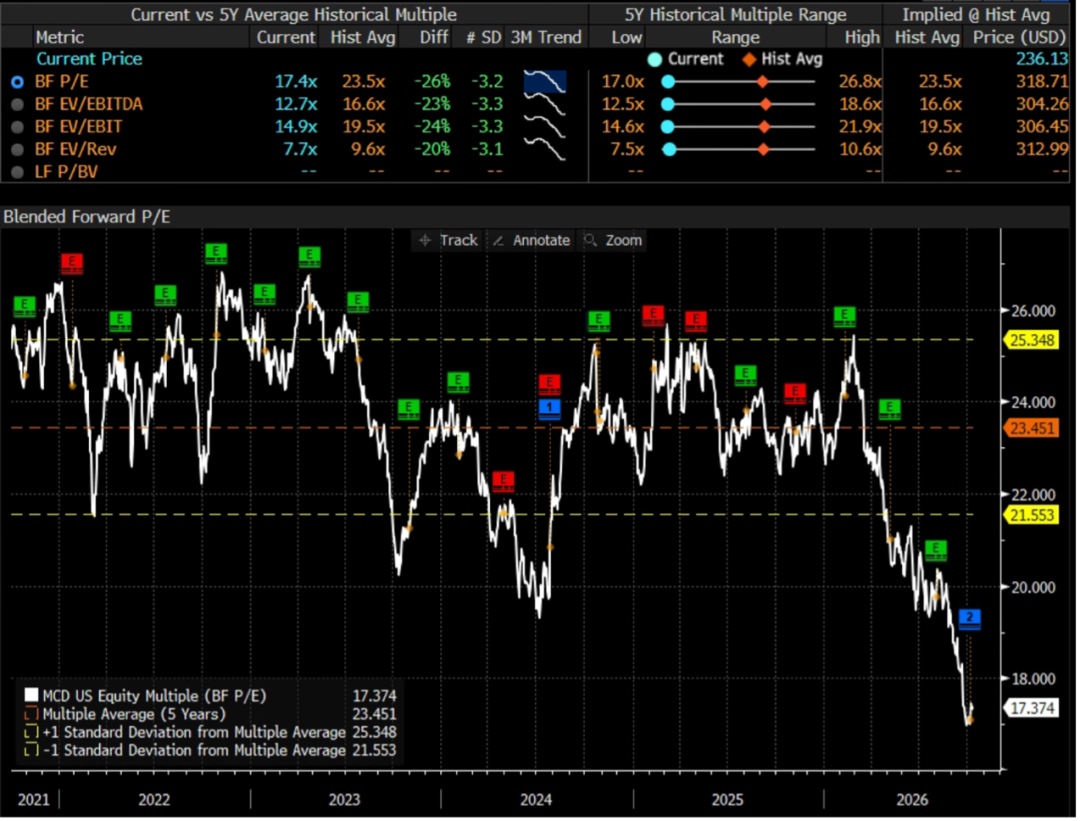
Precisely because the market is concerned about these short-term issues, McDonald's valuation has dropped to a five-year low after the big share price fall—with 2027 PE ratio down to just 17x. Still, don’t rush to buy big just because the stock is cheap after a big drop. Current valuation may contain “bubbles”—if traffic doesn't recover, earnings forecasts will likely be cut again, and the valuation won’t be as attractive as it looks now. If earnings are cut again next quarter, the valuation could actually look higher. Therefore, this is not yet the time to take a large position; further observation is warranted.
But don’t be too pessimistic about McDonald's. Throughout history, McDonald's has faced several crisis moments.
2002 was the biggest crisis in McDonald's history. That year, the S&P 500 index fell 23%, and McDonald's stock price dropped nearly 40%, mainly due to declining same-store sales and continuous profit erosion. In Q4, massive store closures and asset write-downs led to the first quarterly loss ever for McDonald's.
Afterwards, McDonald's slashed expansions, cutting new openings from 1,247 to 513 stores, focusing on existing stores and no longer allowing new stores to cannibalize old ones. It also launched the “Plan to Win” strategy—improving people, product, store, price, and promotion—focusing on quality, service, and cleanliness. On the product side, they launched upscale salads and further pushed the $1 menu that debuted at the end of 2002. In September 2003, the iconic “I’m lovin’ it” campaign launched worldwide. As a result, US same-store sales grew 6.4% in 2003, 9.6% in 2004—EPS growth turned positive in 2003, and hit 35.7% in 2004.
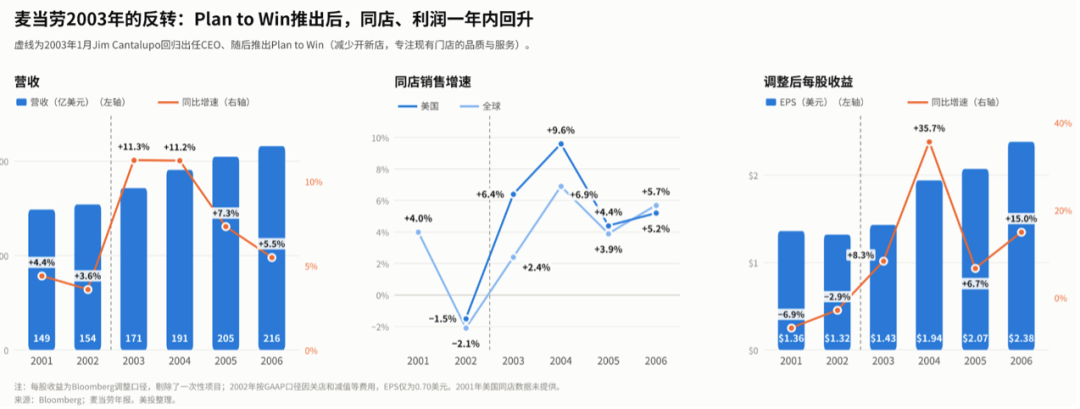
Another crisis came in 2014, when US same-store sales dropped 2.1%, traffic fell 4.1%, and adjusted EPS dropped 13.2%. The problems were two-fold: an increasingly complex menu slowed service, and in July that year, supplier Husi in China was involved in a food safety incident. The S&P 500 was up 11% that year, but McDonald's shares fell 3%.
In March 2015, McDonald's appointed a new CEO and began its second transformation: selling 4,000 company-owned stores to franchisees, raising the franchise rate from 81% to about 93% and cutting $500 million in management expenses. In October 2015, it also rolled out the highly requested all-day breakfast.
The impact was soon visible. In Q3 2015, US same-store sales turned positive for the first time in two years; in Q4, same-store sales grew 5.7%. From 2016 to 2018, adjusted EPS grew 14.6%, 16.9%, and 18.6%. Revenue actually declined over these years due to accounting changes after selling stores—McDonald's only collected rent and royalties, so revenues dropped but profit margins rose further.
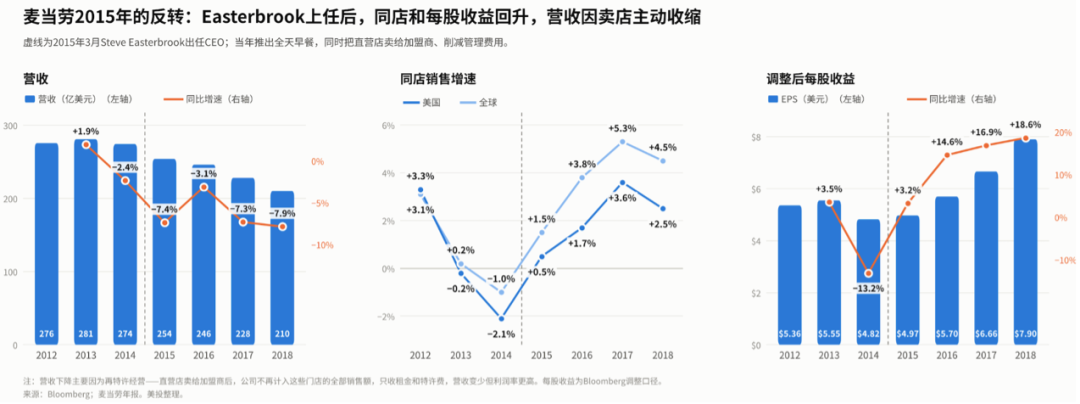
In both crises, McDonald's reversals were driven by two things: 1) downsizing, lightening the business structure; 2) launching blockbuster products to draw traffic back. In 2003, it refocused on existing store quality plus a new ad campaign; in 2015, it increased franchising and introduced all-day breakfast.
Similarly, the Next plan announced at Investor Day in September follows that playbook. Make It Golden mirrors the quality and service of 2003; increasing the franchise proportion to 98% and cutting management expenses is similar to 2015. What’s missing now is a blockbuster product to bring customers back. Chicken and beverages are possible—notably, this year more beverage items have been added, but hand-breaded chicken is still being tested with no confirmed launch date.
Moreover, franchisee attitudes often decide the success of any turnaround. In 2003, McDonald's slashed new store openings, stopped cannibalizing existing stores, sent 900 ops staff to help franchisees improve outlets, and franchisees and HQ aligned. In 2015, franchisee ratings for HQ hit a historic low of 1.48; when all-day breakfast launched, many franchisees complained of overloaded kitchens, but when the product drew in customers, they became happy to comply.
Today, McDonald's hasn’t achieved either of these yet: 1) a blockbuster product to attract traffic is still absent; 2) franchisees haven’t fully cooperated—only 60%–65% of stores are offering the under $3 value menu. Thus, it will take some time to see real turnaround for McDonald's.
And historically, major share price rallies have always been rooted in a fundamental turnaround.
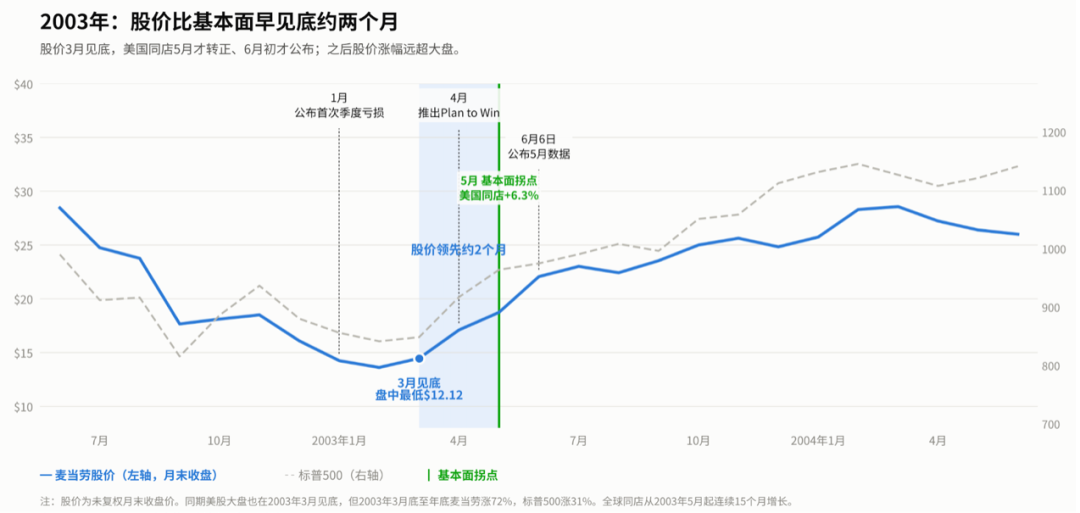
In 2003, McDonald's share price bottomed in March around two months before US same-store sales growth turned positive—but the whole US market bottomed then as well. Significant outperformance didn’t start until May, after same-store sales crossed into positive territory: from the end of March to year-end, McDonald's gained 72%, while the S&P 500 rose only 31%.
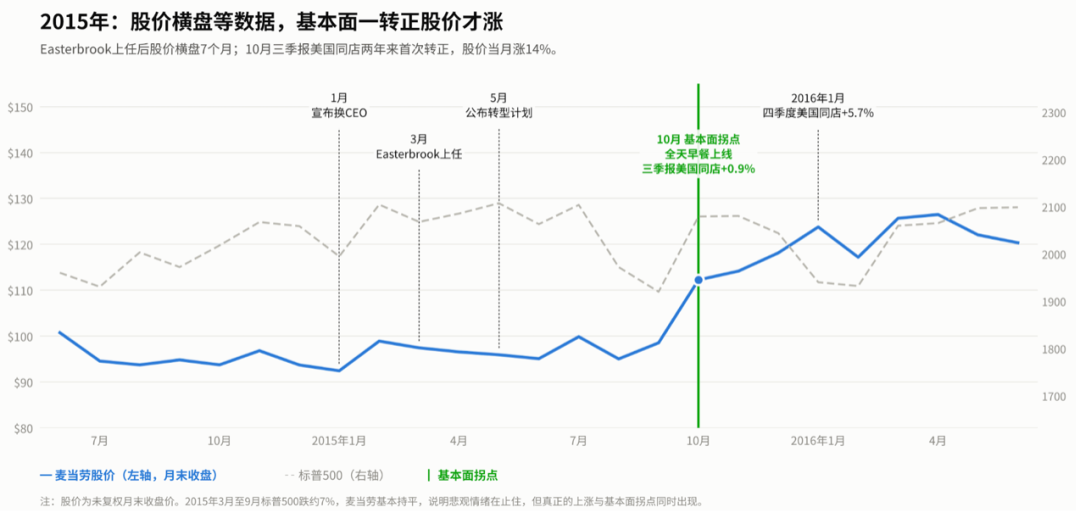
It was even more obvious in 2015: after the new CEO arrived and the transformation plan was announced, the stock didn’t react, drifting sideways for 7 months. Only when all-day breakfast launched and Q3 results showed positive US same-store sales for the first time in two years, did the stock jump 14% in a month—and kept going up afterwards.
So, for McDonald's now, the market is also likely to wait for concrete evidence of a traffic turnaround before any meaningful rebound in share price.
There are two upcoming observation points: 1) the Q3 report in early November—to see whether same-store sales fall more than the expected 1% drop; 2) the new value menu strategy and possible chicken product launches announced early next year. If traffic turns positive in the first half of next year, investors would be willing to wait for the long-term payback of remodels. If traffic remains negative and the subsidies hit the P&L from 2027 on, McDonald's share price could be under pressure for some time. Based on our analysis above, this outcome is relatively likely.
Therefore, the current share price isn’t a great entry for a big position. At present, upside and downside risks are balanced; for real upside, we must see clear fundamental recovery, which could still take time—so the risk/reward isn’t attractive enough. The best time to buy is after the fundamentals are confirmed, even if the stock price is already up by then—because the certainty of making money is higher, and you don't have to endure market uncertainty with your position, making it much easier to hold.
That said, even if we aren’t so optimistic about McDonald's short-term rapid rebound, long-term we’re still confident in the company. As the world’s biggest fast food chain, the McDonald's brand is deeply rooted. No company’s path is smooth, and McDonald's has encountered troubles in nearly every era: the overexpansion and product flops of the late 1990s lasted until 2003; the bloated menu and food safety incident of 2014 weren’t resolved until 2015. But every time, McDonald's found a way out. So, I believe, years from now, this difficult patch will just be another hurdle in McDonald's long history.
While it’s not time to buy in bulk, if you’re optimistic about McDonald's long-term value, starting with a small position or accumulating shares gradually through this downturn could also be appropriate. Once the right strategy is found, McDonald's turnaround could be even faster than Starbucks, given its greater familiarity and necessity in Americans’ daily lives—get the price and product right and customers quickly return. That’s how history has played out: in 2003, four months after the rescue plan was announced, US same-store sales turned positive; in 2015, it took about 7 months after the new CEO took over. By comparison, Starbucks’ turnaround took over a year after its CEO change in September 2024.
Additionally, McDonald's has a virtue—its business is almost immune to being disrupted by AI, and it has little relevance to AI-themed stocks. So, if you want to diversify your portfolio and don't wish to concentrate positions in AI-linked stocks, McDonald's is also a solid defensive, diversification play.
Conclusion



Disclaimer: The content of this article solely reflects the author's opinion and does not represent the platform in any capacity. This article is not intended to serve as a reference for making investment decisions.
You may also like
ECB Presidential Contest Centers on Crisis Management: French Debt Risk Becomes the Touchstone
The competition for the position of President of the European Central Bank is increasingly centered on a key question: which candidate is best equipped to deal with the "vigilantes" of the bond market? As France's debt issues revive memories of turmoil in the Eurozone and the current president, Christine Lagarde, prepares to step down early, Dutchman Klaas Knot and Spaniard Pablo Hernández de Cos may soon take over amid financial turbulence.
Peter Schiff’s ‘$75K Bitcoin call’ meets a vital week: Fed, inflation, and ETF outflows loom

Deutsche Bank, which "accurately called the top" two weeks ago: Tech stocks need to "fall another 5%" to reach the "long-term trend bottom"
After Deutsche Bank downgraded its rating on US tech and large-cap growth stocks two weeks ago, tech stocks have underperformed the rest of the S&P 500 components by 12 percentage points. However, Deutsche Bank noted that tech stocks still have about 5 percentage points of downside before reaching the bottom of their long-term trend channel. Institutional positions have been quickly cooling, and signs of outflows from the $30 billion bottom-fishing funds are beginning to appear. Going forward, earnings performance, capital flows, and external risks will determine whether the adjustment stops at structural rotation.
Smart Trader 0xe813 Opens $63.88M ETH Long After Market Drop — 100% Win Rate
Crypto prices
More


