
Gold prices weaken, silver prices fluctuate: Weak housing data offsets impact of rising oil prices

Huitong Network, October 20—— During early US trading hours on Tuesday (October 20), spot gold prices fell while spot silver prices experienced sharp volatility. The US housing market performed below expectations, highlighting the impact of high borrowing costs on the US economy. However, rising crude oil prices and persistently high inflation have led the market to continue betting that the Federal Reserve will further tighten monetary policy. The latest housing data has to some extent alleviated inflation concerns that have been weighing on precious metals, but renewed tensions in the Strait of Hormuz have dampened expectations for a rate cut.
During early US trading hours on Tuesday (October 20), spot gold prices fell while spot silver prices experienced sharp volatility. The US housing market performed below expectations, highlighting the impact of high borrowing costs on the US economy. However, rising crude oil prices and persistently high inflation have led the market to continue betting that the Federal Reserve will further tighten monetary policy. The latest housing data has to some extent alleviated inflation concerns that have been weighing on precious metals, but renewed tensions in the Strait of Hormuz have dampened expectations for a rate cut. In early trading, spot gold was quoted at about $4,126.87 per ounce, down 0.33%; spot silver was quoted at about $57.391, up 0.52%.
US housing starts data for September continued to weaken, further demonstrating that high mortgage rates are suppressing investment in the residential sector. The number of new housing starts fell by 7.4% year-over-year. Single-family housing starts dropped 4.6%, with an annualized start rate of 859,000 units; building permits dipped slightly by 0.2% to 1.4 million units, after August’s revised figure of 1.403 million units. Single-family building permits fell 4.0% to 845,000 units.
Earlier on Monday, the NAHB housing market index fell from 32 to 29, hitting its lowest value since June 2012. Climbing mortgage rates, rising construction costs, and cooling homebuying demand have weighed heavily on builders’ confidence. The latest data further confirms that the tight financial environment is having an increasingly significant impact on interest-rate-sensitive economic sectors.
The market is deeply divided: on one hand, economic activity is weakening; on the other, inflation pressure remains stubborn. In September, the US consumer price index (CPI) rose 0.6% month-over-month and 3.7% year-over-year; the producer price index (PPI) climbed 1.3% month-over-month and 6.3% year-over-year. With inflation data exceeding expectations, traders expect the Federal Reserve to keep interest rates unchanged at its October 27–28 policy meeting, with Fed funds futures indicating an 82.8% probability of no change and a 17.2% chance of a 25 basis point hike. However, the market is still pricing in a 93.6% probability of a rate hike by the December 9 FOMC meeting.
Tuesday’s housing data added further justification for keeping rates unchanged in October, but with energy prices remaining high, it’s unlikely that this data alone will reverse market expectations for a rate hike in December. The benchmark US 10-year Treasury yield hovers around 5.1%, after reaching 5.13% on Monday; the US Dollar Index weakened slightly overnight after having strengthened in the previous session.
The Federal Reserve is currently in its pre-meeting communications blackout period, so the latest economic data becomes the main basis for projecting monetary policy trends. The following US economic agenda for Tuesday: At 10:00 AM ET (UTC+8), the September pending home sales index will be released. On Thursday at 8:30 AM ET (UTC+8), initial jobless claims data for the week will be released; on Friday at 9:45 (UTC+8), preliminary October manufacturing and services PMI numbers are due, followed by the final University of Michigan Consumer Sentiment reading at 10:00 (UTC+8).
If labor market and business activity data deteriorate further, it will reinforce concerns about an economic slowdown and weaken expectations for further rate hikes; US Treasury yields could fall, supporting gold prices. Conversely, if inflation expectations remain elevated and economic data beat expectations, then the case for further tightening by the Federal Reserve will be strengthened, continuing to weigh on precious metal prices.
The Strait of Hormuz and US-Iran relations remain major sources of uncertainty for the energy market. Merchant vessels and Saudi targets have recently come under attack, causing crude oil prices to give back some of Monday’s losses. Iran has threatened the security of this strategic shipping route and Houthi forces have resumed military action, prompting growing concerns about energy supply security in the Gulf. Currently, oil transit volume through the Strait of Hormuz has recovered to 80%-82% of pre-conflict levels, but tanker traffic continues to face disruption, with persistent risk of renewed supply outages pushing up the geopolitical risk premium.
Iran maintains that the strait is under its sovereign jurisdiction; negotiations between the US and Iran over sanction relief, maritime passage, and a comprehensive security framework have yet to yield a lasting agreement. During intraday trading, Brent crude oil climbed as high as $111.94 per barrel, the highest since May, before pulling back to $109.53; West Texas Intermediate (WTI) crude briefly climbed back above $100 per barrel, then retreated to $98.84.
The escalation contributes to a mixed impact for gold. Geopolitical risk in the Gulf boosts gold’s safe-haven demand; however, higher crude oil prices worsen inflation pressures, delaying a US monetary policy pivot to easing. Tuesday’s weak housing report reflects the economic cost of high borrowing costs, but oil-driven inflation pressure continues to limit gold’s upside.
Silver faces similar bearish pressure from monetary policy, but as silver has substantial industrial demand, it’s even more sensitive to economic downturns.
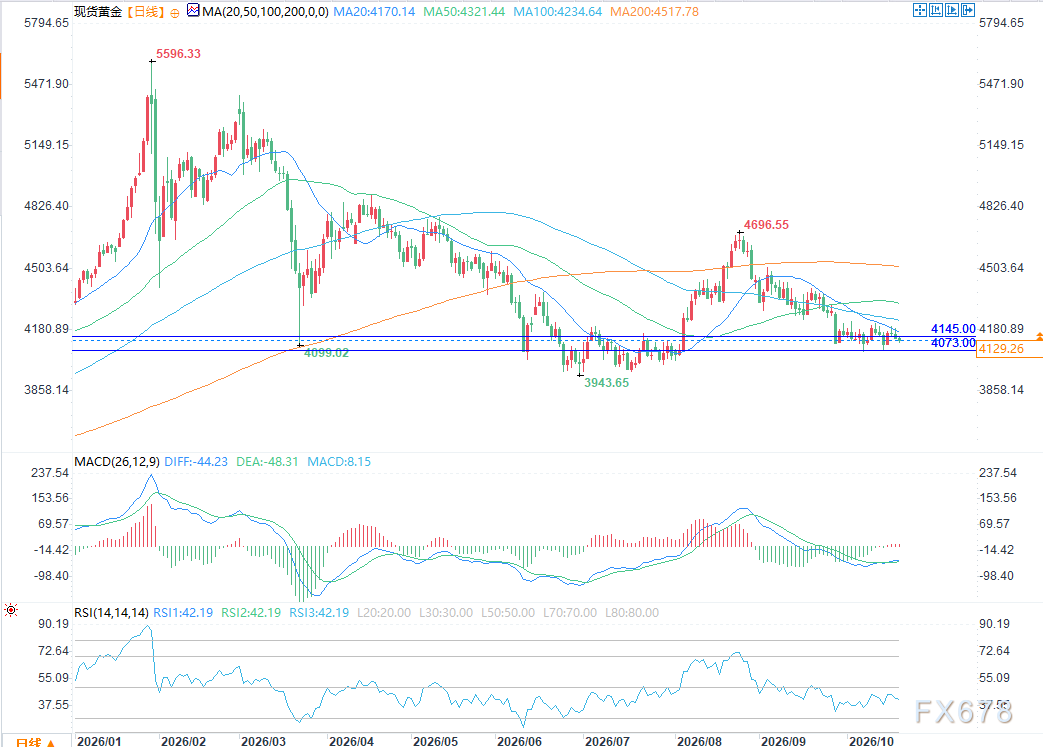
(Spot gold daily chart. Source: Yihuichong)
The next bullish target for spot gold is to push the price back above the $4,141.97–$4,145.47 resistance zone; if this level is effectively broken, the next target is $4,199.08, followed by $4,217.40.
The short-term bearish target is to break below $4,073.55, with deeper support at $4,066.54, and then $3,942.10.
First resistance is at $4,141.97, then $4,145.47; first support at $4,073.55, then $4,066.54.
Silver Technical Analysis
The next bullish target for spot silver is to push the price back above the $57.390–$57.860 area; if this range is breached, the target will be $58.700, then $59.370.
The bearish target is to break below $56.920, with the next downside target at $56.340, and then $55.400.
First resistance is $57.390, followed by $57.860; first support is $56.920, followed by $56.340.
Disclaimer: The content of this article solely reflects the author's opinion and does not represent the platform in any capacity. This article is not intended to serve as a reference for making investment decisions.
You may also like
Waymo, a subsidiary of Alphabet (GOOGL.US), expands into the European market: entering Spain and planning to launch services next year
Waymo, a subsidiary of Alphabet, will further expand into the European market, planning to launch its services in Madrid in 2027.

It is reported that Samsung and SK Hynix (SKHY.US) are seeking to upgrade their factories in China: aiming to win AI orders and prevent Yangtze Memory from taking market share.
According to four sources familiar with the matter, Samsung Electronics and SK Hynix are upgrading production lines at their factories in China.

PENGU Price Prediction: Can SoFi Adoption Push Pudgy Penguins Above $0.0085?

Meta Q3 Earnings Preview: Revenue May Exceed Expectations, 2027 Spending Is the Key Disagreement
The market generally holds an optimistic view on this quarter's revenue, but the real divergence lies in whether a balance can be achieved between capital expenditures in 2027 and AI monetization. Aside from spending concerns, analysts expect the earnings call to also focus on several key areas: user adoption rates for Muse and per-user token costs, enterprise-level AI opportunities, and large language model and infrastructure strategies. Bank of America warns that if management suggests capital expenditures or operating expenses may further increase in 2027, or if the timeline for AI monetization lags behind expectations, the company's stock price will inevitably come under pressure.

Crypto prices
More


