-
Strategy and other Bitcoin treasury companies are facing MSCI global index delisting risk following the development of new eligibility criteria.
-
MSCI may deem it a non-operating company based on three indicators, including that most of its revenue is dependent on the underlying asset rather than operational income.
-
JPMorgan estimates that Strategy faces $2.8B liquidation risk, which could extend to up to $11.6 billion if the downlisting spreads out.
The world’s leading publicly traded Bitcoin treasury company, Strategy, is among a list of companies of its kind that face potential removal from Morgan Stanley Capital International (MSCI) global indexes.
Announced on October 15, the decision established new financial tests that deem non-operating companies ineligible for indexing. In this context, non-operating firms are those whose primary value, income, or business activities stem from passive financial investments rather than traditional commercial operations.
According to MSCI, there are three core indicators of a non-operating company:
The first is asset misalignment, where the vast majority of a company’s valuation is tied to passive assets such as Bitcoin or treasuries, rather than operational income. The second is revenue disconnect, where the company’s income and cash flow are dictated by the valuation of the underlying asset rather than core operational activities. Third is its mode of capital allocation, where the company issues new debt or equity to acquire more passive assets rather than investing in research, development, and business expansion. Companies that get stricken off are those that fail financial and operational tests across two consecutive review periods.

JPMorgan predicts $2.8B liquidation risk
JPMorgan now estimates that Strategy’s removal from MSCI indexes could trigger $2.8 billion worth of liquidations. The company came up with the figure by analyzing the passive funds tracking the MSCI USA Index and MSCI World Index. These funds hold about 13 million shares of Strategy (3.1% of the basic shares outstanding).
Since ETFs mirror index allocations, a deletion would require these companies to dispose of those shares, igniting high selling pressure.
What’s worse, if competing providers like FTSE Russell or S&P Dow Jones implement similar measures, outflows could skyrocket to between $8.8 billion and $11.6 billion.
What next?
Notably, MSCI will publish the official list of the affected companies on November 11, with the new eligibility rules taking effect following the November 30 market close.
While Strategy has deemed this potential delisting unfair, it continues to accumulate Bitcoin, with its most recent purchase bringing its stash to 848,250 BTC.
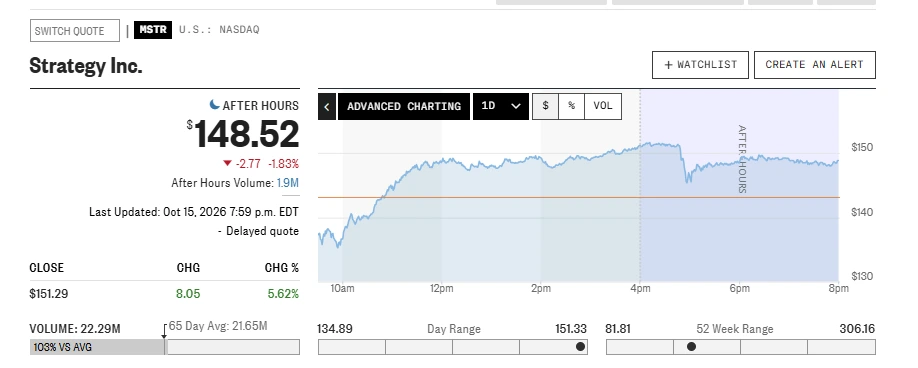
Meanwhile, its shares have so far barely reacted, with MSTR (Nasdaq) down 1.83% to trade at $148.52 in the after hours. STRC (Nasdaq) was down 0.18% in that same period, trading at $99.35.