
Gold prices rebound sharply but with limited upside; AI performance drags down US economic growth expectations

Huitong News, October 9th—— OpenAI’s performance fell short of expectations, leading to concerns in the market about the US economic growth rate. Combined with easing tensions in the Middle East, gold prices saw a sharp rebound! However, the rebound remains limited.
On Friday (October 9), during the Asian and European sessions, gold prices rebounded sharply, mainly due to the US stock market decline and Trump’s statement that he will not go to war with Iran this month. Previous articles have continuously highlighted opportunities in gold—whether readers have seized them or not is unknown. Currently, gold is trading around 4186.
The trend is clear: the US 10-year Treasury yield has declined significantly, while gold prices rebounded; however, the 2-year Treasury yield remained virtually unchanged.
In brief: The market has not changed its view on the US economy and Federal Reserve policy over the next one or two years; it has simply downgraded expectations for long-term US economic growth, mostly for reasons unrelated to inflation.

Main Line: Easing AI Expectations Weigh on Long-Term Growth Outlook
The initial trigger came from OpenAI.
The market is worried that the speed of AI commercialization and computing power demand expansion is not as fast as previously imagined.
The market previously expected AI to significantly boost the long-term US economic growth rate, but this expectation is now cooling.
With lower long-term growth expectations, yields on long-dated bonds such as the 10-year Treasury move lower.
Meanwhile, short-term economic conditions have changed little, and the Federal Reserve's near-term plans for raising or cutting rates remain unchanged, so the 2-year Treasury yield, which represents short-term policy expectations, stays steady.
Supporting Factors: Easing Middle East Tensions, Oil and Dollar Moving Together
The easing of oil price pressures supports the outlook for the European economy, while the euro’s strength drags down the dollar index.
The weaker dollar also gives gold prices a breather.
Note: Easing Middle East tensions is only a supporting factor—not the main story behind the current drop in long-dated US Treasuries. Just one month of easing is unlikely to change inflation trends over ten years.
Gold itself does not generate interest; the biggest opportunity cost of holding gold is the US 10-year Treasury Inflation-Protected Securities yield (TIPS).
When long-term real yields fall, the opportunity cost of holding gold decreases. Combined with a weaker dollar, these twin positives have fueled the gold price rebound.
Key Variables for Gold Prices Ahead
AI industry growth expectations: These correspond to market judgments on long-term US economic growth.
If expectations for AI commercialization and capital expenditure on computing power continue to soften, long-term US Treasury yields will likely face further pressure—supporting gold. If AI data beats expectations and long-term growth expectations warm up, long-term Treasury yields will climb and gold will come under pressure.
Oil price expectations: The Middle East has only seen a short-term easing; risks of renewed conflict remain.
If tensions flare up again and oil prices surge, the market will return to trading a stagflation theme, causing a shift in trading logic. If oil prices remain stable, the dollar and gold will continue to track long-term real yields.
Summary and Technical Analysis:
The main storyline is the cooling of AI expectations, lowering growth forecasts and pushing down long-dated Treasury yields;
Easing Middle East tensions reduce oil price surge risks, while a stronger euro and weaker dollar further support gold prices.
For gold’s future movement, the key is whether the AI industry faces further negative news. It is necessary to watch both the growth trend of AI and the US economy, as well as changes in oil prices.
Currently, the US stock market has rebounded sharply. AI’s short-term contribution to the economy and its funding demand are still hard to dismiss, so interest rates may stay high and gold’s upside may be limited.
Technically: Spot gold finds support at the bottom of the range, with the 5-day moving average turning upward, but the head-and-shoulders neckline and the 10- and 20-day moving averages above still form a bearish pattern, capping the gold price. Therefore, the space for gold’s rebound may be limited.
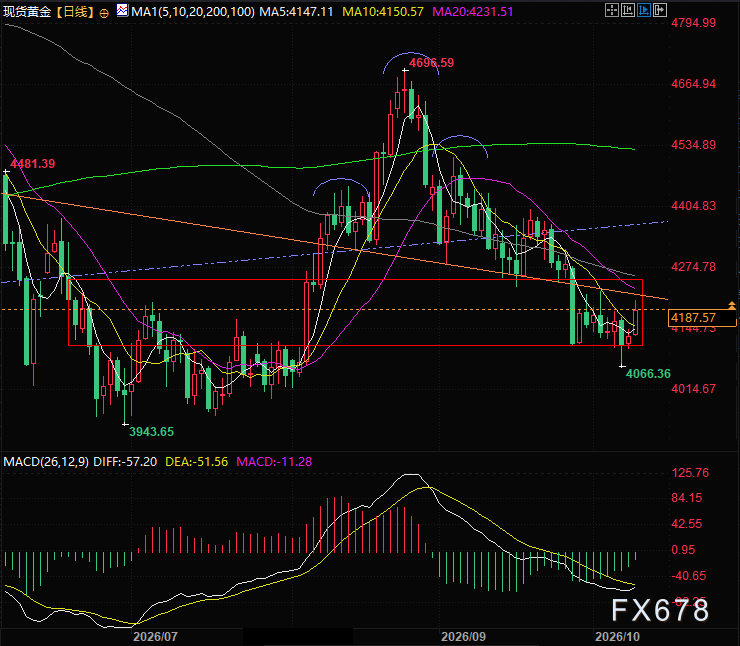
(Spot gold daily chart, source: Yihuixun)
At 17:28 (GMT+8), spot gold was last quoted at $4,187 per ounce.
Disclaimer: The content of this article solely reflects the author's opinion and does not represent the platform in any capacity. This article is not intended to serve as a reference for making investment decisions.
You may also like
Chipmaker earnings growth cools to 136% as AI boom lifts S&P 500
Updated: Delta Air Lines warns that as fuel prices hit profits, airline capacity will tighten further
Delta Airlines lowers its annual profit forecast due to an expected increase in fuel costs to $6 billion. The CEO stated that ticket prices have risen by about 20% this year, with limited passenger resistance. Analysts warn that maintaining high ticket prices in 2027 is critical for improving profitability. The article includes comments from the earnings call and analyst remarks. Rajesh Kumar Singh/Shivansh Tiwary, Reuters Chicago, October 9 - Delta Airlines (DAL.N) said on Friday that, despite strong travel demand and rising ticket prices, soaring fuel costs have forced it to cut its 2026 profit expectations by nearly a quarter. So, the airline industry may need to further limit flight growth next year to protect profitability. This warning highlights the increasingly tough challenges faced by U.S. airlines. While strong demand and restricted seat growth have allowed airlines to significantly raise ticket prices and offset higher fuel costs, aggressively increasing flights to capture more demand may intensify competition, making it harder to maintain high fares and protect profits. Based in Atlanta, Delta now expects its annual fuel expenditure to increase by about $6 billion compared to last year—about $2 billion higher than its July forecast—due to the Iran war (link) causing global jet fuel prices to spike. Airlines worldwide are preparing for a prolonged fuel shock. Michael O’Leary, CEO of Ryanair Group RYA.I, said Thursday that high jet fuel prices could persist for another 12-18 months (link), adding more pressure on airlines to raise fares and control costs. https://www.reuters.com/graphics/AUTOMATED-20261008/A4A-JET-FUEL-DAILY-1Y/xmpjwjnmbvr/chart.png “In a high-cost environment, you can’t simply grow your way out,” Delta CEO Ed Bastian said on the earnings call. He noted that the industry has already taken steps to restrict capacity, but more measures will be needed next year to improve profitability. Bastian said Delta raised ticket prices about 20% this year, and passenger resistance has been limited. He is confident that even if fuel costs eventually drop, the high fares can still be maintained. Delta lowered its adjusted annual earnings per share forecast from the July prediction of $6.50-$7.50 to $5.10-$5.60. According to LSEG data, the midpoint of the new range is below analysts’ average expectation of $5.46. Third-quarter adjusted earnings per share were $1.72, four cents below analysts’ average forecast. In midday trading, shares of Delta dropped 1.7%, United Airlines UAL.O fell 1.4%, and both American Airlines AAL.O and Southwest Airlines LUV.N were down about 1%. Delta partly shields itself from rising fuel costs by owning a refinery outside Philadelphia (link), which is expected to generate over $700 million in profits this year. Even with this buffer, the airline expects its fourth-quarter fuel price to rise from $3.61 per gallon in Q3 to $4.25 per gallon. Delta forecasts adjusted fourth-quarter earnings per share to be between $1.15-$1.65, with the $1.40 midpoint roughly matching analysts’ average expectation of $1.39. Fare increases Government data shows that in the first eight months of 2026, U.S. airlines spent $42.9 billion on fuel, an increase of $13.2 billion compared to the same period last year despite slightly reduced consumption. According to the U.S. Bureau of Labor Statistics, strong demand and limited seat growth pushed average U.S. airline ticket prices up by about 25% year-on-year between April and August. https://www.reuters.com/graphics/USA-AIRLINES/FUEL/lbpgdnbzwvq/chart.png Analysts at Melius Research said that despite surging fuel costs, Delta’s ability to raise fares helps keep second-half profits roughly stable. Still, they warn that the company’s profit margin has struggled to improve over the years. “It is critical for margin improvement to maintain or raise fares in 2027,” they wrote in their research report. With industry capacity growth expected to accelerate in Q4, this challenge will likely become even tougher. Deutsche Bank analysts expect the proportion of fuel costs recouped through revenue measures to fall in Q4 and predict full recovery won’t happen until early 2027. Bastian noted that low industry returns are another reason for limiting capacity growth. He said Delta will be cautious with its 2027 capacity plan until the fuel price outlook becomes clearer. He added that international routes may account for a larger share of Delta’s capacity expansion compared to domestic routes. Currently, Delta says its premium cabins and corporate travel business remain strong, and its economy cabin business is gradually improving. With Q4 ticket bookings already exceeding 60%, Delta expects revenue to increase about 20% year-on-year, despite limited capacity growth. Executives said early booking trends for Q1 2027 are also encouraging. (For the convenience of non-native English speakers, Reuters automatically translates its reports into several
AI and Quantum: Trump's $6 Billion Plan Could Also Impact Bitcoin
Wall Street giants to release financial reports next week: stock trading revenue expected to approach $19 billion, "everyone is a winner" may be a thing of the past
According to analyst expectations compiled by Bloomberg, the combined equity trading revenue of the five major U.S. banks in the third quarter will approach $19 billion, but fixed income trading revenue is expected to drop to its lowest point of the year, and M&A activity has also cooled. Meanwhile, AI-driven cash optimization tools may lead to deposit outflows, sparking concerns about bank stocks in the market. Analysts believe that while the profit performance of each bank may further diverge, market concerns about the impact of AI may be overblown.
Crypto prices
More


