
Gold Trading Reminder: FOMC Minutes to Be Released Soon, Will the Gold Bull-Bear Deadlock Be Broken?

Huitong.com, October 7th — Spot gold saw a slight increase yesterday, driven by safe-haven demand as French bond turmoil and U.S. bond concerns intensified, while the 10-year U.S. Treasury yield retreated from a 24-year high and the dollar eased from a one-year peak, providing dual support for gold prices.
In early Asian trading on Wednesday (October 7), spot gold was trading near $4,170 per ounce. On Tuesday, gold prices rose 0.57% as the pause in the U.S. Treasury yield rally and dollar weakness provided support. By the New York close on Tuesday, spot gold increased by 0.57% to $4,163.78/oz, while December U.S. gold futures settled up 0.7% at $4,187.10/oz. After the 10-year U.S. Treasury yield rose to a more than 20-year high on Monday, it edged lower, and the dollar retreated from a one-year high, making dollar-denominated gold cheaper for investors holding other currencies.
Safe-Haven Demand Returns: French Bond Turmoil and U.S. Treasury Concerns Drive Gold Higher
The core driver of gold’s increase on Tuesday was the return of safe-haven demand. American Gold Exchange market analyst Jim Wyckoff said: “Due to turmoil in the French bond market and increasing concerns over the U.S. bond market, we are seeing some safe-haven demand for gold.” In certain parts of the Eurozone, especially France, swelling government debt and persistent budget deficits continue to make investors uneasy and push up sovereign bond yields.
This safe-haven mentality marks a reversal from last week’s suppressive logic— previously, the shock from France’s fiscal issues boosted U.S. Treasury yields, supporting the dollar and weighing on gold; now, worries from French bond turmoil are morphing into safe-haven demand for gold, while the pause in the rise in U.S. Treasury yields is providing double support for gold prices.
Retreat in the Dollar and Yields: Breathing Space for Gold Prices
The retreat in the dollar and yields is a direct driver of gold’s rebound. After the 10-year U.S. Treasury yield climbed to a more than 20-year high on Monday, it edged down by 4.2 basis points to 5.269%, the 30-year yield dropped 2.2 basis points to 5.642%, and the two-year yield fell 4.4 basis points to 4.789%. The dollar’s retreat from a one-year high made dollar-denominated gold cheaper for overseas buyers.
FHN Financial macro strategist Will Compernolle said that traders are taking a brief respite, waiting for the next major catalyst, likely PPI or CPI. Yields are already high, and before rising further, traders will need to see more convincing reasons to push U.S. Treasury prices down further.
The implication for gold is: If yields remain stuck at high levels, gold’s downward pressure will ease, opening up space for a rebound.
Stable Treasury Auctions: Demand Has Not Significantly Weakened, But Concerns Persist
Tuesday’s stable three-year Treasury auction further boosted the momentum of U.S. Treasury prices. The three-year U.S. Treasury auction saw decent demand, with a winning yield of 4.932%, lower than the secondary market yield at the bidding deadline. Direct bidders received 31.7%, the highest since February. However, the bid-to-cover ratio was somewhat weak at 2.62, below the recent six-auction average of 2.65. This combination suggests short-term demand is intact, but investors remain cautious.
Olivier d'Assier, Senior Director of Investment Decision Research at SimCorp, noted that although the bond market has recently been sold off, it’s still too early to turn bullish on U.S. Treasuries.
He pointed out that a crisis is underway, but no one has yet proposed a credible solution, and most governments are not even pretending to strive for fiscal balance. The implication for gold: worries about fiscal sustainability will persist, providing medium- to long-term safe-haven support for gold.
Rate Hike Expectations: 22% Probability for October, Still 84% for December
Market pricing for Federal Reserve rate hikes shows a clear split. After weaker-than-expected U.S. jobs growth in September, the market has trimmed bets on a Fed rate hike this month.
According to the CME FedWatch tool, traders see only a 22% chance of a rate hike by the Fed this month, but still assign an 84% probability for December. The implications for gold are complex: the lower probability of an October hike gives gold some support, but the high December odds mean the overall policy outlook still leans hawkish.
The Federal Reserve’s September FOMC meeting minutes will be released Thursday Asia time; these minutes may help judge the future direction of monetary policy. If the minutes are dovish, it could confirm the market’s dovish repricing and support gold; if hawkish, it could reignite rate hike expectations and pressure gold prices.
Institutional Views: TD Securities Sees Gold Above $5,000 in 2027
Despite short-term headwinds, the long-term outlook remains positive among institutions.
Analysts at well-known institution TD Securities said in a report that continued buying by exchange-traded funds and ongoing demand from self-directed investors continue to support gold, maintaining their previous forecast that gold will surpass $5,000 per ounce in 2027.
This forecast is based on the long-term logic of sustained ETF buying and self-directed investor demand, which contrasts with the current short-term pressured scenario.
In addition, resilient oil exports from the Middle East, coupled with the G7’s emergency release of reserves, have eased supply concerns and pushed oil prices down. This has, to some extent, alleviated inflation worries and has an indirect, complex impact on gold.
Summary
Currently, the core drivers of gold’s rise are the return of safe-haven demand and the fall in the dollar and U.S. Treasury yields. Turmoil in the French bond market and concerns about U.S. Treasuries are pushing safe-haven flows into gold, while the 10-year U.S. Treasury yield’s retreat from a 24-year high and the dollar’s decline from a one-year high provide double support for gold prices. Demand for the three-year Treasury auction was steady, though the bid-to-cover ratio was soft, reflecting continued cautious investor sentiment. The market is pricing a 22% probability of a rate hike in October and 84% in December; the Fed’s September FOMC minutes will be key for near-term direction.
TD Securities maintains a bullish stance, expecting gold to break above $5,000 per ounce in 2027. Against a backdrop of lower yields and dollar, and returning safe-haven demand, gold has some short-term breathing room, but high December rate hike expectations may cap the rebound at the $4,200 mark. The FOMC minutes and subsequent inflation data will be core variables for gold’s short-term direction.
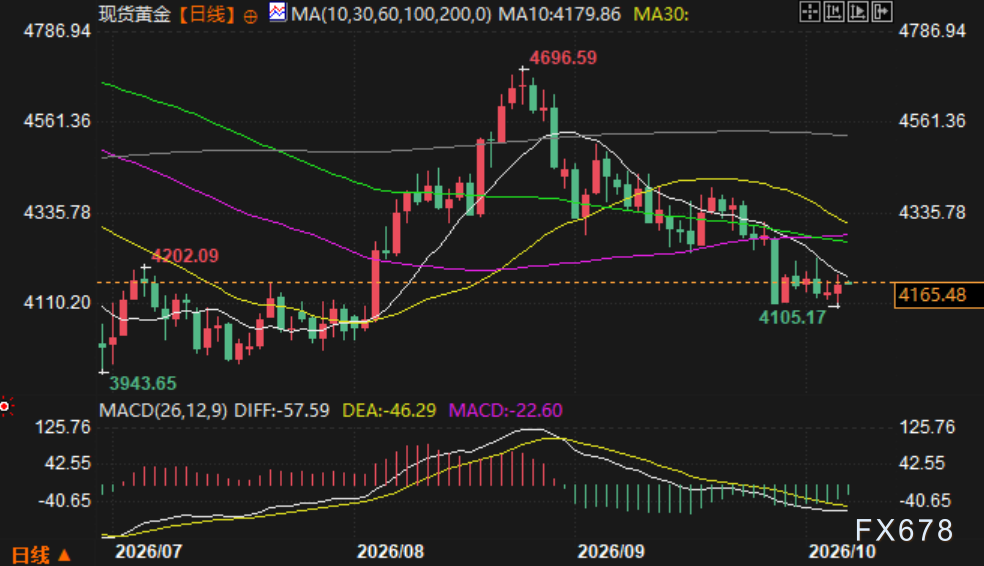
(Spot gold daily chart, source: Easy Huitong)
As of 7:53 (GMT+8), spot gold was quoted at $4,166.87 per ounce.
Disclaimer: The content of this article solely reflects the author's opinion and does not represent the platform in any capacity. This article is not intended to serve as a reference for making investment decisions.
You may also like
"Tail risks" of components such as ASIC, storage, and optical modules: Power shortage in the US means racks are installed but can't be powered
Morgan Stanley predicts that by 2028, U.S. data centers will face a net electricity shortage of about 32GW, equivalent to 34%. Power bottlenecks may first impact the tail end of the supply chain, including ASIC, storage, optical modules, and power management, while Nvidia and Broadcom are relatively more resilient. Even with accelerated self-generated power and overseas expansion, the gap will still be difficult to fill quickly.
Meme Coin Insider Allocations: 5 Supply Red Flags Before You Buy

Morgan Stanley: Is the market about to start a catch-up rally?

Crypto prices
More


