
Why hasn't the US debt crisis toppled the dollar? European debt crisis becomes the biggest drag on gold prices

FX168 Financial News, October 6th—— The recent continuous rise in real interest rates, as well as the sharp increase in the US dollar index caused by the European debt storm, are the main reasons suppressing the rebound in gold prices.
On Tuesday (October 6th) during the Asian-European session, international gold prices have continued to be suppressed recently and are currently trading near 4139. The recent surge in real interest rates, coupled with the sharp rise in the US dollar index due to the European debt storm, are the main factors restraining a rebound in gold prices. This article summarizes the main reasons affecting recent gold price movement.
Recent Global Oil Price Correction Leads to Cooling Overall Inflation Expectations
At the same time, the slowing growth of non-farm payroll wages in the United States and the easing of an overheated labor market further undermine the foundation for continued inflation, leading to a re-pricing of Federal Reserve monetary policy.
According to CME FedWatch data, the probability of the Fed keeping rates unchanged in October is as high as 77.3%, while the probability of a total 25 basis point rate hike is only 22.7%. Looking ahead to December, the probability of rates holding steady is 13.4%, a 67.8% chance of a 25 basis point hike, and an 18.8% probability of a 50 basis point hike.
Overall, cooling inflation and employment data have led to a temporary easing in Fed tightening pressure, providing potential monetary policy tailwinds for gold.
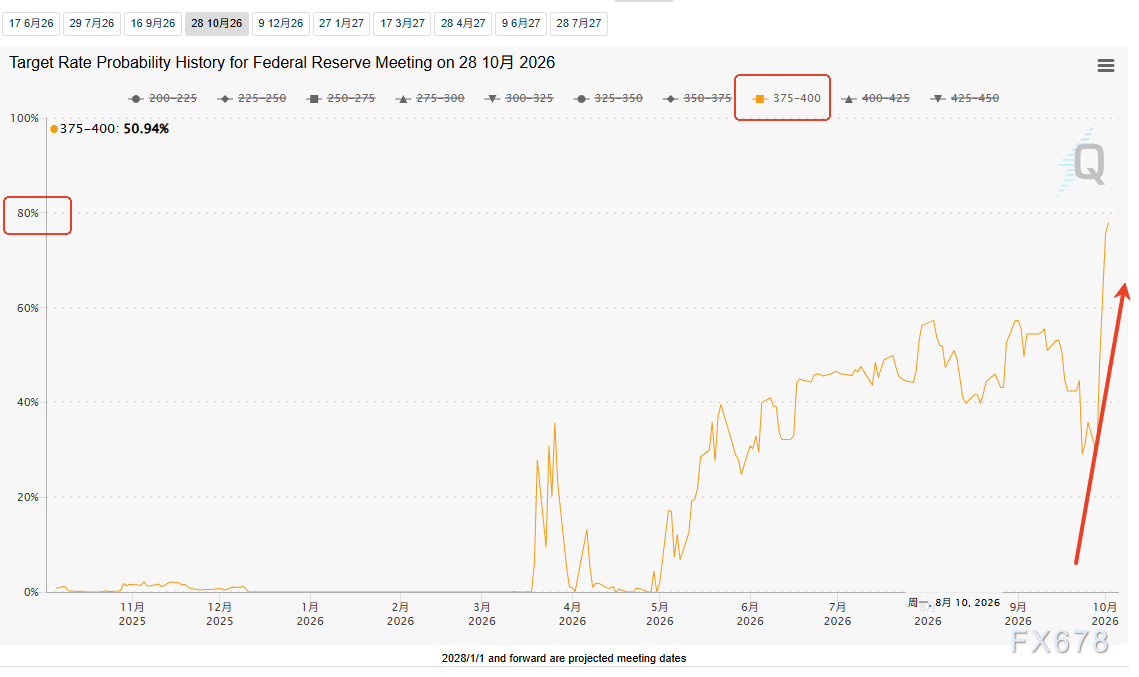
(FedWatch Interest Rate Tool, Source: CME Group)
Bullish Factors Completely Offset: US Treasury Yields and Real Interest Rates Continue to Skyrocket
Although the cooling rate hike outlook should benefit gold, this positive effect has been completely offset by the surge in US Treasury yields and real interest rates, which have become the main bearish force suppressing gold prices.
This round of rising Treasury yields was not driven by market panic over inflation, but rather by the extraordinary resilience of the US economy.
Nohshad Shah, EMEA Head of Fixed Income Sales at Citadel Securities, pointed out in a client note that nearly all of the increase in 10-year Treasury yields in September was due to higher real yields, with inflation expectations remaining relatively stable.
The lift in real yields is attributable to a combination of US fiscal easing, loose financial conditions, and massive investment in the AI sector, fueling intense capital competition. The market is reassessing the sustainability of economic growth, and investors are demanding higher real (inflation-adjusted) returns, rather than merely seeking inflation protection.
Meanwhile, BMO Asset Management warns that it is nearly inevitable for the 30-year Treasury yield to breach 6%—possibly as soon as October—while increased bond market volatility is reinforcing a self-perpetuating cycle of even higher yields.
As gold is a non-interest bearing asset, rising real interest rates persistently increase the opportunity cost of holding gold, restraining its rebound potential.

(10-Year TIPS Real Yield, Source: Federal Reserve)
Core Pricing Logic Switch: US Dollar Index Strength Dominates Gold, Hedges Out Negative US Treasury News
Gold is primarily priced in US dollars, and the market has long followed the core rule: "strong dollar, weak gold price." This is also the most crucial factor capping gold's recent rebound.
Behind the ongoing surge in Treasury yields lies the worsening government debt in a high interest rate environment, which, by conventional market logic, should undermine the dollar's credibility and favor gold by providing a strong safe-haven support.
However, this advantage is being fully offset by risk aversion due to European market turmoil.
Compared with US debt worries, Europe entered its current crisis earlier and has seen greater risk exposure, making it the central focus for global safe-haven flows.
Among these, Japanese investors, who hold massive amounts of French bonds, have become the main force of selling. The outsized allocation to French debt in Japan's overseas holdings now faces major reduction risks, and the ongoing European bond sell-off has delivered a direct blow to the euro, with EUR/USD plunging to a 17-month low and the euro depreciating sharply against the dollar.
When compared with other major global economies, the shock of the European crisis far outweighs US debt concerns, causing a stampede of global safe haven capital into US dollar assets and driving the US dollar index relentlessly higher.
Ultimately, the negative impact of US debt issues has been completely overshadowed, with the strong US dollar suppressing gold prices and entirely stripping gold of its safe-haven appeal, becoming the key factor pressuring gold in recent sessions.
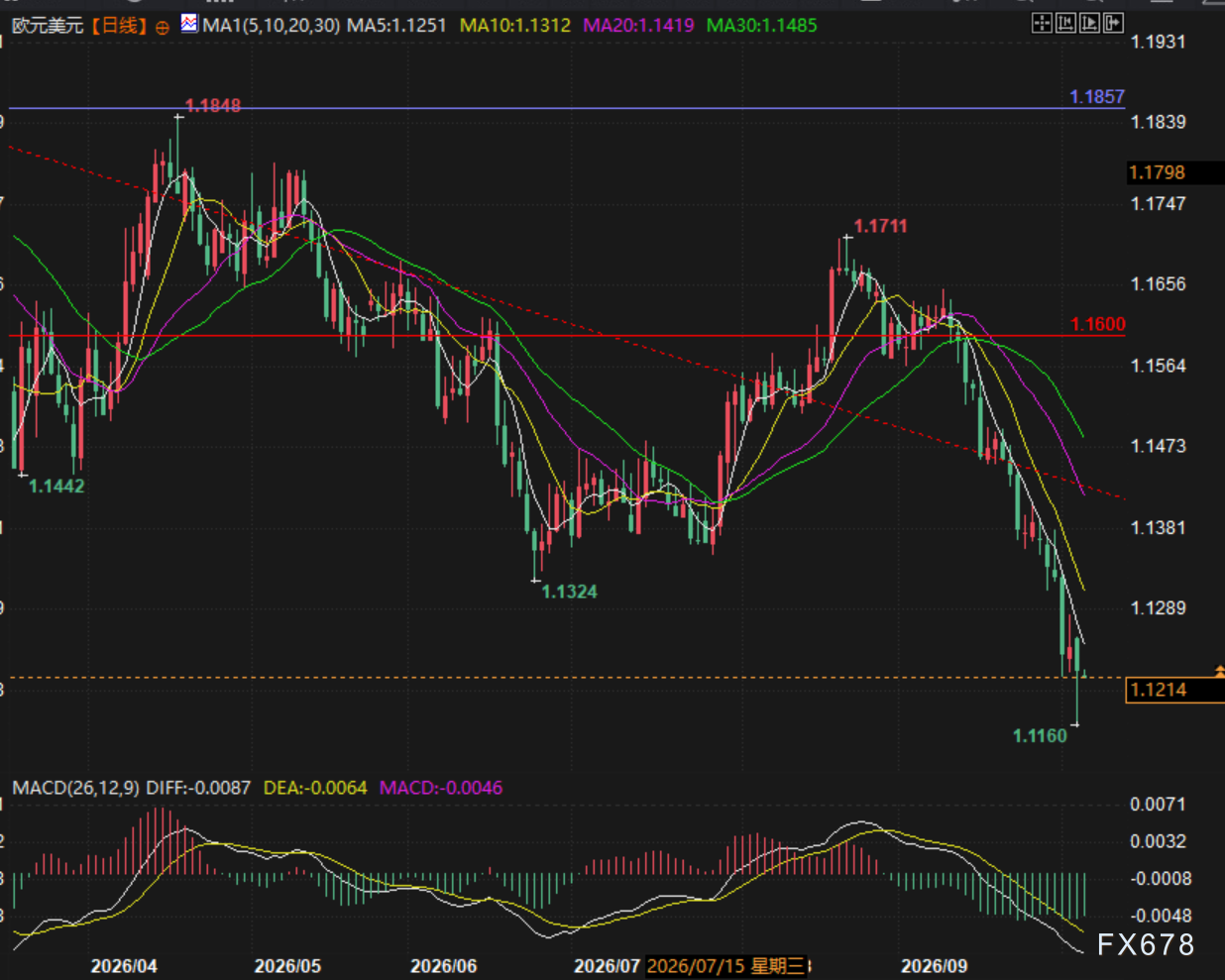
(EUR/USD Daily Chart, Source: Yihuicharts)
Divergence in Central Bank Gold Buying: Energy Crisis Intensifies Bull-Bear Tug-of-War
Against a backdrop of macro-level struggle, global central bank gold buying shows clear divergence. This provides a floor for gold prices but makes it difficult to drive a one-sided trend. On one hand, tightening global energy conditions and volatile oil prices have prompted certain countries with thin forex reserves to sell gold and cash out in order to obtain dollars for oil imports, creating short-term selling pressure on gold.
On the other hand, most sovereign states continue with long-term strategic gold accumulation and large-scale purchases.
Russia’s Ministry of Finance announced a sharp ramp-up in foreign exchange and gold purchases, raising the gold buying quota from October 7 to November 6 to five times the September amount, using extra oil and gas income to strengthen the National Welfare Fund. Ongoing official gold purchases have helped build a solid medium- to long-term floor for gold prices.
Retail Investors Remain Cautious: ETF Inflows Slow, Technical Pressure Evident
Gold ETFs, representing retail and short-term speculative funds, are showing extremely cautious sentiment.
Currently, the overall technical posture of gold is bearish, market chasing enthusiasm is subdued, ETF inflow is extremely slow, and there is a lack of incremental short-term funds to drive a gold rebound.
In the absence of retail participation and with only central bank support, gold prices struggle to mount a sustained rally and overall remain under pressure.
Outlook Summary and Key Variables to Watch
The current gold market is caught between multiple macroeconomic forces, with bullish factors (cooling inflation, lowering rate hike expectations, central bank gold buying) and bearish dynamics (soaring real interest rates, a strong US dollar, subdued retail flows) effectively offsetting each other, leaving prices directionless.
The outlook hinges on three key variables: first, US inflation and labor market data, plus Q3 tech company earnings, which will determine the turning point for US economic strength and real interest rates;
Second, Gulf energy conditions and US-Iran geopolitical tensions, which will directly impact oil prices and global inflation expectations, indirectly influencing the Fed’s policy path;
Third, the inflection point in European bond market sentiment—when the sell-off in French bonds stabilizes will determine the euro’s downtrend and the strength of the US dollar index.
At this stage, with European debt risk prevailing, the influence of the US dollar index on gold prices has significantly increased. During a strong US dollar cycle, gold’s rebound space will continue to be limited, with overall performance dictated by the dual pressure from real interest rates and the dollar.
Technical view: Spot gold is still grappling with the push and pull of previous bullish candles and recent bearish ones, with moving averages still aligned bearishly—thus gold remains rangebound, waiting for moving average adjustment.
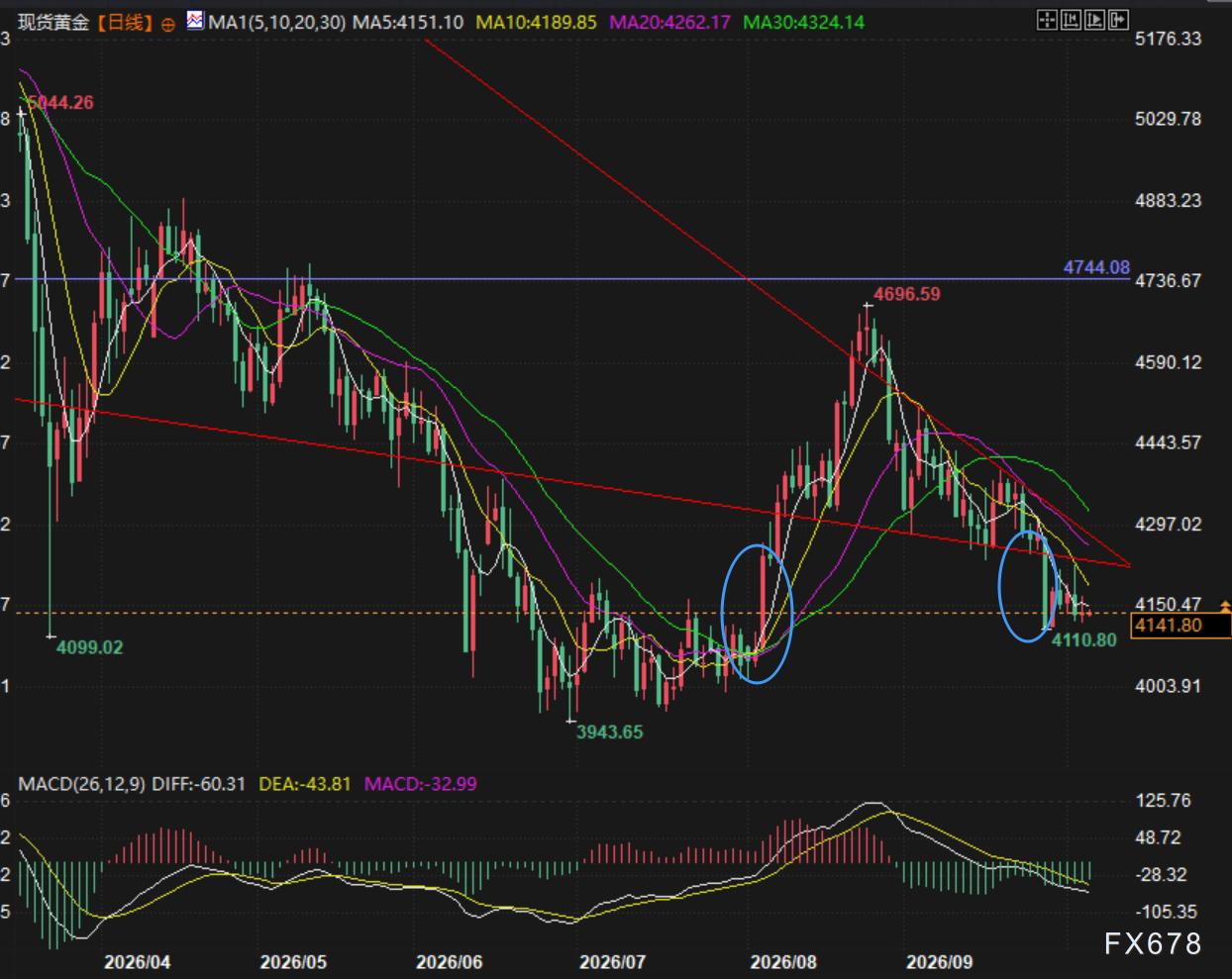
(Spot Gold Daily Chart, Source: Yihuicharts)
Disclaimer: The content of this article solely reflects the author's opinion and does not represent the platform in any capacity. This article is not intended to serve as a reference for making investment decisions.
You may also like
ROI - For the Trump-led Treasury, the "tail" of the auction is the most difficult part: McKeever
The views expressed in this article are solely those of the author, Reuters columnist Jamie McGeever. Reuters, Orlando, Florida, October 6 – U.S. Treasury auctions are typically dull, predictable, and not newsworthy. But these are not ordinary times, and the Trump administration now faces the risk of sluggish U.S. debt sales making headlines. The U.S. Treasury plans to issue nearly $120 billion in Treasuries this week, the first non-bill bond sales in two weeks: $58 billion in three-year notes on Tuesday, $39 billion in ten-year notes on Wednesday, and $22 billion in thirty-year bonds on Thursday. These auctions would usually be insignificant events, but due to the exceptionally weak performance of auctions from September 22 to 24—especially the five-year note auction on September 23, which triggered the largest spike in bond yields since April last year—they are attracting growing attention. Since then, yields have not only failed to retreat but have surged across most tenors to multi-decade highs. It's worth noting that the possibility of a U.S. Treasury auction "failing" is almost zero. Primary dealers—currently 26 Wall Street banks and institutions authorized by the New York Fed as market makers for Treasuries—are always involved. They effectively underwrite the sales, ensuring the smooth operation of the $30 trillion U.S. Treasury market, the most liquid market in the world. This, in turn, allows the entire global financial system to function, given that trillions of dollars in global debt, assets, and market derivatives are benchmarked against U.S. Treasuries. Treasuries are also the primary collateral for lubricating the financial “pipes” of the U.S. and global markets, including repo agreements, interbank loans, and financing. In short, as long as U.S. Treasuries remain the pillar of the global financial system, there will always be buyers at Treasury auctions. The question, as always, is at what price these bonds will be sold. Currently, borrowing costs in the secondary market are at their highest levels since the mid-2000s, so it's reasonable to expect that the Treasury will pay relatively high rates in the primary market as well. But as recent auctions have shown, negative surprises remain possible. "Too big to be absorbed by the market"? The $70 billion five-year auction on September 23 was among the most worrisome in years. Demand, as measured by the bid-to-cover ratio, was at a nine-year low. The Treasury ended up selling the notes at a yield of 5.033%, more than 3 basis points above the market yield at the close of bidding. Three basis points might not sound like much, but it's exceptional for a five-year note auction. This is the largest so-called "tail" since June 2022. According to JPMorgan analysts, the last time a five-year auction had a three-basis-point tail was back in 2011—amid the brewing debt ceiling crisis that eventually led to a U.S. credit rating downgrade in August that year. Currently, concerns over the U.S.'s daunting fiscal outlook are driving up long-term borrowing costs. As a result, markets generally expect the Trump administration to gradually shift the Treasury’s massive funding needs toward the lower-yield (and therefore lower-cost) short- and medium-term segments of the curve. That's why the five-year note auction two weeks ago sparked such concern. A three-basis-point tail is common in long bond auctions, but not in the "belly" of the yield curve. If the Treasury is forced to pay a higher premium to issue these bonds, then Houston, we have a problem. A large auction tail can be caused by many factors, including market volatility on the day of the auction or more concerning, fundamental issues that may erode demand over time. The two are often hard to distinguish because they are not mutually exclusive. On a brighter note, this unease has not yet spread to the short end of the yield curve. At least, not yet. Three-year and ten-year Treasury yields are up about 50 basis points from the last auction a month ago, hovering around 4.96% and 5.32%, respectively. The thirty-year yield is up roughly 35 basis points to 5.65%. These levels should be high enough to attract strong demand and ensure smooth sales, right? Maybe. But if surprises do occur, volatility and uncertainty could spill over across the market. Investors will be watching developments as closely as hawks. (The views in this article are solely those of the author, a Reuters columnist.) Like this column? Check out Reuters' "Unhedged" (ROI), your essential new source for global finance commentary. Follow ROI on LinkedIn and X. You can also listen to the daily "Morning Bid" podcast on Apple, Spotify, or the Reuters app—subscribe for in-depth market and finance news, seven days a week. US 5-year auction has biggest 'tail' since 2022 https://fingfx.thomsonreuters.com/gfx/mkt/dwpkmkzogpm/TAIL.png (For the convenience of non-English speakers, Reuters provides automated translations of its reports
Money market fund inflows plummet to 158 billion—Is short-term US Treasury liquidity flashing a warning sign?
Money market fund inflows have sharply dropped to $158 billion in the first three quarters of this year, driving Treasury yields higher. Increased volatility at the short end has raised market concerns about tightening short-term financing.
TAO crypto price consolidates – Why $318 is Bittensor’s next big test
Tokenization Becomes a Key Focus for the U.K. Financial Sector

Crypto prices
More


