
JPMorgan: The U.S. Tech Magnificent Seven's "Valuation Kill" Is Nearing Its End, but It's Hard to Regain Solo Outperformance

After several months of valuation compression in the US technology sector, JPMorgan believes the toughest phase may be over, but the era of "technology dominating alone" will not return.
According to Trend Trader, JPMorgan strategist Mislav Matejka noted in a report published on September 28 that the valuation of large technology stocks represented by the "Mag-7" has dropped to its lowest level in a decade, and the P/E premium of Hyperscalers over the S&P 500 has also compressed to a low point of more than one standard deviation, indicating that the valuation compression process is largely nearing its end. The report also maintains an overweight stance on semiconductors and suggests a renewed positioning in the "long semiconductors, short software" pair trade.
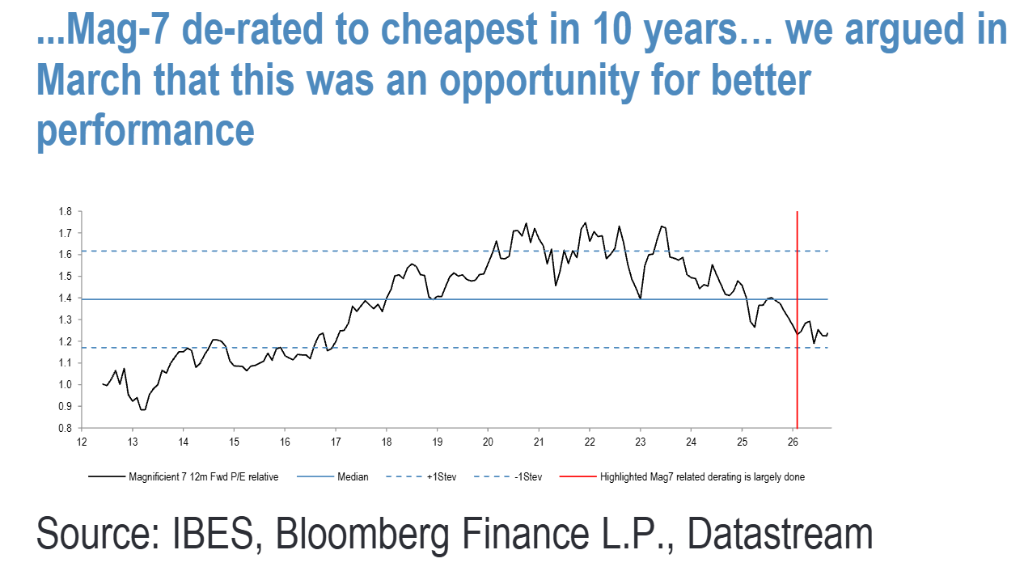
However, JPMorgan makes it clear that the technology sector is unlikely to return to its previous period of extreme outperformance. The bank believes that the AI capital expenditure cycle will persist, earnings momentum remains robust, and monetization paths are gradually clarifying, all factors that are collectively supporting renewed market attention on technology. However, the era of tech stocks dominating market returns is now over.
Mag-7 and Hyperscalers: Valuation Compression Nears Its End
The Mag-7 has consistently underperformed the broader market this year, with its 12-month forward P/E relative to the S&P 500 dropping to nearly one standard deviation below the mean, making it the cheapest level in a decade. As early as March this year, JPMorgan pointed out that this valuation compression process might have gone too far.
The Hyperscalers index—covering Amazon, Google, Microsoft, Meta, and Oracle—has lagged behind the S&P 500 by 8% since the start of this year. With AI capital expenditures surging, these companies' free cash flows have turned negative: according to Bloomberg data, the combined free cash flow of these five firms is expected to fall from about $233.4 billion in 2024 to roughly $10.6 billion in 2026, and become negative by 2027. Meanwhile, both debt and equity financing have been rising accordingly.
JPMorgan acknowledges that the shift in business models from asset-light to asset-heavy does provide some rationale for valuation compression, but with the current relative P/E at over one standard deviation below the mean, the degree of compression may be overdone. The bank believes that Hyperscaler stock performance will still be supported by profit growth—although further valuation compression could erode some of these returns, it will not completely offset them.
Another frequently cited concern is monetization capability. Although LLM Token prices have dropped substantially in recent months, JPMorgan points out that the explosive rise in consumption volume has been enough to offset falling prices, and overall expenditure is actually still rising, with accumulated monetization cases.
Semiconductors: Profits Continue to be Revised Up, Pair Trades Re-enter the Market
JPMorgan maintains its overweight position in the semiconductor sector and suggests a renewed "long semiconductors, short software" pair trade.
During the momentum unwinding in June-July this year, the Philadelphia Semiconductor Index (SOX) recorded a maximum drop of 28%, and the Korea Composite Stock Price Index (KOSPI) fell by an even steeper 39%, the latter being hit by amplified concerns regarding HBM downgrades and improved algorithmic efficiency reducing memory demand. However, by late July, JPMorgan was already calling for a return to semiconductor long positions, citing continued strength in earnings.
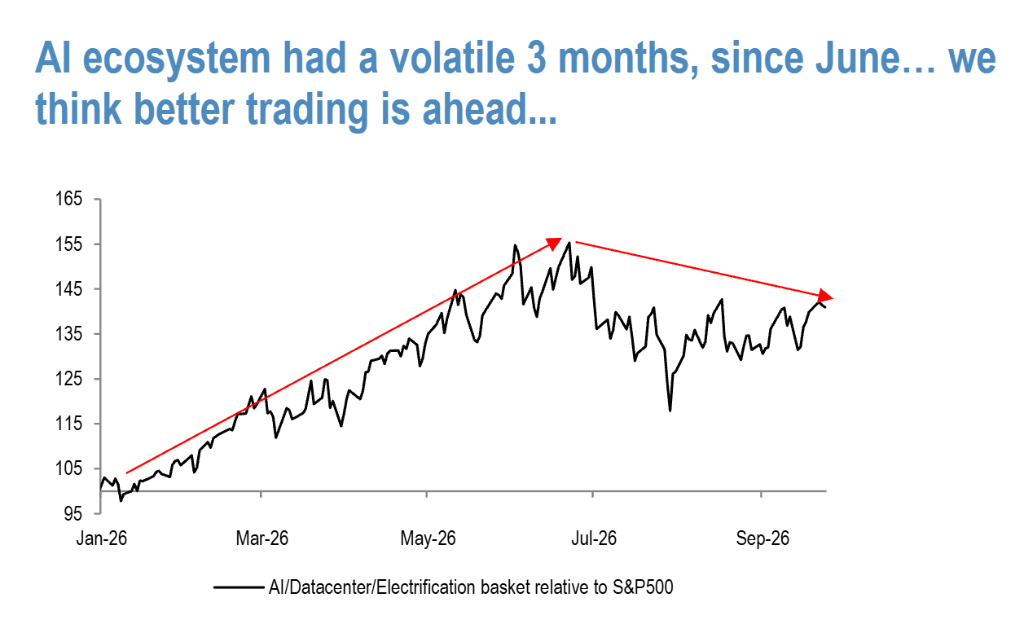
This judgment is borne out by the data: since June, when semiconductors' relative price against software peaked, the 12-month forward EPS for semiconductors has been revised up by 30%, while earnings expectations for software have hardly improved. JPMorgan believes this pronounced divergence between price and earnings constitutes a solid buying opportunity.
From an industry fundamentals perspective, the JPMorgan semiconductor research team emphasizes that supply-demand balance is unlikely to be achieved before 2028, and pricing is expected to keep rising until 2027. Recent quarterly comments from several companies further confirm accelerating demand: Broadcom management said inference demand is accelerating custom XPU adoption; Applied Materials issued much higher-than-expected guidance and described exceptionally strong visibility from its largest customer stretching eight quarters; Arm Holdings stated that its Cloud/AI royalty portfolio is doubling annually.
The capital expenditure outlook for Hyperscalers also supports this view. JPMorgan estimates total Hyperscaler capex will climb from $950 billion in 2026 to $1.4 trillion in 2027, and reach $3 trillion by 2030, posting a compound annual growth rate of about 28% from 2027 to 2030.
Within the semiconductor supply chain, JPMorgan specifically highlights the Semiconductor Production Equipment (SPE) sub-sector and names ASML as its core European target. Despite the market's bets on earnings downgrades resulting in a low PEG ratio for ASML, JPMorgan sees this as a buying opportunity and believes the company's fundamentals will ultimately prove resilient.
Software: Record-Low Valuations but Weak Fundamental Support
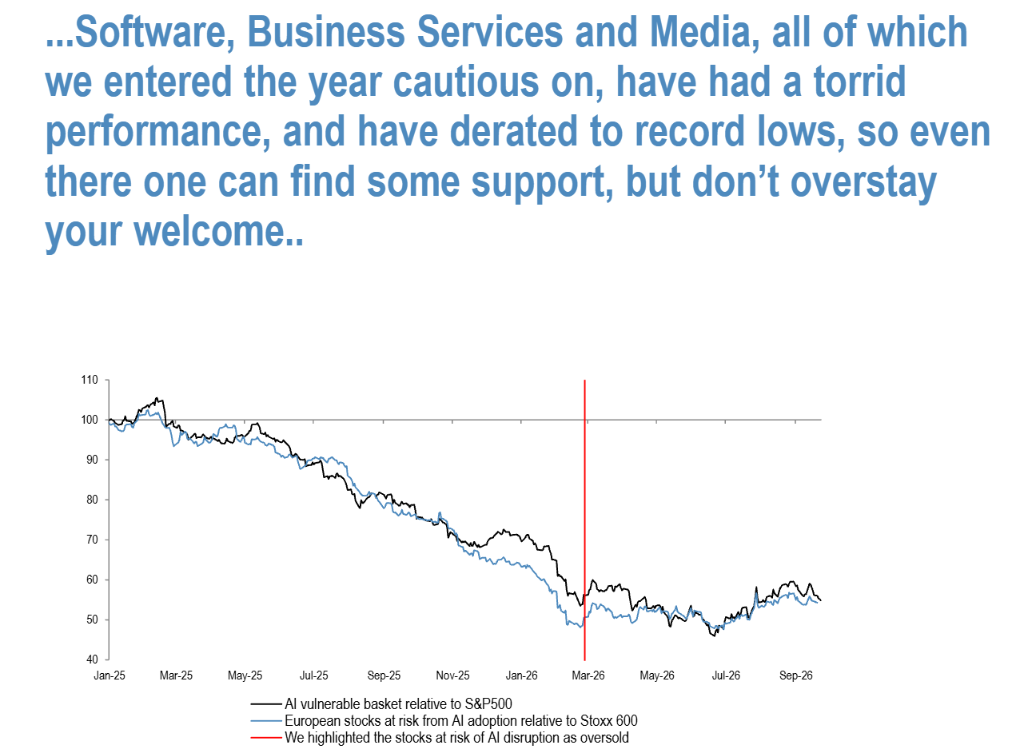
The software sector has consistently underperformed the broader market since mid-2023, with investors worried that the rise of AI could erode business and revenue models. At present, the US AI Vulnerable basket and European AI risk-exposed stocks have both reached near-historic low valuations.
In late June this year, comments from Anthropic CEO Dario Amodei about the need to "slow down the frontier of AI development" triggered a single-day rally in software stocks relative to semiconductors of 12.2%—one of the largest ever. JPMorgan remains skeptical, believing the AI race is fundamentally "a fight for survival, winner-takes-all", making a significant slowdown unlikely.
JPMorgan pointed out in March that, as the software sector had declined too much, there could be short-term bounce-back trading opportunities and advised against excessive short positions. However, the bank also stressed that the profitability of the software sector will continue to be questioned and that it may lag behind other parts of the AI ecosystem over the long term.
Cybersecurity is the exception within the software sector. JPMorgan notes that the security risks brought on by AI models are increasingly serious, driving a significant rebound in cybersecurity stock prices in recent months and making the AI security theme a sustainable one.
Market as a whole: Gains to Resume Once Oil and Rate Volatility Fades
JPMorgan believes that once oil price and interest rate volatility stabilizes, and the seasonal headwinds from September subside, the overall equity market is expected to resume its upward trend, with strong Q3 results serving as a key catalyst.
The current market faces two main disturbances: first, the US 10-year Treasury yield last week broke above 5% for the first time in nearly 20 years, driven by rising energy prices, strong PMI subindices, poor demand at the 5-year Treasury auction, and hawkish Fed commentary; second, oil prices rose due to escalating US-Iran tensions. Nevertheless, the S&P 500 and the Euro Stoxx 600 are down just 1-3% from their peaks, showing the market's strong ability to digest volatility.
JPMorgan points out that improvements in the tech sector benefit the broader market—as tech stocks account for as much as 39% of the US and 44% of the Emerging Markets indices—but outperformance by tech is not a necessary condition for overall market gains. During the momentum unwind in June-July, both KOSPI and SOX fell sharply, but the overall stock market remained steady and reached new highs in August, only coming under pressure again recently due to oil and rate volatility.
In terms of sector allocation, JPMorgan maintains an overweight position in semiconductors, an underweight in software and media, and is optimistic on Korea and emerging markets benefiting indirectly from improvements in the semiconductor sector.
Disclaimer: The content of this article solely reflects the author's opinion and does not represent the platform in any capacity. This article is not intended to serve as a reference for making investment decisions.
You may also like
Financial Services Roundup: Market Talk
Pump.fun Price Prediction: PUMP Gains 17% as Buying Activity Strengthens
Solana cools after a 22% rally: $124 now decides what comes next for SOL
XRP Faces 980% Liquidation Imbalance as Longs Take Hit in Market Selloff
Crypto prices
More


