
Iran May Briefly Open the Strait, Double Peak Interest Rate Hides Opportunity for Gold Price Reversal

FX168 Finance, September 22nd—— Progress in US-Iran negotiations triggers a short-term rebound in gold prices, while inflation and capital outflows limit gains; interest rate inflection point hints at bottoming opportunities
On Tuesday (September 22), during the Asian and European sessions, spot prices saw a dip and subsequent rebound, currently trading near $4,331.
According to Japan's Kyodo News,
Iran plans to use the opportunity of the United Nations General Assembly in New York to engage in formal negotiations with mediating countries, based on this proposal.
Previously, Secretary of Iran’s Supreme National Security Council Rezaei also made it clear that the resumption of US-Iran negotiations requires the US to meet seven conditions, including lifting the port blockade and unfreezing Iran’s overseas assets as core demands.
Stimulated by expectations of substantial easing in US-Iran tensions, market geopolitical risks have cooled and inflation concerns have briefly subsided, sending gold prices into a short-term rapid rebound.
Refined oil prices continue to reach new highs, reigniting inflation concerns and pressuring gold to retreat
But in essence, it is still oil prices driving inflation, prompting central bank tightening that suppresses gold. However, this time it is refined oil prices that keep hitting new highs instead of crude oil, indicating that end-use energy inflation remains extremely resilient, and overall market inflationary concerns have not faded.
This has also led to gold quickly giving back its short-term gains, as its trend weakens in tandem with energy-driven inflation logic.
At this stage, the core pricing logic for gold remains anchored to inflation expectations driven by oil prices. As long as high refined oil inflation persists, gold prices will continue to be suppressed by rate hike expectations.
Equities, U.S. Dollar, and U.S. Treasury bonds strengthen, ongoing capital outflows pressure gold
The asset-side sees a clear seesaw effect, further dragging on gold’s performance. Currently, U.S. stocks continue to refresh stage highs, with risk appetite rising; the U.S. dollar index remains strong, boosting its appeal as a store of value
At the same time, demand for U.S. Treasuries continues to improve, with stable and rising returns on fixed-income assets.
The strength in multiple high-yield assets is prompting persistent capital flows away from zero-yield gold, becoming a major factor weighing on gold prices recently.
Double-top formation in U.S. Treasury yields provides potential support for gold to form a bottom
Amid persistent negative factors, gold has shown marginally positive signals.
Recently, both nominal yields and TIPS (real yields) on U.S. Treasuries have formed daily chart double-top patterns, technically suggesting a high probability of peaking and subsequent decline.
A drop in real interest rates generally directly benefits gold valuations, which is expected to help gold form a short-term bottom and limit further downside, intensifying the ongoing bull-bear contest in the market.
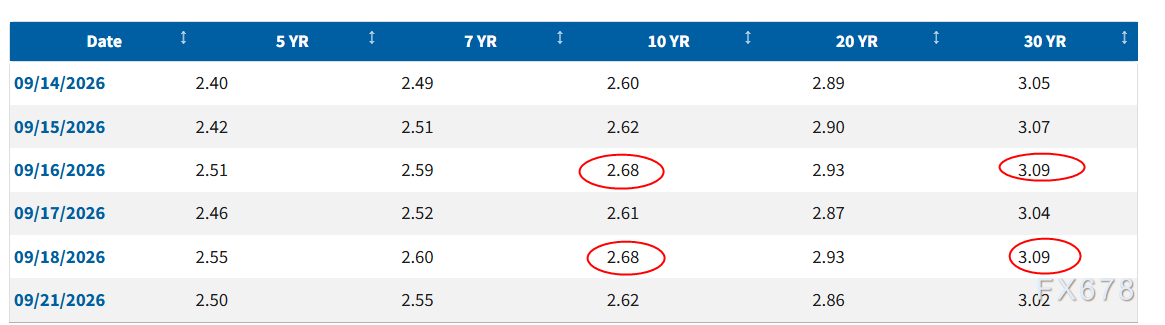
(Overview of TIPS yields, source: Federal Reserve)
Institutional view: Focus on Federal Reserve commentary and oil prices, short-term outlook for gold remains pressured
Chris Weston, Head of Research at Pepperstone, offers the latest market outlook: with few major U.S. economic data releases this week, the market’s core focus shifts to speeches by Federal Reserve officials and international oil price trends for clues as to whether policy tightening will resume in October.
He stresses that although oil prices have come off their highs slightly, any rebound in oil prices that boosts inflation expectations will again reinforce the case for the Federal Reserve to tighten monetary policy, keeping gold under pressure and the short-term market outlook weak overall.
Summary and mid- to long-term trading logic
In the short term, resilient inflation, rate hike expectations, and capital outflow are the three main bearish factors dominating the market, making it hard for gold to escape a pressured range-bound pattern. But in the mid to long term, a drop in real interest rates from high levels and inflation peaking at the margin will significantly compress the Fed's future rate hike space.
Going forward, the market can focus on two major themes: First, as the U.S. election nears, expectations for phased government easing policies may materialize;
Second, continued easing in the US-Iran situation could lead to lower oil prices, cooling inflation, and an improved market liquidity environment.
However, whether we will see as strong a surge as at the start of the year still depends on whether there is collective support from capital. Recently, demand for consumer gold purchases has cooled, and persistent ETF outflows during periods without clear bullish trends in gold are also reasons why gold is unlikely to see a violent rally.
Technical perspective: Gold has retained last Thursday’s large bullish candle and now shows signs of a counterattack, facing resistance near the lower boundary of the box at around $4,400.
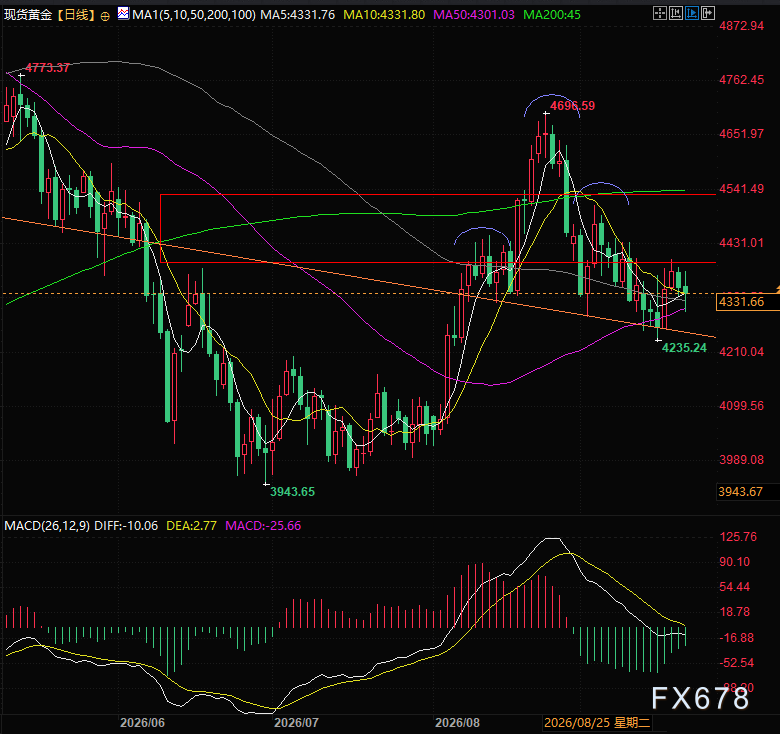
(Spot gold daily chart, source: FX168 Finance)
At 17:02 Beijing time, spot gold was last quoted at $4,323/ounce.
Disclaimer: The content of this article solely reflects the author's opinion and does not represent the platform in any capacity. This article is not intended to serve as a reference for making investment decisions.
You may also like
Equity Futures Largely Steady Pre-Bell; Oil Falls Amid Growing Optimism for Middle East Resolution
Valuation drops to a ten-year low! Jensen Huang calls Nvidia the "world's first growth-value stock", but investors don't seem convinced
Nvidia's price-to-earnings ratio has dropped below 17 times, which is only about half of its projected 2025 level. Although revenue and net profit for fiscal year 2027 are expected to grow by 90% and 99% respectively, the company's stock has risen only about 20% this year, significantly lagging behind the Philadelphia Semiconductor Index. Meanwhile, gross margin is expected to decline from 75% in the second quarter to below 72% in the fourth quarter. Rising memory costs and continued pressure from customers developing their own chips, as well as uncertainty over future AI capital expenditures, have become key factors for the market to reassess Nvidia's valuation.
Bitcoin Hashrate Stalls at 934 EH/s — Miners Are Leaving for AI
XRP price prediction splits traders as $27 black swan target ignites debate

Crypto prices
More


