
154.06! Yen rises to highest since February, surpassing the peak of Japan-US joint intervention

The yen-to-dollar exchange rate has risen to its highest level since February this year, strongly breaking through the previous peak set by joint intervention between Japan and the U.S. Expectations of a Bank of Japan rate hike are heating up, and the confluence of multiple technical factors is driving this rally to exceed the results of prior policy interventions.
During London trading hours on Monday, the yen once surged 1.4% to 154.06, with prices rallying sharply intraday. In the Asia-Pacific session on Tuesday, the yen appreciated further, breaking through the 154 mark.
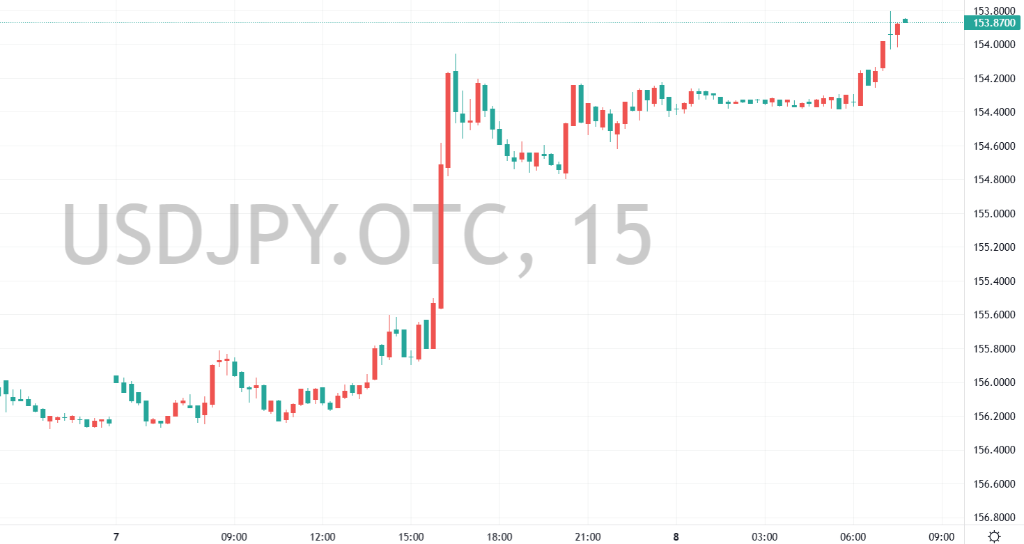 (15-minute chart of USD/JPY, inverted axis)
Traders generally believe that reduced liquidity caused by a U.S. public holiday exacerbated price volatility. Meanwhile, USD/JPY broke through the critical support at 155, triggering a cascade of stop-loss orders and forcing options market makers to sell dollars, further accelerating the yen’s rally.
The yen had already risen by 2.4% last week, and the current rally has sharply increased market focus on the Bank of Japan's policy meeting scheduled for September 18.
Technical Breakout: Loss of 155 Level Triggers Chain Reaction
The loss of the 155 level holds important technical significance for the market.
Masahiko Loo, Senior Fixed Income Strategist at State Street Asset Management, stated:
The yen falling below 155 is significant, as this level previously served as a support bottom after past interventions.
According to a trader familiar with the matter quoted by Bloomberg, after a large number of stop-loss orders were triggered below 155, options market makers were forced to follow suit and sell dollars, further amplifying the yen's upward move.
Motonari Sakai, Chief Manager of FX and Financial Products Trading at Mitsubishi UFJ Trust Bank, pointed out:
Because the market tends to be highly volatile when New York is closed, it is necessary to be highly vigilant about any downward pressure.
Sakai also gave technical targets:
The key target below for USD/JPY is near the February low of 154 yen. If this level is breached, there is no clear support until the 152 yen area.
Rate Hike Expectations and Asset Reallocation
The fundamentals driving this yen rebound are strengthening.
Last week, comments by Bank of Japan board member Hajime Takata significantly reinforced expectations that the central bank could take more aggressive rate hike moves. He made it clear that future rate increases will not be rigidly capped at 25 basis points, and that in normal circumstances, the central bank could well adopt a strategy of “consecutive rate hikes.”
At the same time, speculation about the Government Pension Investment Fund (GPIF) possibly adjusting its asset allocation has also provided additional support for the yen. Fixed income strategist Masahiko Loo also pointed out that early in the month there is usually active portfolio rebalancing by real money, and this seasonal factor is also helping the yen.
Macro strategist Skylar Montgomery Koning noted in a Bloomberg article:
The conditions for a rapid yen rally are building. The decline in oil prices on the day improved Japan’s terms of trade and boosted the yen. Against a backdrop of increasingly favorable domestic fundamentals, the dollar-yen rate consequently broke below 155.
The Yen Rally Is More Sustainable
Unlike previous intervention-driven surges, many in the market believe this yen strength is more endogenous and has more potential for sustainability.
Russell Investments Global Head of Fixed Income and Currency Solutions Van Luu commented:
This feels like the start of a bigger move. The effect of the first intervention has faded, and if market observers are correct, this second wave appears to be driven by more factors, making this move more significant.
BNY Senior Strategist Geoff Yu pointed out that the 160 level has now established “a certain degree of deterrence,” suggesting the market’s tolerance for an overly weak yen is now more clearly defined.
Signals from the options market confirm this view. Last Friday, implied volatility on yen options rose to the highest level since January this year, and the premium on options betting on further yen appreciation nearly reached cycle highs, showing that traders are actively positioning for continued yen strength.
Disclaimer: The content of this article solely reflects the author's opinion and does not represent the platform in any capacity. This article is not intended to serve as a reference for making investment decisions.
You may also like
Euro holds gains above 1.1600 on ECB tightening prospects
Deutsche Bank Issues Warning: Accumulating Inflation and Interest Rate Risks, Increasing Market Dislocation May Impact Stocks and Credit Assets
Deutsche Bank has warned that financial markets are facing increasingly severe dislocation—a situation where inflationary pressures are mounting, yet markets are expecting only limited policy tightening from major central banks. This leaves equities and credit assets vulnerable to potential repricing.

Intel increases CPU prices by another 10% and plans to phase out low-margin products
Intel plans to raise prices for its PC CPUs by about 10% in October, marking the third round of price increases since the end of 2025. Meanwhile, CEO Chen Liwu is reviewing low-margin product lines, with some products possibly facing discontinuation and market withdrawal. The main segments affected are industrial computers, IoT, and the embedded market. The core logic behind this round of adjustments by Intel is to prioritize gross profit margin, moving away from the previous strategy of boosting volume through lower prices.
Stellar price rises 4.6% as network activity and trading volume surge
Crypto prices
More


