
Approval rating falls below 40%! When will the market start trading on Trump's midterm election defeat?

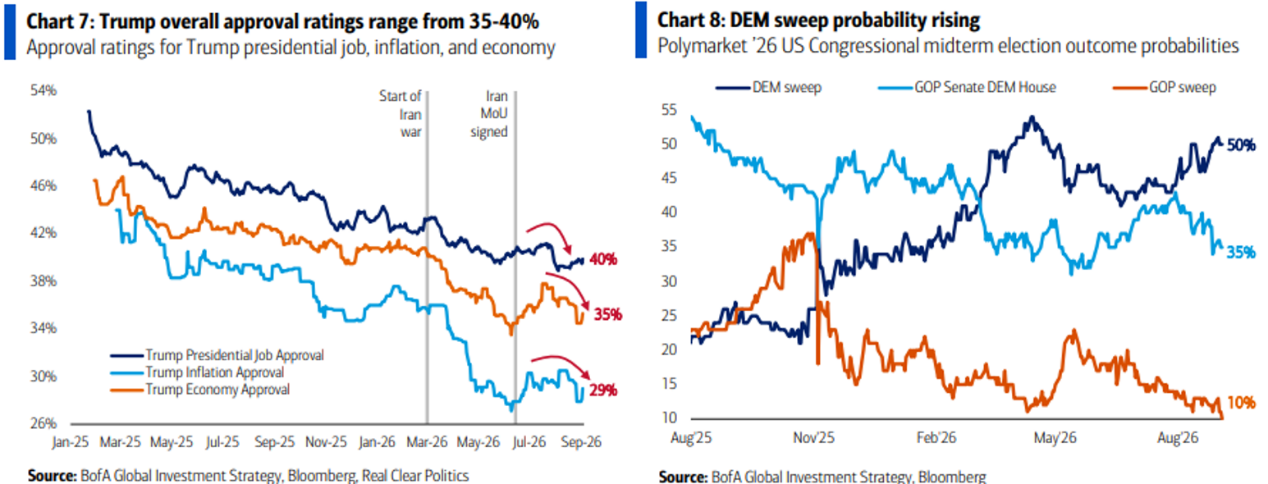
There are now less than two months left until the US midterm elections on November 3, with both parties entering a crucial sprint phase. Multiple polls currently show that Trump’s approval rating has dropped below 40%, nearing a new low during his term; prediction market data shows that the probability of the Democratic Party winning control of the House is about 85%, while the Senate is close to a toss-up. The outlook is clearly unfavorable for the Republican Party.
So far, the overall landscape of the US midterm elections has basically become clear, with the baseline scenario pointing to a divided Congress: the Democratic Party takes back the House, while the Republican Party holds on to the Senate; however, there is also a tail risk of the Democratic Party sweeping both chambers.
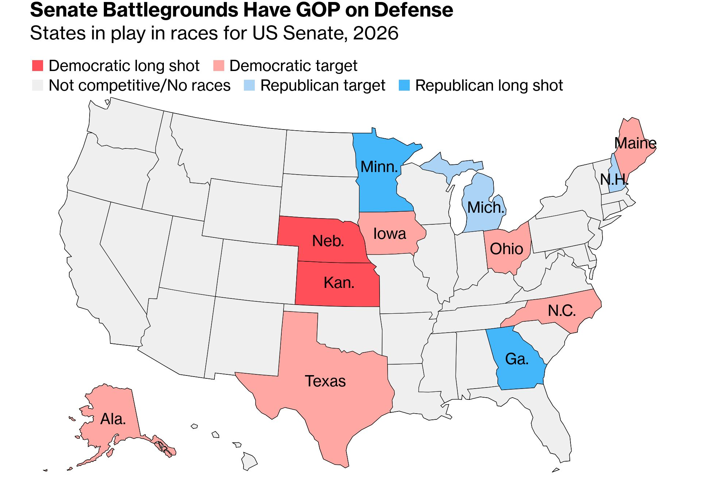
This year’s midterm elections will see the replacement of 435 House seats, 35 Senate seats, and 36 governorships. Currently, the Republican Party has only a 3-seat advantage in the House, one of the narrowest majorities in decades. In the Senate, although Republicans currently control a 53 to 47 advantage, control is highly dependent on the results in key swing states such as Alaska, Iowa, Maine, North Carolina, Ohio, and Texas, making the outlook far from optimistic.
It is worth noting that while the market has largely priced in the likelihood of the Republican Party losing the House, the chain reaction of decreased legislative capacity, restricted fiscal expansion, and rising policy uncertainty has not yet been fully priced in. As the midterm elections draw closer, Trump is also expected to resort to more aggressive measures to recover lost ground. Therefore, the key in the next two months is not simply betting on the election results, but watching when political variables are reflected in asset pricing through oil prices, inflation, and fiscal expectations.
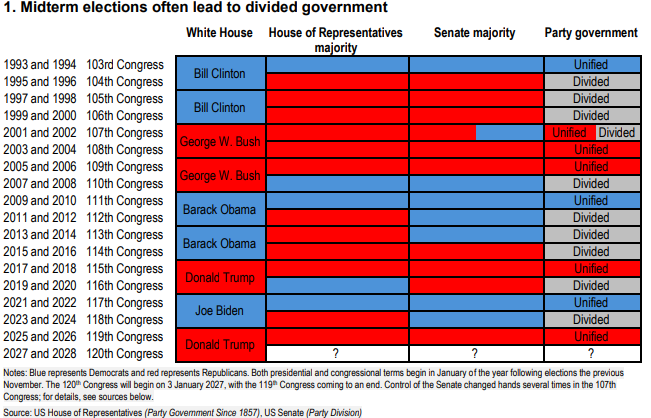
A divided Congress will shift Trump’s policy from legislative expansion to stronger executive action
Under a divided Congress, the biggest change in Trump’s latter term would be a significant weakening of legislative capacity.
Disclaimer: The content of this article solely reflects the author's opinion and does not represent the platform in any capacity. This article is not intended to serve as a reference for making investment decisions.
You may also like
The yield on the 10-year US Treasury is approaching the 5.5% red line! Societe Generale warns: Stock valuation support is failing, US stocks may face a severe shock.
Société Générale pointed out that this year’s global profit expectations have been significantly raised. Even with rising yields, this has prevented equity risk premiums from plunging.

Canadian Dollar: Trade tensions and US CPI in focus – TD Securities
Bitget to list PONS spot trading
Humble Group names Henrik Arfwidsson chief of staff to strengthen group management
Crypto prices
More


