
U.S. Treasury yields continue to rise, gold comes under pressure and adjusts, returning to range-bound fluctuation

FX168 News, September 2—— Escalation of tensions in the Middle East has pushed up oil prices and reignited inflation fears, raising expectations of further tightening by the Federal Reserve. As a result, the US dollar and US Treasury yields have both strengthened, putting pressure on spot gold and causing it to fall back to near $4,300, hitting a four-week low. In the short term, the market focus shifts to US non-farm payroll data, and whether gold can hold above $4,276 will be key to determining whether the next phase of the decline will continue.
Spot gold remained weak during Wednesday's Asian session, touching a near four-week low before a slight rebound. It is currently hovering above $4,300, with an intraday decline still exceeding 0.5%. Under multiple pressures—including a stronger US dollar, rising US Treasury yields, and renewed hawkishness in Federal Reserve policy expectations—gold's recent upward momentum has clearly weakened. Market risk sentiment has also shifted from previous safe-haven buying to revaluing interest rates and real yields.
This round of gold correction was first influenced by rising energy prices. Persistent tensions in the Middle East have pushed crude oil prices to new highs since July 24, bringing energy supply risks back into market pricing. Higher oil prices indicate that future inflation may once again face upward pressure. If energy costs are transmitted to broader goods prices through transportation, production, and consumption channels, major central banks' room for rate cuts will be further limited.
For gold, this change has created a notable double-edged effect. On one hand, an escalation in geopolitical risks usually sparks safe-haven flows into gold; on the other hand, if geopolitical risks mainly manifest as higher oil prices and rising inflation expectations, then higher interest rate expectations and real yields may offset gold’s safe-haven advantage. The market has clearly focused more on the latter recently, which is a key reason why gold prices have continued to fall despite ongoing risk events.
A stronger US dollar has further amplified gold’s downward pressure. Since gold is priced in dollars, a rising dollar typically increases the holding cost for non-dollar investors and reflects market expectations for sustained high US interest rates. Recently, hawkish remarks by Federal Reserve Chair Kevin Walsh at the Jackson Hole meeting have continued to have an impact, with expectations for further policy tightening in September rising notably.
Changes in market rate pricing are especially noteworthy. According to current market estimates, expectations for a rate hike by the Federal Reserve in September are now clearly higher than before. If upcoming US employment data remain resilient and energy prices continue to push up inflation expectations, the chances of the Fed adopting a more hawkish stance may further increase, providing new support for the dollar and Treasury yields and keeping gold under pressure.
Meanwhile, the US long-term Treasury market has also become a major drag on gold. Amid fiscal risk concerns and a global bond sell-off, the US 10-year Treasury yield has climbed to its highest level since January 2025. Rising yields mean higher opportunity costs for holding non-interest-bearing assets like gold, causing some funds to be reallocated to dollar-denominated fixed income assets.
The Societe Generale strategy team believes the recent sell-off in the US bond market may continue to drive long-end yields higher and warns of the risk that the US 10-year yield moves closer to 5%. If this scenario gradually becomes market consensus, the short-term pressure on gold will further increase. Especially if real interest rates rise in tandem, gold will need much stronger safe-haven inflows to offset the negative impact of rates.
However, gold prices are not without fundamental support at present. The Middle East situation still carries considerable uncertainty; energy transport security and global supply chain risks could once again attract safe-haven capital back into precious metals. If the situation escalates beyond expectations, gold may regain safe-haven buying and experience a technical rebound after a rapid decline.
In addition, US fiscal risks also have a two-way impact. Although fiscal concerns have pushed up US Treasury yields and are short-term negative for gold, if the market starts to worry about the long-term sustainability of US debt and further weakens confidence in US assets, the long-term allocation value of gold may once again be highlighted. Therefore, gold is currently caught in a tug-of-war between "high rate suppression" and "fiscal and geopolitical safe-haven demand."
The most important upcoming catalyst remains US non-farm payroll data. Employment data not only affects the market’s view of US economic resilience but will also directly impact the Federal Reserve’s future policy path. If the non-farm payroll figure beats expectations, the market may further raise rate hike bets, and a rising dollar and Treasury yields will create new pressure on gold; if employment data clearly cools, the market may reposition for a policy pivot and gold could find room to rebound.
In terms of market sentiment, gold is currently in clear caution mode. The safe-haven sentiment that previously drove gold higher still exists, but funds are now focusing more on the changes in rates and yields. Therefore, every short-term rebound in gold is likely to face profit-taking and short-selling pressure. Only when the dollar and Treasury yields fall simultaneously, or when geopolitical risk expands to affect global financial market stability, can gold possibly regain strong bullish momentum.
From a daily chart structure perspective, spot gold has recently weakened, with prices falling back to near $4,300 and gradually approaching a key medium- to long-term support area. Technical indicators show that the MACD is below the zero axis and remains significantly negative, with the RSI around 44—indicating bullish momentum continues to weaken, but not yet in an extremely oversold zone. This means gold still has room for further adjustment. The current key technical level is the 200-day exponential moving average at $4,280. If gold can hold this area, there is still a chance to repair the previous medium-term upward structure; if $4,280 is decisively broken, the next support will focus on the 61.8% Fibonacci retracement level near $4,230, with further support at the 78.6% retracement level near $4,120, and even lower at the previous low region around $3,952. On the upside, watch for resistance at $4,350 first, then at $4,400, and stronger resistance near $4,520.
On the 4-hour time frame, gold remains in a short-term downward consolidation pattern. After consecutive declines, there has been some degree of technical rebound, but no clear trend reversal signals have emerged. $4,300 is an important psychological level—if the price can regain $4,350, there is potential to further test $4,400 in the short term. However, if the rebound remains capped and $4,300 is broken again, the market may test $4,280 anew. If $4,280 is effectively broken, bearish momentum could strengthen further, driving gold towards $4,230 or even the $4,111 area. Current short-term technicals overall remain weak, so until key support is confirmed, chasing the downside still requires caution against rapid rebounds.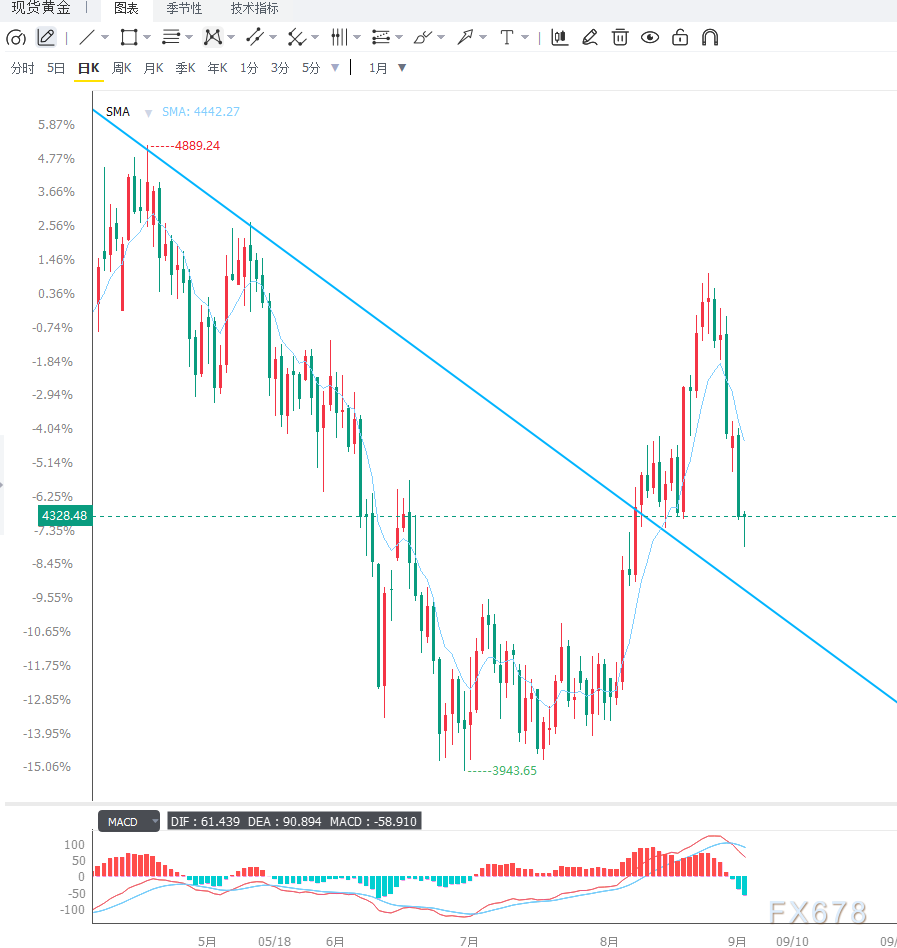
The main contradiction for spot gold has shifted from pure geopolitical safe-haven demand to a game between safe-haven needs and interest rate pressure. Escalation in the Middle East and rising oil prices are providing safe-haven support for gold, but intensifying inflation concerns, rising expectations for a Fed rate hike, and higher US Treasury yields are becoming stronger suppressive forces. In the short term, $4,280 is the key level to determine whether gold opens up further downside; if this area is breached, $4,230 and $4,111 will become the next important targets. Conversely, if US employment data weakens and pushes the US dollar and Treasury yields lower, gold could still quickly recover its losses. In the near term, focus should be on non-farm payrolls, US inflation data, Treasury yields, and changes in the Middle East situation, and be alert for sharp volatility in gold prices caused by rapid shifts in macro expectations.
Disclaimer: The content of this article solely reflects the author's opinion and does not represent the platform in any capacity. This article is not intended to serve as a reference for making investment decisions.
You may also like
Federal Reserve "third-in-command": Tariff impact gradually fading, inflation continues to show a downward trend
Williams stated that there is evidence showing inflation continues to cool as the impact of tariffs gradually fades, and the rise in energy prices has not spread to other service sectors.

Cryptocurrency investment losses hit 99% as Internet Computer collapses
XRP Ledger liquidity trends show RLUSD surging 642% as retail traders retreat
Stripe’s acquisition strategy builds a $10 billion stablecoin and AI empire
Crypto prices
More


