
Crypto market breakout could accelerate as AI trade cools, analyst says

Bitcoin and the broader cryptocurrency market looked poised for a recovery on Tuesday as progress on landmark US crypto legislation boosted sentiment, with analysts also pointing to a slowdown in the AI trade as a potential catalyst for capital rotating back into digital assets.
Bitcoin (BTC) briefly climbed above $67,000 and Ether (ETH) neared $1,950, while crypto-related stocks rallied sharply. Coinbase shares rose 12%, American Bitcoin gained 14% and Cipher Digital jumped 17%.
The gains came after US Treasury Secretary Scott Bessent lawmakers were at the “1-yard line” on the long-debated CLARITY Act, which would define the regulatory roles of the Securities and Exchange Commission and Commodity Futures Trading Commission over digital assets.

Coinbase (COIN) was among the market’s top-performing stocks on Tuesday. Source:
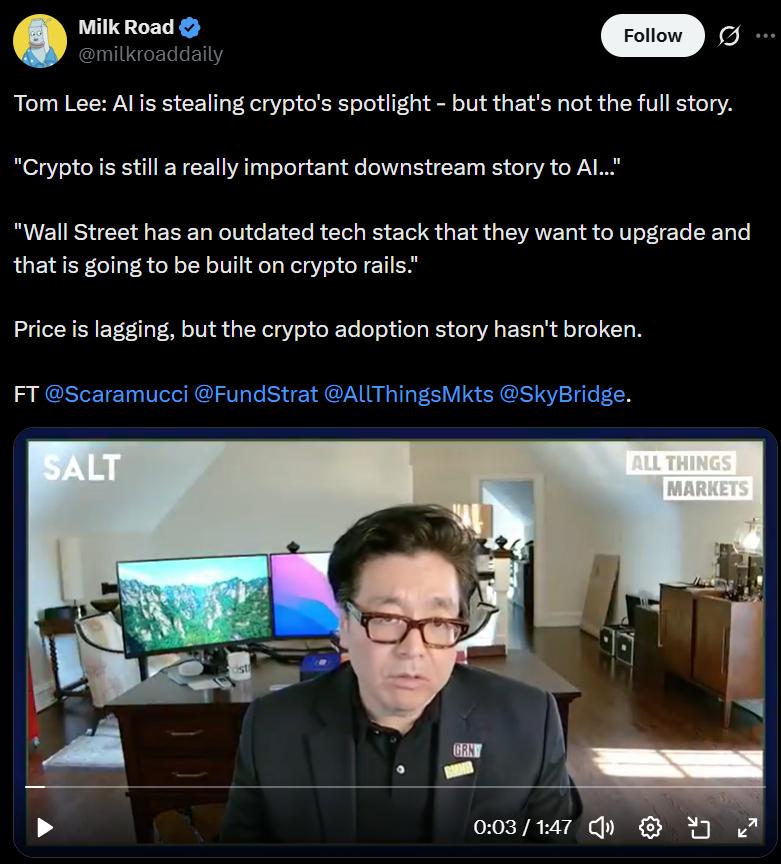
Beyond the regulatory tailwinds, some analysts said crypto could also benefit from investors shifting capital away from AI-linked equities.
“With Bitcoin at the top end of the range, we see the path of least resistance being higher and an elevated likelihood of a breakout of the range as the AI trade slows and the market becomes more comfortable with the path of interest rates,” FRNT Financial CEO Stephane Ouellette told Bloomberg.
Related:
AI trade loses momentum as chipmakers fall
AI-related stocks have dominated speculative markets over the past year, with the Philadelphia Semiconductor Index (SOX) — a widely watched benchmark for chipmakers powering the AI boom — surging roughly 110%.
However, the rally has begun to lose momentum. Last week, the SOX index entered a technical bear market after falling more than 20% from its recent high, as investors grew increasingly concerned about lofty valuations and the risk of overcapacity in AI infrastructure spending.
This follows an extended period in which AI largely overshadowed digital assets. Since the launch of ChatGPT in late 2022, a wave of innovation, venture capital investment and retail enthusiasm has shifted much of the market’s speculative appetite toward AI.
Source:
Related:
Disclaimer: The content of this article solely reflects the author's opinion and does not represent the platform in any capacity. This article is not intended to serve as a reference for making investment decisions.
You may also like
Once frenzied buying, now the "ammunition warehouse" shrinks by 51 trillion KRW! Korean retail investors can no longer afford to buy
In four months, Korean retail investors' "ammunition stockpile" has dropped by 36.5%, returning to levels seen at the beginning of the year. Although retail investors have collectively made net purchases exceeding 75 trillion won, they are still absorbing the sell-off, but the influx of new funds has dried up, and the replenishment rate lags far behind the consumption rate. Combined with the KOSPI plunging nearly 20% this month, continued net selling by foreign investors, and concerns over AI-related credit risks, the Korean stock market may find it difficult to see a sustained rebound in the short term without support from private investors' funds.
Apple Prints TD Sequential Sell 9 — Last Two Led to 15.66% and 13.63% Corrections

The Collapse of "Consensus Trading" and the Birth of a New Consensus! Goldman Sachs Explains: Why Institutions Are Currently Significantly Reducing AI Holdings
The extremely crowded trade of "going long on AI, short on everything else" is undergoing a painful unwinding—markets are no longer satisfied with the "burn rate narrative." Mega-scale cloud providers must deliver real, visible revenue conversions alongside $1.1 trillion in capital expenditures. A power gap of 40-50 gigawatts, rising capital costs, and a macro paradigm shift from an era of "overspending" are turning AI trades from a matter of faith into a harsh test of monetization.

Starknet TVL crashes 3.7x to $42M after getting 93% vote to become L1
Crypto prices
More


