
Bitget App
Trade smarter
Buy cryptoMarketsTradeFuturesEarnAISquareMore
Near Protocol (NEAR) Adds 100% in Futures Flows as Volatility Dynamic May Flip Again

Near Protocol (NEAR) Adds 100% in Futures Flows as Volatility Dynamic May Flip Again

CryptoNewsNetCryptoNewsNet2026/07/19 11:48
By:CryptoNewsNet
Back to the list

Near Protocol (NEAR) Adds 100% in Futures Flows as Volatility Dynamic May Flip Again

Near Protocol (NEAR) Adds 100% in Futures Flows as Volatility Dynamic May Flip Again image 0  u.today 21 m
Near Protocol (NEAR) Adds 100% in Futures Flows as Volatility Dynamic May Flip Again image 1

Following a more than 100% increase in derivatives market flows, Near Protocol ($NEAR) is exhibiting renewed activity, indicating that traders are once again preparing for a bigger move. Fresh capital entering futures markets may indicate that volatility is about to return, even though $NEAR has spent the last few weeks consolidating following its explosive rally in May and June.

Liquidity is growing

Recent futures flow data shows that $NEAR saw a net inflow of about $1.7 million during the four-hour period, which is a 242% increase. With net inflows of $1.78 million and growth of more than 200%, the eight-hour period also remained steadily positive. When traders start opening new positions ahead of expected market movement, such spikes usually signify increased speculative interest.
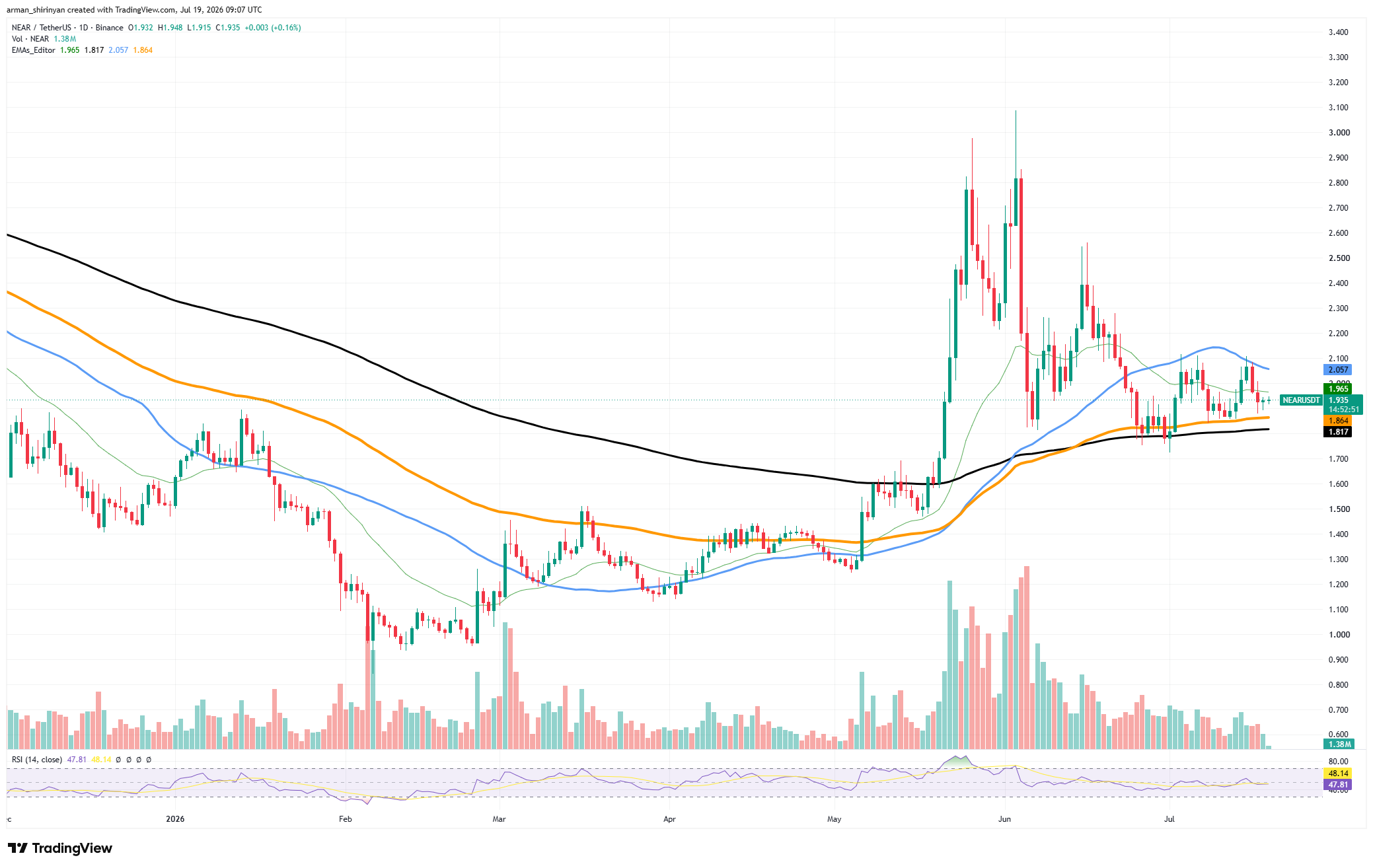
Near Protocol (NEAR) Adds 100% in Futures Flows as Volatility Dynamic May Flip Again image 2 $NEAR/USDT Chart by TradingView

When combined with growing open interest across major exchanges, the derivatives picture becomes even more intriguing. Despite a recent slowdown in spot market volume, open interest remains high, and Binance, Bybit, and MEXC continue to dominate $NEAR trading activity. When traders prepare for a directional breakout during accumulation phases, this divergence frequently appears.

Near might be stuck

Technically speaking, $NEAR is still stuck between important moving averages and is currently trading at about $1.93. After failing to maintain a move above the $2.00-$2.10 range, where the 50-day moving average continues to serve as resistance, the asset recently lost momentum. Bulls, however, continue to have a significant advantage because the price is still above the 100-day and 200-day trend indicators in the $1.80-$1.85 range.

The chart also shows that, in contrast to the extreme fluctuations observed in May and June, volatility has considerably decreased. Sharp directional movements have historically followed such contraction periods. This indecision is reflected in the Relative Strength Index near 48, which is essentially in neutral territory and allows for either bullish or bearish expansion.

Regaining $2.05 would probably give bulls fresh momentum and possibly pave the way for the $2.30-$2.50 range. On the downside, losing support at $1.80 would render the existing recovery structure invalid and put $NEAR at greater risk of a retracement.

$NEAR appears to be entering a phase where the next volatility expansion could happen sooner rather than later, as futures flows have accelerated by more than 100% while the price remains compressed. Traders are already positioning themselves for it.

0
0

Disclaimer: The content of this article solely reflects the author's opinion and does not represent the platform in any capacity. This article is not intended to serve as a reference for making investment decisions.

Understand the market, then trade.
Bitget offers one-stop trading for cryptocurrencies, stocks, and gold.
Trade now!

You may also like

Is a new wave of sell-offs approaching? The ultimate rival of the AI bull market emerges—The "global anchor of asset pricing" breaks through the 5% super threshold

After the 10-year US Treasury yield breaks back above the critical 5% mark, it is more likely to usher in a period of high-level tug-of-war and accelerated asset differentiation. Especially before energy shocks and the significantly eased large-scale expansion of the US fiscal deficit, the conditions to quickly replicate the sharp yield decline seen at the end of 2023 are not yet fully in place.

智通财经2026/09/15 03:26
Is a new wave of sell-offs approaching? The ultimate rival of the AI bull market emerges—The "global anchor of asset pricing" breaks through the 5% super threshold

Anthropic releases another article: What will the economy look like in the AI era?

Anthropic's economics team has released an AI economic scenario model, centered around three scenarios: moderate and gradual growth, transformative changes with GDP doubling, and an extreme situation with 15% annual growth but massive job losses among knowledge workers. The model treats work as "bundles of tasks" and analyzes AI’s enhancement and substitution effects on different types of tasks. Anthropic emphasizes that the economic outlook for 2030 is not predetermined; the key lies in how the dividends from AI are widely shared.

华尔街见闻2026/09/15 03:26

"New Federal Reserve News Agency": Waller's Rate Hike "Has No Way Back", Trump's "Trust" Faces Test

Nick Timiraos believes that after the higher-than-expected August CPI, the probability of the Federal Reserve raising interest rates this week has surged, while Waller’s hawkish stance on inflation has left himself almost "no leeway." With seven weeks before the election, whether or not Waller raises rates will directly test how long Trump's “trust” in him can last. Previously, Waller maintained a balance between the White House and the Federal Reserve by “talking less and avoiding provocation,” but after this meeting, silence will no longer serve as his shield.

华尔街见闻2026/09/15 03:26

Trump Opposes AI "Guardrails": Congress Pushes Legislation for Restrictions, Deepening Bipartisan Divide

U.S. President Trump opposes setting guardrails for artificial intelligence (AI), putting him at odds with a growing number of bipartisan lawmakers. As the midterm elections approach, voters' concerns about AI safety have intensified their doubts about this technology.

智通财经2026/09/15 02:46
Trump Opposes AI "Guardrails": Congress Pushes Legislation for Restrictions, Deepening Bipartisan Divide