Bitget App
Trade smarter
Buy cryptoMarketsTradeFuturesStocksEarnInstitutionAI & More
Bitcoin bottom countdown nears 50 days after BTC supply in loss passed 50%

Bitcoin bottom countdown nears 50 days after BTC supply in loss passed 50%

CryptoNewsNetCryptoNewsNet2026/07/17 10:57
By:CryptoNewsNet
Back to the list

Bitcoin bottom countdown nears 50 days after BTC supply in loss passed 50%

Bitcoin bottom countdown nears 50 days after BTC supply in loss passed 50% image 0  cointelegraph.com 34 m
Bitcoin bottom countdown nears 50 days after BTC supply in loss passed 50% image 1

Bitcoin ($BTC) has been counting down to its next bottom for nearly two months, a classic onchain metric suggests.

Key points:

  • $BTC supply in loss passed 50% for the first time this bear market in early June.
  • In previous bear markets, that event sparked a countdown to a new $BTC price macro bottom.
  • Separate data hints that the bull market’s “emotional premium” has now gone.

Supply in loss countdown already Bitcoin’s second-longest

In its H1 2026 Round-Up report, crypto research company K33 Research flagged more than 50% of the $BTC supply now being held at a loss.

A typical bear-market feature, supply in loss has become a yardstick for progress toward macro bottoms for $BTC/USD.

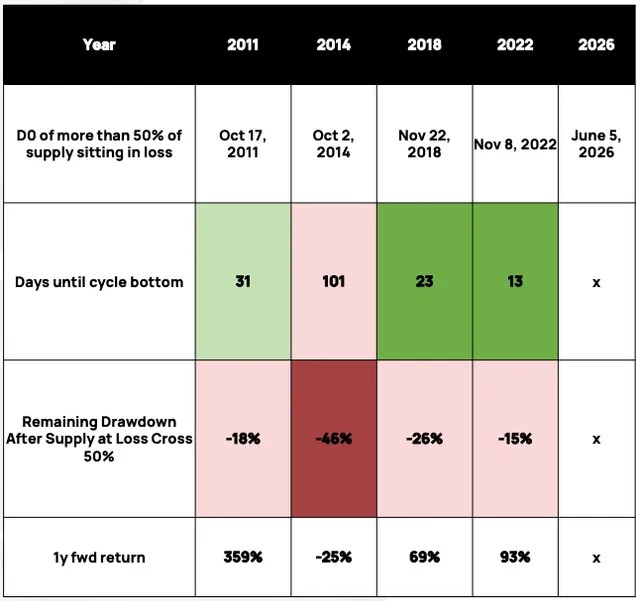
K33 data shows that once supply in loss passes the 50% mark, the bottom has come no more than 101 days later. Bear markets have provided various time frames, with the shortest bottom “window” lasting just 13 days in 2022.

The 2018 bear market required 23 days to reach its floor, while in 2014, Bitcoin continued to decline for 101 days after the 50% supply-in-loss mark was hit.

In 2026, supply in loss repeated standard bear-market behavior, crossing 50% on June 5. Since then, 42 days have elapsed, making this year’s bottom window Bitcoin’s second-longest ever.
Bitcoin bottom countdown nears 50 days after BTC supply in loss passed 50% image 2

$BTC supply in loss and days until bear-market bottom (screenshot). Source: K33 Research


In accompanying commentary, K33 observed that returns over the year following the phenomenon “tend to be very solid.”

Earlier this month, Axel Adler Jr., a contributor to onchain analytics platform CryptoQuant, estimated that supply in loss was around two months away from levels that correspond to bear-market bottoms.

CryptoQuant data puts supply in loss at 46% as of July 17.

“Distribution of capital” teases silver lining

Continuing, CryptoQuant eyed what it described as “rare” readings from Bitcoin investor cost-basis models.

Related: Bitcoin $107K buyers providing ‘early signals’ of 2026 bear-market bottom: Glassnode

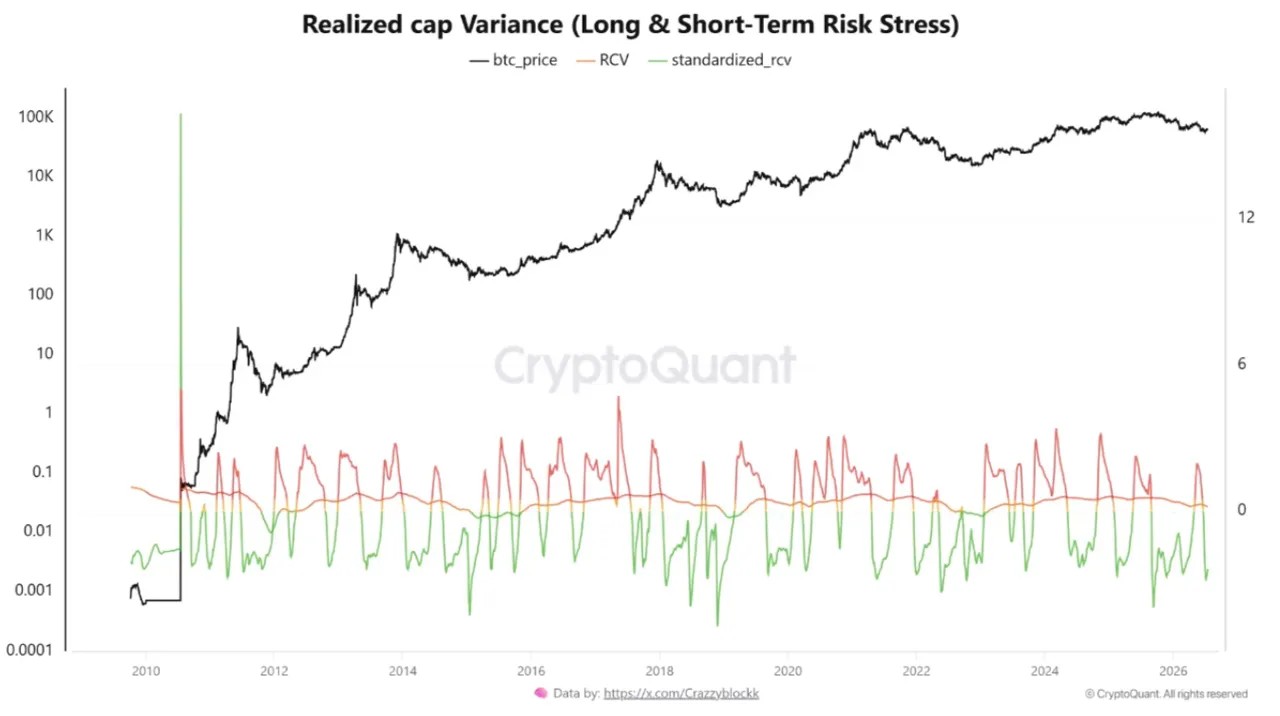
The realized cap variance (RCV) model, which measures the difference between realized cap and market cap, currently sits in the bottom six percent of its historical range.

“Instead of tracking price alone, it isolates the variance between realized cap and market cap relative to its own rolling history, capturing how stretched or compressed investor cost basis has become versus current valuation,” contributor Crazzyblockk explained in a QuickTake blog post on Thursday.

“When that variance compresses into deeply negative z-score territory, the emotional premium built during rallies has largely been priced out. The metric doesn’t read narrative, it reads the distribution of capital.”
Bitcoin bottom countdown nears 50 days after BTC supply in loss passed 50% image 3

Bitcoin RCV data (screenshot). Source: CryptoQuant


At -2.35, standardized RCV’s Z-score is once again pointing to the final stages of the Bitcoin bear market.

“Every prior stretch where the model spent extended time below a -2.0 z-score, late 2018, mid-2022, early 2015, preceded forward twelve-month returns north of 75%,” the post noted.

“The most extreme reading in this dataset, -4.68 in November 2018, landed almost exactly on Bitcoin’s cycle bottom near $3,792.”

0
0

Disclaimer: The content of this article solely reflects the author's opinion and does not represent the platform in any capacity. This article is not intended to serve as a reference for making investment decisions.

Understand the market, then trade.
Bitget offers one-stop trading for cryptocurrencies, stocks, and gold.
Trade now!

You may also like

Google (GOOGL.US) achieves major breakthrough in quantum computing! Key error rates reduced by about 40 times, moving closer to practical application

Google, a subsidiary of Alphabet, announced that it has demonstrated a new technology which reduces the error rate of a key aspect of quantum computing by about 40 times. This marks progress toward building powerful and reliable machines capable of solving problems beyond the reach of traditional computers.

智通财经•2026/10/19 00:57
Google (GOOGL.US) achieves major breakthrough in quantum computing! Key error rates reduced by about 40 times, moving closer to practical application

Firmus's IPO dream shattered, triggering a chain reaction! British AI data center developer Nscale's $30 billion valuation under pressure as investors "slash price" to $16 billion

Recently, a group of investors has urged Nscale to consider a valuation range of $16 billion to $19 billion, believing that this range is more likely to attract buyers. One important factor is the failure of the IPO plan of Australian AI data center company Firmus.

智通财经•2026/10/19 00:47
Firmus's IPO dream shattered, triggering a chain reaction! British AI data center developer Nscale's $30 billion valuation under pressure as investors "slash price" to $16 billion

Goldman Sachs: US stocks still have upside potential, but don't chase the leading stocks; market breadth is at its narrowest since the Internet bubble.

Goldman Sachs believes the stock market still has room to rise, but warns investors not to chase the market leaders.

智通财经•2026/10/19 00:47

UBS Trading Desk: Last Week’s US Stock Market Performance Resembled the Time of the ‘AI Stock Guru Liquidation’

UBS Trading Desk believes that US equities last week experienced "deleveraging rather than derisking"—AI and momentum sectors faced targeted sell-offs, with storage dropping 16% in a single week. Funds shifted to defensive and value sectors, but overall risk exposure was not systematically abandoned. Hedge funds' total exposure remains at the high 90th percentile, and risks of further deleveraging persist. The so-called "AI stock guru liquidation" at the time was also a result of crowded positions being forced to close, rather than a fundamental-driven systemic sell-off.

华尔街见闻•2026/10/19 00:16
UBS Trading Desk: Last Week’s US Stock Market Performance Resembled the Time of the ‘AI Stock Guru Liquidation’