TL;DR
- Ripple USD Gets Featured in Japan's Two-Tier Stablecoin System: Licensed exchange SBI VC Trade launched Ripple's RLUSD stablecoin for retail users with strict limits, operating alongside JPYSC, an unlimited yen stablecoin engineered for B2B corporate clearing.
- Bitcoin Split Over Freezing Satoshi's Coins: Investor Fred Krueger backed the BIP-110 proposal to block inactive crypto wallets to prevent quantum computing risks, drawing fierce pushback from Blockstream CEO Adam Back, who denounced it as a technically defective path to a failed network fork.
- Shiba Inu (SHIB) Set for July Rally: Following a 17.5% decline in June, SHIB is tightly compressed at a rock-solid five-year support floor of $0.00000450, positioning the asset for a historically backed July seasonal reversal (median +8.92%).
- Crypto Market Outlook: Bitcoin faces severe base-layer congestion from the Runes protocol and massive institutional ETF outflows ($4.4 billion in 30 days), dragging the BTC price to local support ahead of a major macro liquidity test this Friday.
Ripple's dollar and SBI's unlimited yen: Japan launches a two-tier stablecoin system
Japan's financial sector has recorded a double precedent in digital assets after licensed exchange SBI VC Trade, a subsidiary of giant SBI Holdings, officially launched trading in Ripple's RLUSD dollar stablecoin. The asset has gone down in history as the first registered "Electronic Payment Instrument No. 4" in Japan.
The entry of the U.S. stablecoin into the Japanese market comes with strict regulatory frameworks from the Financial Services Agency (FSA). At launch, trading is taking place with zero fees, but strict limits apply to retail investors: the maximum size of a single transaction is capped at the equivalent of 1 million yen, and transfers are available exclusively on the Ethereum network.
To protect local traders, the exchange has introduced automatic refund mechanisms for excess amounts when daily limits are exceeded and has committed to fully freezing token deposits in the event of a strong deviation from the U.S. dollar.
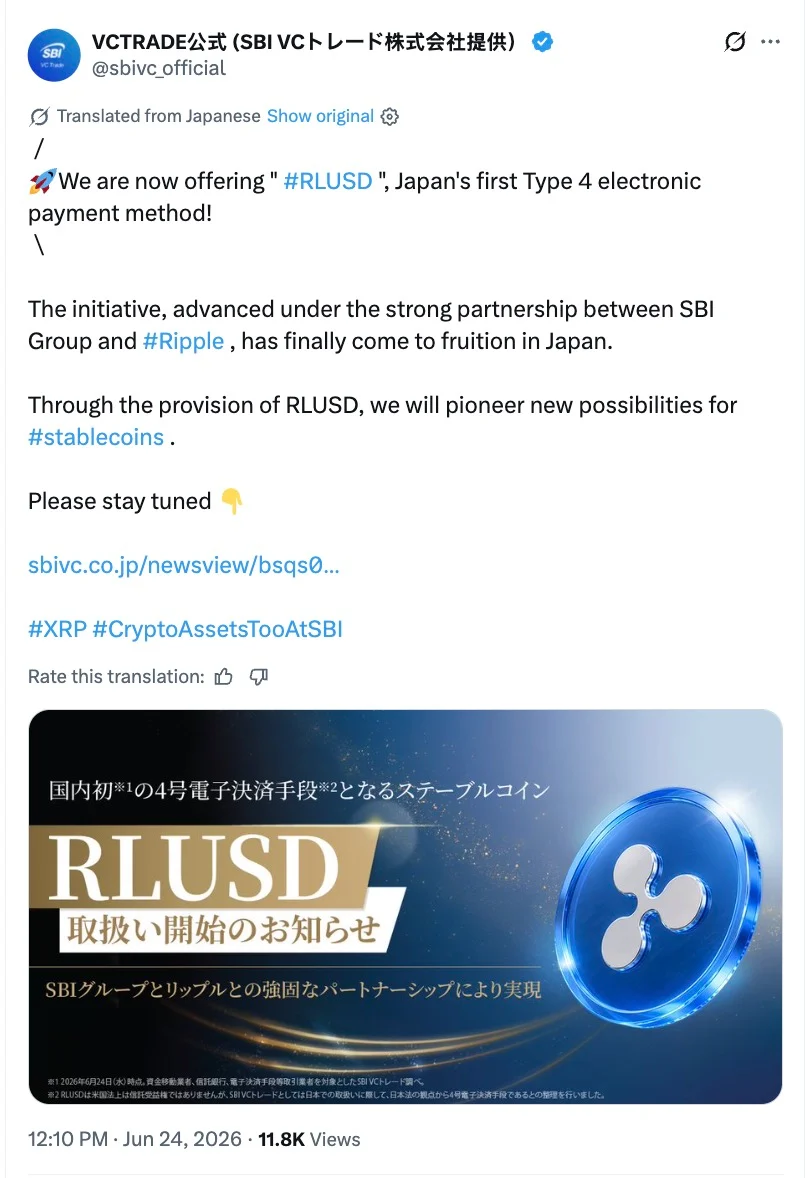 SBI VC Trade regarding historic Ripple USD (RLUSD) listing, Source:
At the same time as Ripple's retail debut, SBI Holdings Group has rolled out infrastructure for large capital by issuing JPYSC, the first yen stablecoin classified as an "Electronic Payment Instrument No. 3." The product, developed jointly with Singapore's Startale Group, uses a trust bank structure to manage reserves.
Unlike RLUSD, JPYSC was created for the B2B sector and has no transaction limits, opening the possibility of multibillion-yen interbank settlements and commercial clearing inside the country.
As of today, a two-tier system of digital settlements has de facto started operating in Japan. While retail users are getting familiar with the dollar-based RLUSD under strict limits, the corporate sector has received unlimited yen in the form of JPYSC to optimize large commercial flows.
Fred Krueger calls for freezing Nakamoto's coins to save Bitcoin
As of June 2026, a fierce ideological dispute has continued in the Bitcoin community. The latest escalation came after well-known investor Fred Krueger publicly supported the technical proposal BIP-110 and the accompanying initiative to forcibly block old, inactive crypto wallets. The main target of this measure would be around 1 million BTC that have remained untouched at the addresses of the network's creator, Satoshi Nakamoto.
Supporters of BIP-110, now joined by Krueger, propose giving owners of "dormant" addresses a fixed period to move their coins, after which inactive wallets would be blocked. The stated motive is security: early Bitcoin addresses use older algorithms that could become vulnerable to quantum computers in the future.
The initiative has met strong resistance from key developers, while Blockstream CEO and cypherpunk legend Adam Back continues to call the idea technically defective, stressing that the project has no support either among miners or in the broader ecosystem.
According to Back, any attempt by activists to implement these rules would only lead to a blockchain split and the creation of a stillborn fork — a copy of the network that would immediately lose value.
The main intrigue of the conflict is the blow to Bitcoin's fundamental value: its resistance to censorship. If the community creates a precedent and blocks Satoshi's coins in the name of security, it would destroy the main economic argument about the inviolability of property in a decentralized network.
If the code allows assets to be taken away from the creator, then in the future they could be frozen for any user at the request of regulators.
Price chart and seasonality point to a July rally for SHIB
Shiba Inu (SHIB) is approaching the end of the first month of summer 2026 on the verge of a historic turning point. After an exhausting six-month decline, the coin is trapped in an extremely narrow price range near five-year lows, around $0.0000045.
This month, the Shiba Inu token has lost another 17.5% of its value, but technical calm on the chart and historical statistics hint at preparation for a July reversal.
On one hand, large sales are pressing the price down. On-chain data recorded how one early investor moved 3.8 trillion tokens worth around $20.7 million to exchanges, while the community's coin burn rate dropped by 74%.
On the other hand, the current level is a rock-solid support zone below which no real market for SHIB has existed over the past five years. The volume profile shows that this is exactly where the strongest interest from long-term buyers is now concentrated.
Depending on which force prevails, the market is considering two potential outcomes for the token's price action in the near term:
- Bull Case: Buyers successfully hold the defense at $0.00000450, driving a 50% rebound toward the nearest resistance at $0.00000680.
- Bear Case: The critical $0.00000450 support fails, causing the asset to capitulate into the uncharted territory of early 2021.
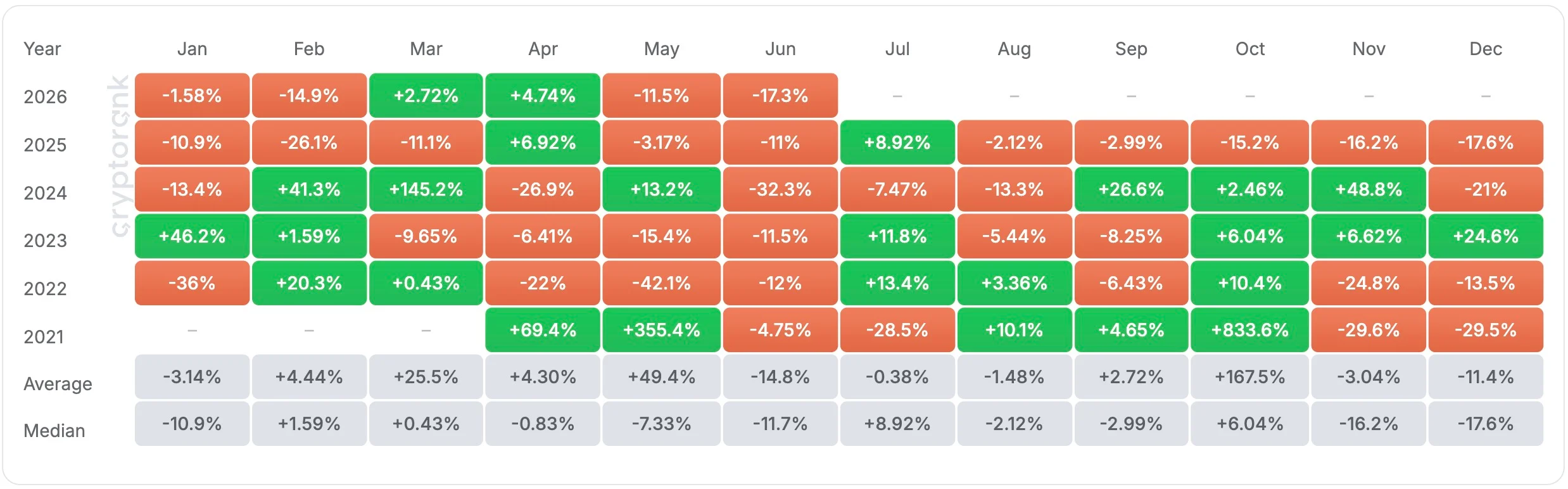 Shiba Inu (SHIB) monthly returns in USD, Source:
The main trigger for a possible jump is the seasonal factor. Historically, June has always been a disastrous month for SHIB, with an average decline of 14.8%, while July has traditionally acted as a lifeline, with median returns of +8.92%. The market is pricing this scenario as a chance for a "relief rally" after a difficult spring.
From a technical point of view, the ultimate resolution of these scenarios will come in the next few days. The market remains highly compressed, meaning the breakout from the current wedge will likely set the definitive trend for the rest of the summer.
Crypto market outlook: ETF outflows push Bitcoin to critical support
The crypto market, led by Bitcoin, continues to go through deep capitulation due to sustained institutional capital flight, extreme network congestion, and rising regulatory roadblocks across the U.S. and the European Union.
Key checkpoints:
- Record institutional ETF drainage: Regulated crypto vehicles recorded their fourth consecutive day of net outflows. Yesterday alone, spot Bitcoin ETFs shed $113.78 million, and Ethereum ETFs lost $82.35 million, with 30-day rolling Bitcoin ETF outflows hitting a record $4.4 billion — the worst capitulation period since inception.
- Bitcoin network hits a two-year traffic high: On-chain activity has surged to more than 820,000 transactions per day, driven entirely by a massive revival of the Runes protocol. This surge in token standard activity now consumes 25% of all network transaction fees, severely congesting the base layer as BTC tests the local $62,200–$62,700 zone.
- Political and regulatory gridlock in the U.S.: House hearings on the CLARITY Act are set for July 17, but the bill has completely stalled in the Senate over ethical clauses and Section 604 guidelines. Due to these legislative disputes, Polymarket has aggressively downgraded the probability of the bill passing in 2026 to just 42%.
- The next macro trigger: On Friday, June 26, the market faces a dual liquidity test with the release of the U.S. PCE inflation index and the quarterly expiration of $10.6 billion in BTC and ETH options. Any further macro pressure will heavily test the $60,000–$62,000 support cluster, risking a cascade toward the $54,000–$58,000 zone.