
Jefferies latest research report: HALO framework implementation in the transportation sector—In the AI era, the real “moat” is not code, but railways


Hello everyone, this is Right Pocket.
On March 2, 2026, Jefferies released a transportation and logistics industry report:
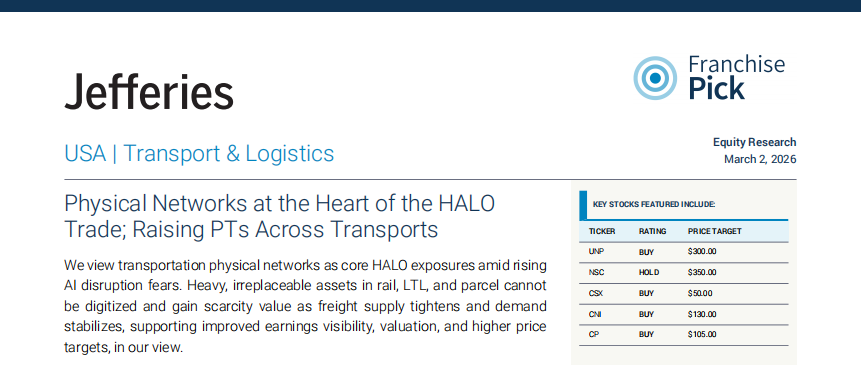
"Physical Networks at the Heart of the HALO Trade; Raising PTs Across Transports"
The core viewpoint of the report is clear:
In an environment where the risk of AI substitution is being amplified, transport assets possessing non-replicable physical networks are becoming typical representatives of the HALO framework (Heavy Assets, Low Obsolescence).
Jefferies emphasizes that AI can optimize efficiency but cannot digitize physical infrastructure. Long-term capital-intensive assets like rail networks, port systems, and airline fleets are being repriced for their scarcity.
Against the backdrop of the ongoing market debate about AI disruption, this angle is structurally significant.
1. Distinguishing “Automatable Tasks” from “Non-Replicable Assets”
The first main thread of the report is to distinguish tasks from assets.
AI can optimize:
Routing efficiency
Pricing models
Asset utilization
But it cannot replicate:
Railroad rights-of-way
Terminal network density
Flight routes and fleet systems
Scaled operational data tied to physical networks
Jefferies points out that for rail companies like UNP, NSC, CSX, CNI, and CPKC, their core value lies in the network itself.
These assets have three characteristics:
Extremely long construction periods
Very high regulatory thresholds
Almost impossible to rebuild
AI enhances efficiency but does not weaken network barriers.
In an environment of rising “substitution anxiety,” the scarcity premium of such assets is actually reinforced.
2. Fundamentals Improvement: Synchronization of Supply Contraction and Demand Recovery
The second logic comes from industry fundamentals.
Jefferies points out:
Accelerated capacity exit
Load-to-truck ratio rebounding
Spot rates outperforming seasonality
ISM Manufacturing PMI has been above 50 for two consecutive months as of February 2026
After inventory destocking, manufacturing activity stabilizes at the margin.
Historical experience shows:
New orders rebound → Lagged transmission to freight volumes → Improved pricing power
With supply constraints, marginal demand recovery means improved earnings visibility.
The logic for the transportation sector is shifting from “cyclical compression” to “earnings recovery.”
3. Raising Price Targets: Upward Shift in Valuation Anchors
Based on the above judgments, Jefferies raised the price targets of several companies:
UNP: $300 (previously $285)
NSC: $350 (previously $300)
CSX: $50 (previously $42)
CNI: $130 (previously $115)
CP: $105 (previously $85)
Also raising price targets for XPO, UPS, FedEx and other companies.
The logical framework is clear:
Tight transport capacity improves price structure
Improved cash flow stability
AI enhances the recognition of the scarcity of physical network assets
The focus of valuation systems is shifting toward “cash flow certainty.”
My understanding:
The value of this report does not lie in the specific price targets.
What is truly worth paying attention to is the implementation of the HALO framework in real-world sectors.
The market has been discussing for the past two years whether AI will squeeze the profit margins of traditional industries.
But Jefferies provides the answer:
When substitutability rises, the premium on non-substitutable assets also rises.
Placed in a broader asset allocation logic:
The premium of software comes from its growth imagination.
The premium of heavy assets comes from their irreplaceability.
When the market shifts from a “growth narrative” to “cash flow certainty,”
the valuation structure naturally changes.
The transportation sector is just a sample.
What is truly being repriced is the certainty of “low obsolescence risk assets.”
Disclaimer: The content of this article solely reflects the author's opinion and does not represent the platform in any capacity. This article is not intended to serve as a reference for making investment decisions.
You may also like
How to avoid AI? This is the big dilemma for pension funds and sovereign funds
The AI wave is breaking through institutional investors' diversification defenses. From stocks and private equity to bonds and infrastructure, AI risk has fully penetrated—Goldman Sachs estimates that companies related to AI account for 40% of the S&P 500's market value, and AI bond issuances make up nearly half of the investment-grade market. Pension funds and sovereign wealth funds are being forced to redefine "risk," struggling to survive between missing out on gains and excessive concentration.
Weekly U.S. Equities Macro Outlook (Sep 21–Sep 25):
Highlights of the U.S. Stock Market This Week: Intensive Speeches from Federal Reserve Officials, Middle East Situation and China-U.S. Summit Influence the Market
This week, U.S. stock market investors will focus on the trajectory of interest rates, tensions in the Middle East, the U.S.-China summit and technology-related topics, as well as calls to slow down the development of artificial intelligence (AI), while weighing whether major stock indexes can reach new historical highs.
Crypto prices
More


