

- WLFI expects individuals to stake unlocked tokens to vote and active participants can receive the yield of 2% APR.
- Access OTC USD1 and partner benefits by participating Node (10 million WLFI) or Super Node (50 million WLFI).
- This plan moves profit from stablecoin arbitrage business (from intermediaries) to long-term governance participation members.
World Liberty Financial (WLFI) has introduced a sweeping governance overhaul that ties voting power, stablecoins access, and partnership flow directly to staking commitment. This makes USD1 the center of the incentive system.

Table of Contents
Governance Now Requires Staking Commitment
According to this proposal, unlocked WLFI token holders need to stake these tokens to participate in governance voting. The minimum time of locking is 180 days. Locked token holders can still vote without supplementary stake request implementation.
The amount of your stake and the duration of time you stake are nonlinear in a formula that calculates your voting power. The system is created to eliminate the possibility of a few people having excessive influence yet rewarding those locking longer the rewards.
The payout is an approximate of 2% annually and is only gained when voting twice upon having the tokens locked. The payoffs are provided by WLFI treasury rather than profits.
Governance rights are not transferable and they decrease as your lock duration reduces. Simply put, the key to influence is seen in the level of commitment you have and not only the level of ownership.
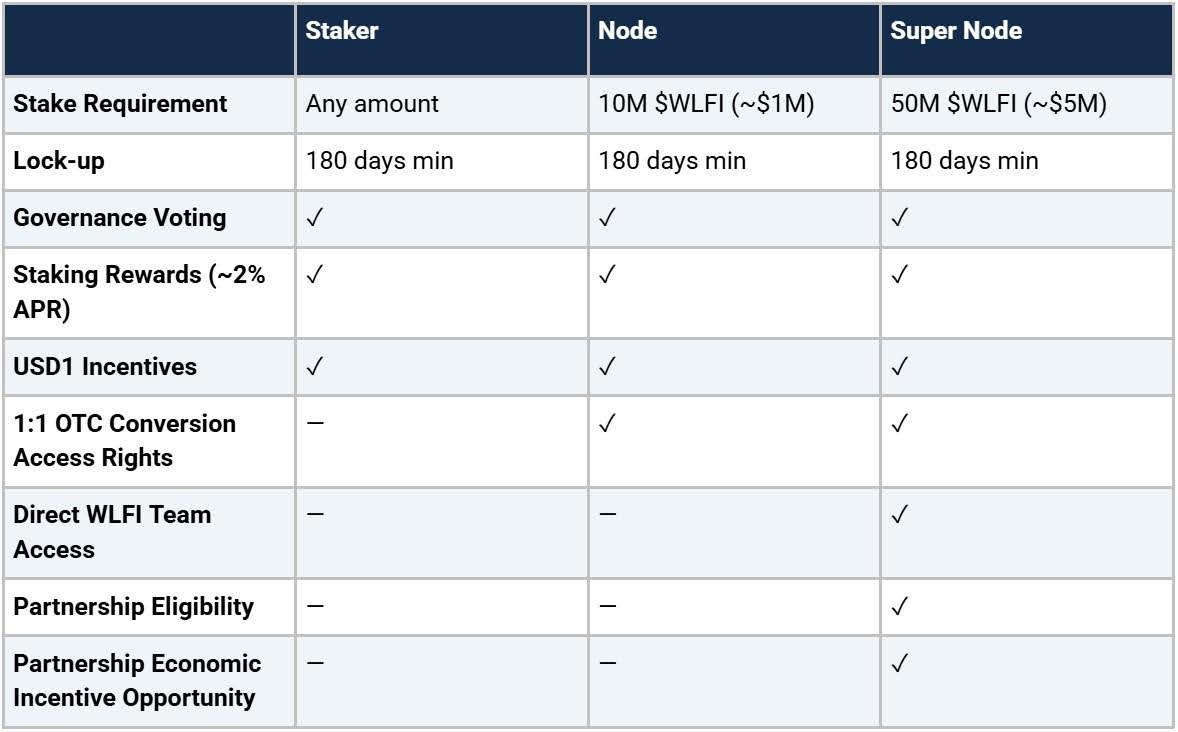
Tiered Structure: Nodes and Super Nodes
Node Tier: 10M WLFI Threshold
A stake of 10 or more WLFI (about one million dollars nowadays) qualifies you to be a Node. Nodes receive simple staking privileges and have access to OTC instruments that allow them to exchange stablecoins with USD1.
WLFI will cooperate with market makers who are licensed that investors/participants can swap 1:1 USD1 with USDT, USDC or other supported coins. This protocol will subsidize these agreements, by doing this, it can move arbitrage margins which previously held by institutional market makers, about 10-15 basis points of each cycle to participating Node members.
Nodes must complete KYC procedures and may also earn additional governance-token rewards tied to USDT-to-USD1 conversion volumes. These volume-based incentives are limited to the first 1,000 qualifying Nodes and settle every six months.
Super Nodes: $5M Governance Commitment
Super Nodes require a 50 million WLFI stake (estimated at approximately $5 million nowadays). They and all of their benefits as a Node in addition to being able to contact the WLFI team directly regarding partnership discussions.


