
WLFI proposes governance staking system and USD1 usage incentives

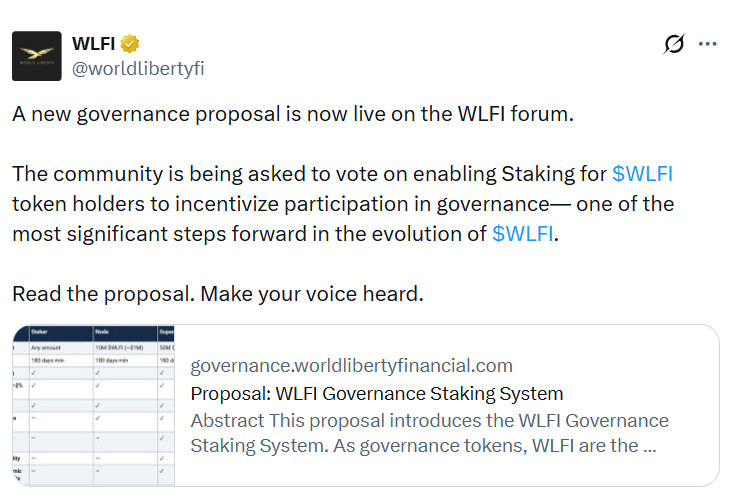
Trump family-backed crypto venture World Liberty Financial (WLFI) has proposed new measures to boost participation in governance through a staking system and incentivize the use of its stablecoin USD1.
In its latest proposal on Wednesday, the team suggested governance votes should require holders to stake their tokens for at least 180 days to ensure “voting power is held by participants with long-term alignment to the protocol,” instead of “short-term holders or speculators.”
Stakers would earn an annual percentage rate of 2% provided they participate in at least two governance votes during the lock-up period. Governance power would be based on the amount staked and the time left in the lock-up. Users with locked tokens can continue to vote as usual.
 Source:
World Liberty Financial
Source:
World Liberty Financial
Incentives for USD1 usage on the table too
WLFI has been trying to increase USD1 adoption since it launched through rewards programs and partnerships with institutional platforms and other protocols.
As part of the staking system, the WLFI team said users who stake their tokens would also gain “additional benefits for USD1 usage,” with USD1 deposits made on the trading and lending platform WLFI Markets attracting unspecified “incentives” from the DeFi protocol Dolomite.
At the same time, “Nodes,” holders with at least 10 million WLFI tokens, will gain access to providers who offer conversion of other stablecoins like USDC (USDC) and USDt (USDT) into USD1 at a 1:1 rate and can provide an off-ramp directly to fiat.
“Super Nodes,” or holders with more than 50 million WLFI tokens, will also have access to the feature.
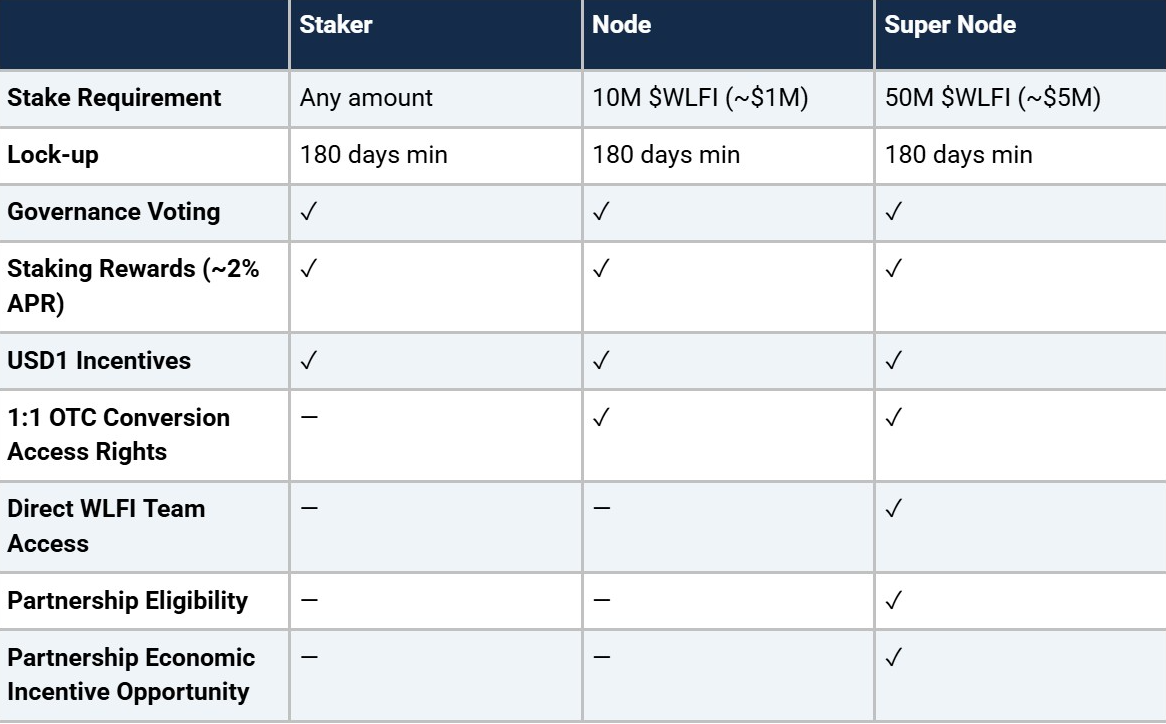 World Liberty Financial is offering incentives for token holders to stake and participate in governance decisions. Source:
World Liberty Financial
World Liberty Financial is offering incentives for token holders to stake and participate in governance decisions. Source:
World Liberty Financial
For the vote to be valid, the WLFI team has set the bar at one billion voting tokens participating, with a majority voting in favor required for it to pass. CoinGecko lists over 27 billion WLFI tokens in circulation.
If approved, the rollout will be in three phases: starting with staking rewards and USD1 deposit incentives, followed by the 1:1 conversion feature and lastly partnership access and a revenue-sharing framework for “Super Nodes.”
Related:
Stablecoin market dominated by USDC and USDT
The total market capitalization for stablecoins is over $309 billion as of Thursday, according to DeFi aggregator DefiLlama. USDT has the largest market cap with over $183 billion and a market dominance of 59%.
Circle’s USDC is the second-largest stablecoin by market cap, with $75 billion. WLFI’s USD1 is the fifth-largest stablecoin with a $4.7 billion market cap.
Magazine:
Disclaimer: The content of this article solely reflects the author's opinion and does not represent the platform in any capacity. This article is not intended to serve as a reference for making investment decisions.
You may also like
The Capital Trends Behind the AI Computing Power Rebound: JPMorgan Fund Flows Reveal Retail Buy-In "Shrinking," Pouring Into Nvidia, SanDisk and Other Computing Power Core Companies
What has been revealed is not a "complete withdrawal of retail investors from AI," but rather a significant slowdown in overall market entry pace under macroeconomic pressure, with stock selections becoming more concentrated. In response to the Federal Reserve's unanimous decision to raise interest rates by 25 basis points, increasing the policy rate to 3.75%–4.00%, JPMorgan's assessment is: if this is simply a withdrawal of last year's "insurance-style rate cuts" during a shallow rate hike cycle—and if corporate earnings remain strong and the Middle East situation does not further spiral out of control—the stock market is still capable of absorbing rising interest rates.
Vote Result 7-2! Bank of Japan Raises Interest Rates at Fastest Pace Since 1990, Does Not Signal a Clearly More Hawkish Stance
The Bank of Japan has raised interest rates to 1.25%, marking the highest level since 1995 and the sixth increase since exiting the negative interest rate policy in March 2024. Out of the nine committee members, Asada and Sato voted against the hike, citing the current economic situation, reflecting ongoing internal disagreements over further tightening. In its statement, the Bank of Japan indicated it will continue to raise rates and adjust the degree of monetary easing, but the forward guidance language showed limited changes from the July statement, without sending notably more hawkish signals.
Crypto prices
More


