
Bel Fuse (NASDAQ:BELFA) Posts Better-Than-Expected Sales In Q4 CY2025


Electronic system and device provider Bel Fuse (NASDAQ:BELFA) reported
Is now the time to buy Bel Fuse?
Bel Fuse (BELFA) Q4 CY2025 Highlights:
- Revenue: $175.9 million vs analyst estimates of $173.4 million (17.4% year-on-year growth, 1.5% beat)
- Adjusted EPS: $1.98 vs analyst estimates of $1.10 (80.8% beat)
- Adjusted EBITDA: $37.59 million vs analyst estimates of $34.13 million (21.4% margin, 10.1% beat)
- Revenue Guidance for Q1 CY2026 is $172.5 million at the midpoint, above analyst estimates of $162.3 million
- Operating Margin: 14.7%, down from 18.1% in the same quarter last year
- Free Cash Flow Margin: 14.9%, up from 1.4% in the same quarter last year
- Market Capitalization: $2.91 billion
"Bel delivered a strong fourth quarter, with sales and gross margin percentage at the high end of our guidance," said Farouq Tuweiq, President and CEO.
Company Overview
Founded by 26-year-old Elliot Bernstein during the electronics boom after WW2, Bel Fuse (NASDAQ:BELF.A) provides electronic systems and devices to the telecommunications, networking, transportation, and industrial sectors.
Revenue Growth
A company’s long-term sales performance can indicate its overall quality. Any business can experience short-term success, but top-performing ones enjoy sustained growth for years. Over the last five years, Bel Fuse grew its sales at a decent 7.7% compounded annual growth rate. Its growth was slightly above the average industrials company and shows its offerings resonate with customers.
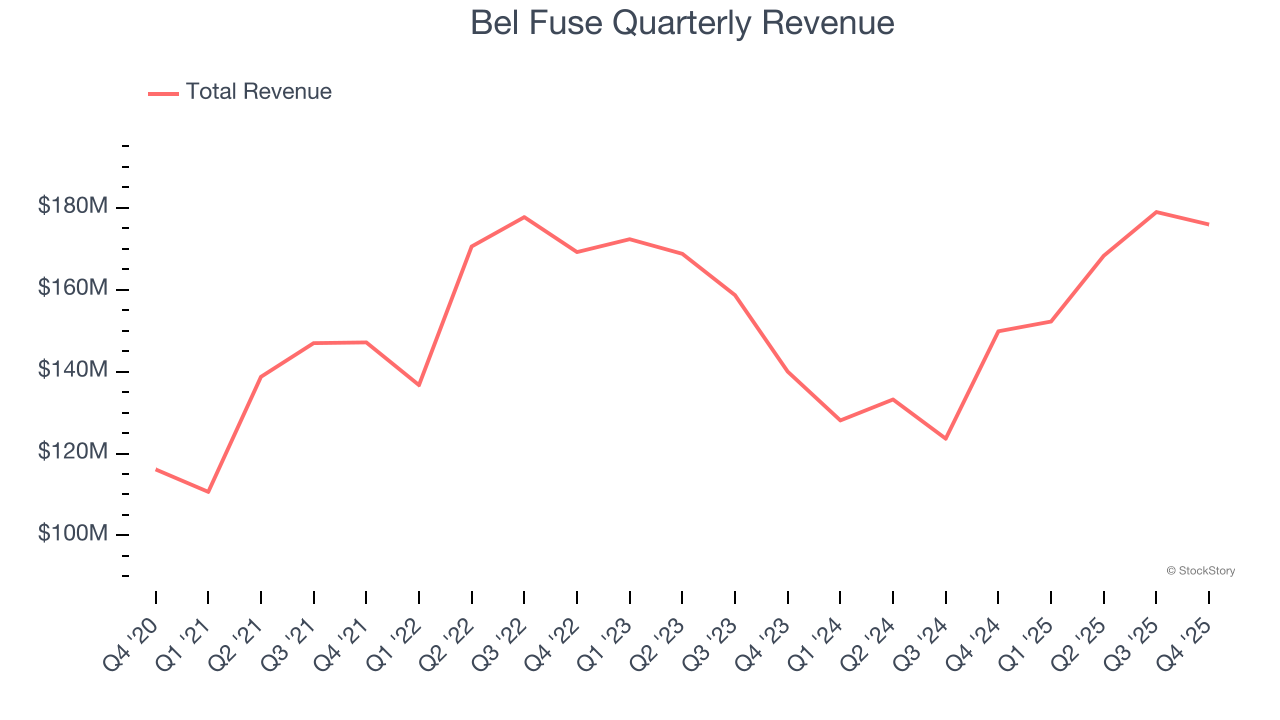
We at StockStory place the most emphasis on long-term growth, but within industrials, a half-decade historical view may miss cycles, industry trends, or a company capitalizing on catalysts such as a new contract win or a successful product line. Bel Fuse’s recent performance shows its demand has slowed as its annualized revenue growth of 2.7% over the last two years was below its five-year trend. We’re wary when companies in the sector see decelerations in revenue growth, as it could signal changing consumer tastes aided by low switching costs.
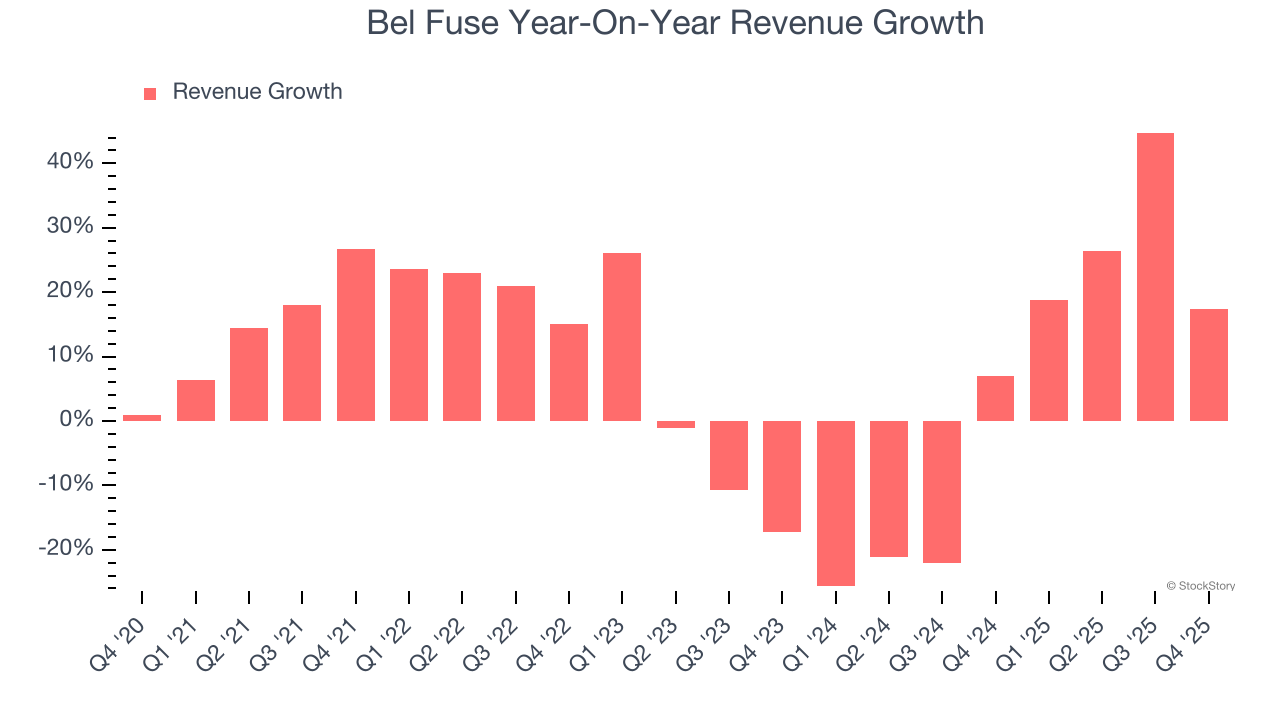
This quarter, Bel Fuse reported year-on-year revenue growth of 17.4%, and its $175.9 million of revenue exceeded Wall Street’s estimates by 1.5%. Company management is currently guiding for a 13.3% year-on-year increase in sales next quarter.
Looking further ahead, sell-side analysts expect revenue to grow 5.9% over the next 12 months. While this projection suggests its newer products and services will spur better top-line performance, it is still below the sector average.
Microsoft, Alphabet, Coca-Cola, Monster Beverage—all began as under-the-radar growth stories riding a massive trend. We’ve identified the next one: a profitable AI semiconductor play Wall Street is still overlooking.
Operating Margin
Bel Fuse has been an efficient company over the last five years. It was one of the more profitable businesses in the industrials sector, boasting an average operating margin of 12.2%.
Looking at the trend in its profitability, Bel Fuse’s operating margin rose by 10.8 percentage points over the last five years, as its sales growth gave it immense operating leverage.
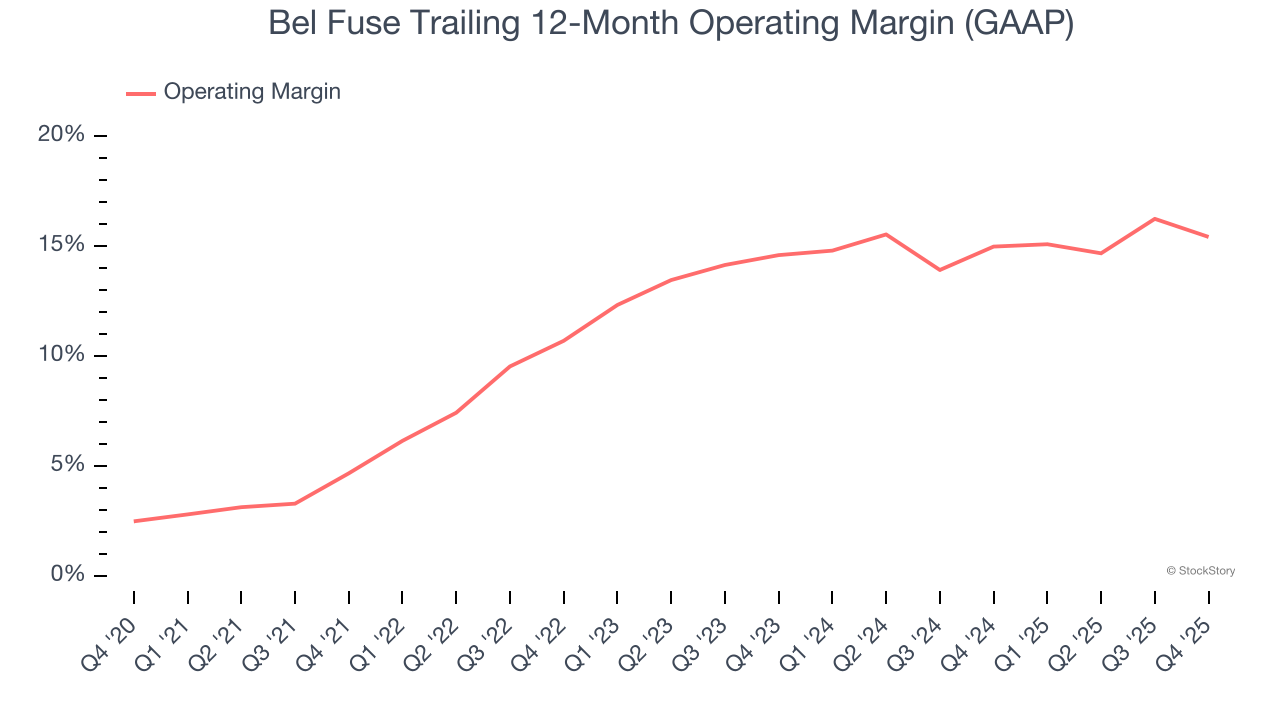
This quarter, Bel Fuse generated an operating margin profit margin of 14.7%, down 3.4 percentage points year on year. Conversely, its revenue and gross margin actually rose, so we can assume it was less efficient because its operating expenses like marketing, R&D, and administrative overhead grew faster than its revenue.
Earnings Per Share
Revenue trends explain a company’s historical growth, but the long-term change in earnings per share (EPS) points to the profitability of that growth – for example, a company could inflate its sales through excessive spending on advertising and promotions.
Bel Fuse’s EPS grew at an astounding 48.1% compounded annual growth rate over the last five years, higher than its 7.7% annualized revenue growth. This tells us the company became more profitable on a per-share basis as it expanded.
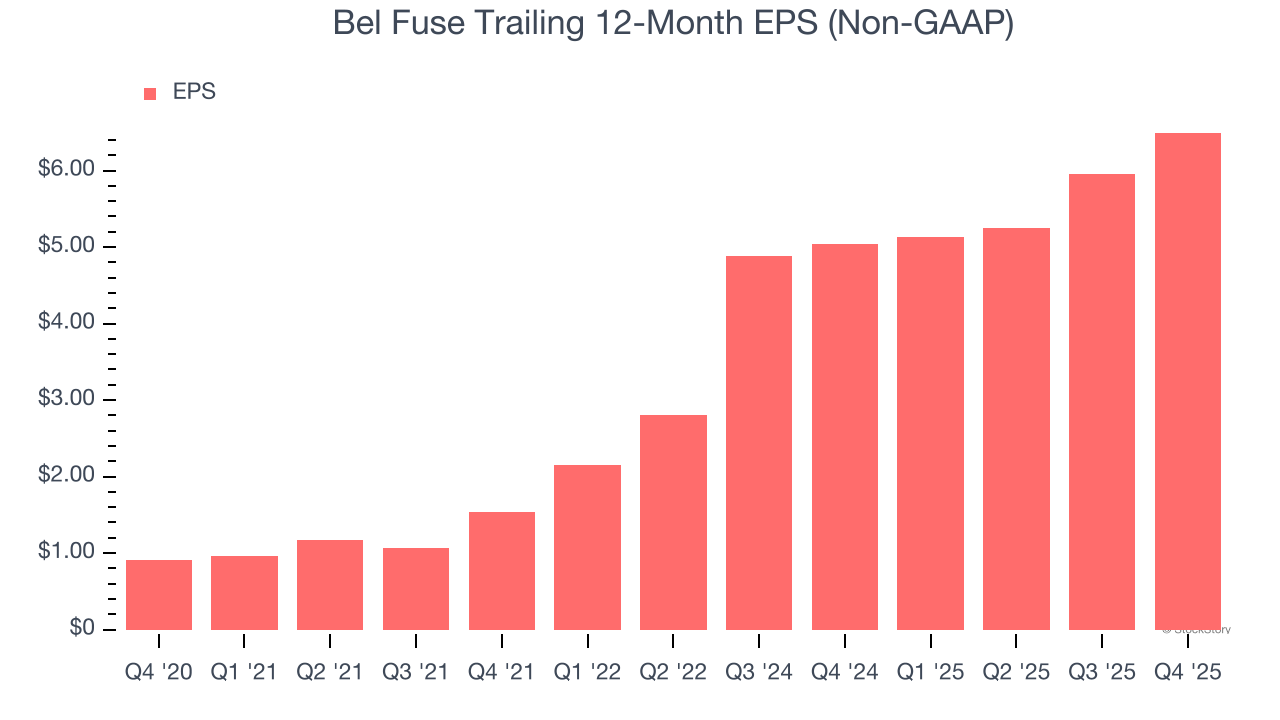
We can take a deeper look into Bel Fuse’s earnings to better understand the drivers of its performance. As we mentioned earlier, Bel Fuse’s operating margin declined this quarter but expanded by 10.8 percentage points over the last five years. Its share count also shrank by 14.4%, and these factors together are positive signs for shareholders because improving profitability and share buybacks turbocharge EPS growth relative to revenue growth.
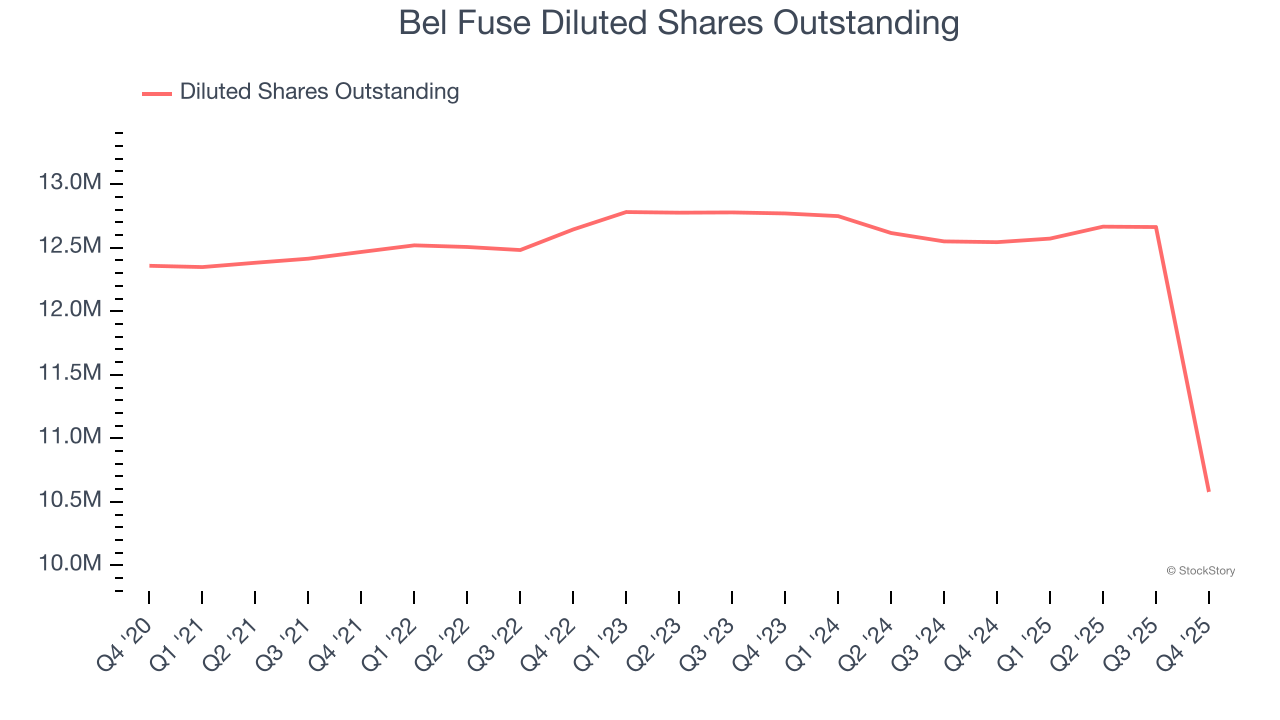
Like with revenue, we analyze EPS over a shorter period to see if we are missing a change in the business.
For Bel Fuse, its one-year annual EPS growth of 7.9% was lower than its five-year trend. We hope its growth can accelerate in the future.
In Q4, Bel Fuse reported adjusted EPS of $1.98, up from $1.45 in the same quarter last year. This print easily cleared analysts’ estimates, and shareholders should be content with the results. Over the next 12 months, Wall Street expects Bel Fuse’s full-year EPS of $6.49 to grow 3.9%.
Key Takeaways from Bel Fuse’s Q4 Results
It was good to see Bel Fuse beat analysts’ EPS expectations this quarter. We were also excited its EBITDA outperformed Wall Street’s estimates by a wide margin. Zooming out, we think this was a solid print. The stock remained flat at $214.21 immediately after reporting.
Is Bel Fuse an attractive investment opportunity right now? The latest quarter does matter, but not nearly as much as longer-term fundamentals and valuation, when deciding if the stock is a buy.
Disclaimer: The content of this article solely reflects the author's opinion and does not represent the platform in any capacity. This article is not intended to serve as a reference for making investment decisions.
You may also like
Once frenzied buying, now the "ammunition warehouse" shrinks by 51 trillion KRW! Korean retail investors can no longer afford to buy
In four months, Korean retail investors' "ammunition stockpile" has dropped by 36.5%, returning to levels seen at the beginning of the year. Although retail investors have collectively made net purchases exceeding 75 trillion won, they are still absorbing the sell-off, but the influx of new funds has dried up, and the replenishment rate lags far behind the consumption rate. Combined with the KOSPI plunging nearly 20% this month, continued net selling by foreign investors, and concerns over AI-related credit risks, the Korean stock market may find it difficult to see a sustained rebound in the short term without support from private investors' funds.
Apple Prints TD Sequential Sell 9 — Last Two Led to 15.66% and 13.63% Corrections

The Collapse of "Consensus Trading" and the Birth of a New Consensus! Goldman Sachs Explains: Why Institutions Are Currently Significantly Reducing AI Holdings
The extremely crowded trade of "going long on AI, short on everything else" is undergoing a painful unwinding—markets are no longer satisfied with the "burn rate narrative." Mega-scale cloud providers must deliver real, visible revenue conversions alongside $1.1 trillion in capital expenditures. A power gap of 40-50 gigawatts, rising capital costs, and a macro paradigm shift from an era of "overspending" are turning AI trades from a matter of faith into a harsh test of monetization.
Starknet TVL crashes 3.7x to $42M after getting 93% vote to become L1
Crypto prices
More


