
Monad hires former FalconX, BVNK and Optimism executives

The Monad Foundation has hired three senior executives from Optimism, FalconX and BVNK as it expands its focus on institutional adoption following its November mainnet launch.
Urvit Goel joins as vice president of go-to-market from the Optimism Foundation, Joanita Titan becomes head of institutional growth after leading custody and staking at FalconX, and Sagar Sarbhai joins as head of institutions for Asia-Pacific, most recently at BVNK.
The three executives previously held roles at JP Morgan, Deutsche Bank, Anchorage Digital, Fireblocks and Amazon, bringing backgrounds in traditional finance and institutional crypto infrastructure.
According to an announcement shared with Cointelegraph, the new hires are expected to focus on capital markets strategy, brand building and institutional adoption across Asia-Pacific jurisdictions including Hong Kong, Singapore, Japan and South Korea.
Monad launched its public mainnet in November along with a token sale on Coinbase. Since launch, the network has reached about $450 million in stablecoin market capitalization and more than $200 million in total value locked across decentralized finance protocols, according to the foundation.
 Source:
Monad
Source:
Monad
The network says it can process up to 10,000 transactions per second with sub-second finality while remaining compatible with the Ethereum Virtual Machine. The foundation said the design targets use cases such as high-frequency trading and payments.
In 2024, Monad Labs, the development company behind the network, raised $225 million in a funding round led by Paradigm. The Monad Foundation now oversees ecosystem growth following mainnet launch.
Related: Perp DEXs will ‘eat’ expensive TradFi in 2026: Delphi Digital
Recent layer-1 launches see steep token declines
While 2021–2023 saw a surge of layer-1 blockchain launches, including Avalanche (AVAX), Near (NEAR), Aptos (APT), Sui (SUI) and others, the pace of new mainnets has slowed over the past year. Even so, Monad is not the only layer-1 blockchain to enter the space recently.
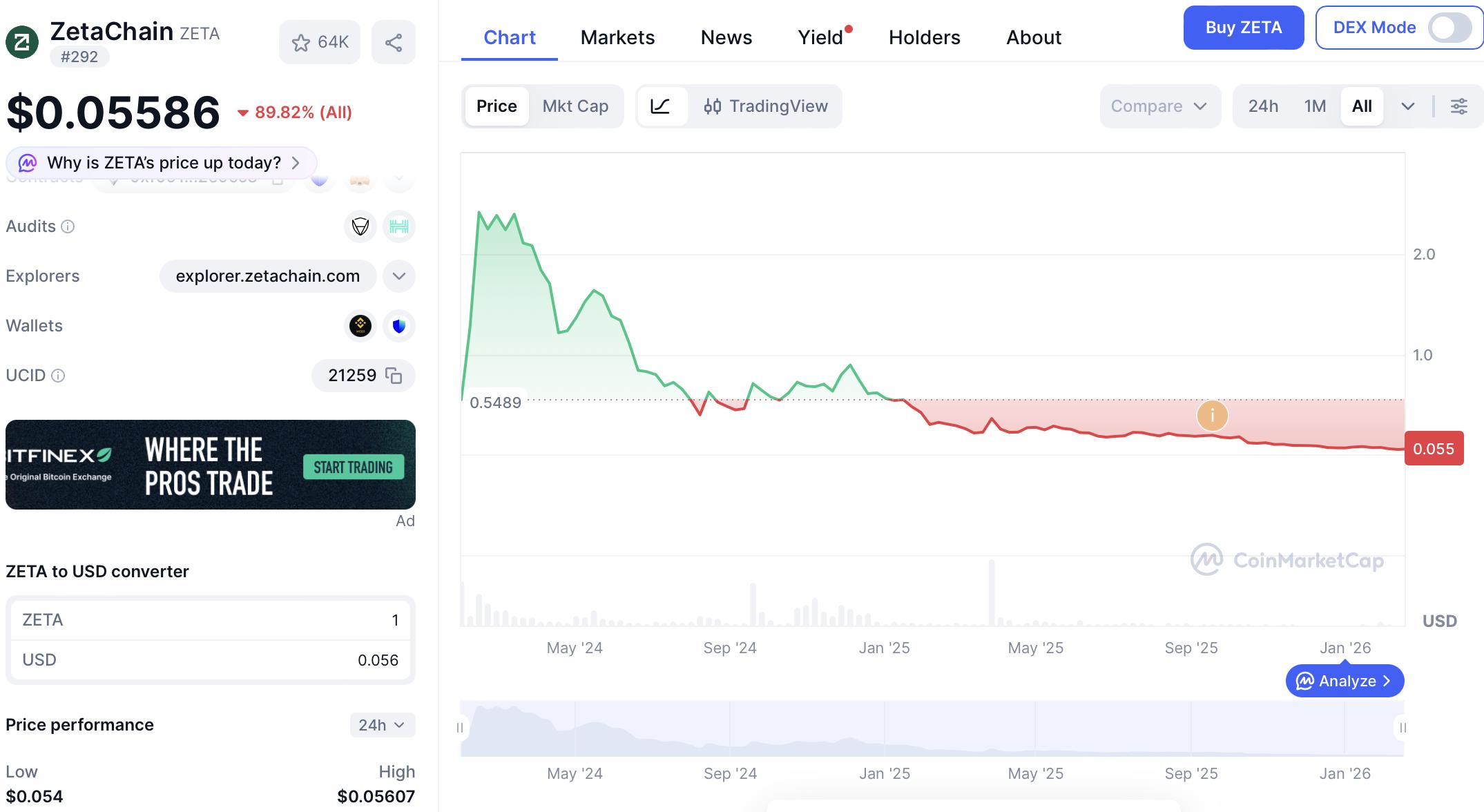
In late 2024, ZetaChain launched its mainnet with a focus on connecting multiple crypto networks without bridges or wrapped assets, and in February 2025, the Berachain Foundation went live with its EVM-compatible layer-1, distributing nearly 80 million BERA tokens to eligible users in an airdrop valued at about $632 million.
In February 2026, decentralized exchange Aster announced its layer-1 testnet had gone live for public users, with a mainnet launch targeted for the first quarter. The roadmap outlines plans for fiat on-ramps, open-source code releases and broader ecosystem development throughout 2026.
But not all investors are convinced the latest wave of layer-1 blockchains will endure. In November, crypto investor Arthur Hayes said most new L1 networks are likely to fail, predicting that only a small group, including Bitcoin (BTC), Ether (ETH), Solana (SOL) and Zcash (ZEC), will remain relevant over the long term.
Recent token performance underscores the challenges facing new chains.
According to CoinMarketCap data, ZetaChain’s (ZETA) native token is down about 98% from its all-time high, while Berachain (BERA) has fallen about 95%. Monad’s token (MON) is trading around 52% below its peak, at the time of writing.
 Source:
CoinMarketCap
Source:
CoinMarketCap
Magazine: IronClaw rivals OpenClaw, Olas launches bots for Polymarket — AI Eye
Disclaimer: The content of this article solely reflects the author's opinion and does not represent the platform in any capacity. This article is not intended to serve as a reference for making investment decisions.
You may also like
Tonight, a "dovish rate hike"?
The Federal Reserve is almost certain to raise interest rates tonight, but the key issue is "what will be said after the hike." Citi characterizes this move as a "fine-tuning" adjustment, suggesting there is no inevitable future rate hike, yet warns that if Chairman Powell does not provide clear forward guidance, it will trigger significant market volatility. Goldman Sachs bluntly stated that there is insufficient economic foundation for this rate hike, with inflation being merely a one-off factor, and expects this to be a "signal-less rate hike."
JPMorgan: "Open source disruption" and "AI safety" are not issues, there is still room for capital expenditure in the next two years, semiconductor equipment will become the "new bottleneck"
JPMorgan believes that open-source models are not a threat, regulatory disruptions are only short-term, and cloud vendors’ leverage remains low—the fundamentals of computing power investment have not changed. It forecasts that the capital expenditure of the seven major tech giants will soar from $443 billion in 2025 to $1.577 trillion in 2027, with semiconductor equipment becoming the core bottleneck of the supply chain and a new round of price increases expected in wafer foundry and advanced packaging.
Micron executive: Storage determines AI limits, substantial new capacity will come after 2028
Micron executive Sumit Sadana stated that memory bandwidth and capacity have become the core factors determining the performance ceiling of AI systems. In the face of structural imbalances between supply and demand, Micron expects to increase capital expenditure to over $45 billion in fiscal year 2027, but due to process complexity, substantive new capacity will not be released until 2028. Additionally, long-term supply agreements are reshaping the industry's business model, and humanoid robots will trigger the next wave of massive demand.
Goldman Sachs warns top clients: AI momentum trading shows unprecedented cracks, recommends hedging
Goldman Sachs has issued a rare warning to top clients: deep structural cracks are emerging in AI momentum. The AI-themed basket has dropped nearly 45% from its peak, with the one-day performance gap between short-term and long-term momentum reaching a five-year high. Capital is accelerating its shift from semiconductors to software. Goldman Sachs explicitly recommends that investors with AI exposure start hedging.
Crypto prices
More


