
Dogecoin Tightens Up: Symmetrical Triangle Converges With High-Timeframe Wyckoff Setup

Dogecoin is entering a pivotal phase as its price action tightens within a symmetrical triangle, aligning with a high-timeframe Wyckoff setup. The combination of higher lows, compressed structure, and developing Wyckoff signals suggests growing strength beneath the surface, raising the possibility that DOGE is quietly preparing for its next major move.
MTF Range Strategy: Longs At Discount, Shorts At Premium
According to an update by Wyckoff Insider via the lens of a multi-timeframe (MTF) range, the focus is on seeking long positions in areas of extreme discount and short positions in areas of extreme premium. When an MTF range is present, it often develops a Wyckoff structure near both the range highs and lows, providing clearer points of interest for traders.
Dogecoin is currently forming an 8H Bojan pivot in the extreme discount zone of this MTF range. The key to trading a Bojan pivot is identifying the Sign of Strength (SOS) that forms on the third candle. Bitcoin displayed a similar 8H Bojan recently, but trading it was more challenging due to deviations on both sides of the range, making DOGE difficult to trade also.
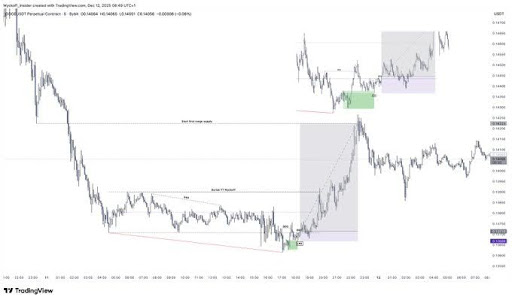
On the lower timeframes, Dogecoin is also showing a Wyckoff Model 1 range. When the third candle opens, and price pulls down, traders look for an LPS, BOS, and internal BOS pattern. Valid entries include taking the breakout on the 3-minute BOS with a stop below the M1 low, or entering on the LPS after the internal BOS, with a stop placed beneath the LPS itself.
In terms of trade management, Wyckoff Insider outlines a clear plan: risk should be kept at 2% per setup, with TP1 at the Wyckoff target zone (40%), and TP2 at the first range supply, fully closing the trade once a Sign of Weakness (SOW) appears. This structured approach helps navigate DOGE’s multi-layered Wyckoff-driven price action with discipline and clarity.
Daily Structure Shows Strength Despite Downtrend
Trader Tardigrade revealed that the daily chart provides clear indications that Dogecoin is actively building a stronger market structure despite the recent overall downtrend. This strength is apparent when comparing the current price action to past cycles.
Historically, when the broader market is weak, DOGE typically reinforces its bearish trend by forming lower lows following a distinct new swing low. However, in a significant departure from this pattern, DOGE is now attempting to establish a higher lows structure within a symmetrical triangle pattern.
This formation is key, as the analyst suggests the symmetrical triangle structure indicates that Dogecoin has been rejected from trading further downward. Such a development signals that selling exhaustion is setting in, preparing the market for a potential directional breakout.
Disclaimer: The content of this article solely reflects the author's opinion and does not represent the platform in any capacity. This article is not intended to serve as a reference for making investment decisions.
You may also like
 VIPAI Asset Sell-Off and Selective Rotation in Crypto
1. Technology stocks fell sharply as investor interest shifted toward energy and selected defensive assets. From October 10 to 16, the Nasdaq 100 declined 5.49% and the S&P 500 fell 1.95%, while the Dow gained 0.67% and WTI crude rose 10.41%. BTC, ETH, and SOL declined 1.27%, 2.65%, and 4.44%, respectively. This week's technology earnings will be an important test of whether revenue growth, margins, and cash flow can justify current valuations. Better-than-expected results could help stabilize markets in the near term. 2. Crypto continues to see pockets of strong activity, but a broad-based altcoin season has yet to materialize. CoinMarketCap's (CMC) Altcoin Season Index stood at 54 as of the October 18 UTC daily observation, below the altcoin-season threshold of 75, while BTC dominance rose to 60.08%. Our proxy leverage ratio fluctuated between 4.00 and 4.07 during the week, showing no sustained increase and suggesting limited appetite for additional leverage. Meanwhile, as major exchanges expand access to traditional financial assets, the recent sell-off in AI-related equities could attract short-term speculative capital away from crypto. Such capital rotation could make it more difficult for a new altcoin season to take hold. 3. Papertrade's loss-to-mine model has generated significant interest across the crypto community. The protocol combines high-leverage derivatives trading with zero slippage and a mechanism that rewards trading losses with PAPER tokens. Across the eight complete UTC days from October 10 to 17, cumulative reported revenue reached approximately $56.08 million, including $51.90 million distributed to token holders. With growing participation from key opinion leaders (KOLs), Papertrade has reportedly ranked among the top three platforms by profitability in the broader market recently. Assets to watch: BTC, ETH, SOL, ARB, OP, SKHYNIX, SKHY, META, TSLA, LRCX, and SPCX. Key research priorities this week: Cash flow performance in technology earnings; the relative discount and holding costs of the two SK Hynix contracts; and U.S. initial jobless claims and PMI data. Weekly market data cover the period through October 16, while research information was verified through October 18. Observation periods are specified separately for each chart.

Why Bernstein Thinks the AI Stock Sell-Off Could Help Small Caps

Morgan Stanley Builds Crypto Lab to Test Stablecoins, Tokenization and DeFi at Scale

Top 4 Earnings Reports This Week: What Tesla, Meta, SpaceX, Netflix Must Show

Crypto prices
More


