
Exodus Taps Bitcoin Reserves for $175M Move Into Onchain Payments

Quick Breakdown
- Exodus is acquiring W3C Corp for $175M, aiming to become a fully integrated onchain payments provider.
- A Bitcoin-backed credit facility with Galaxy Digital partly funds the deal.
- The move aligns with a broader industry push as Visa, Swift, and others accelerate the adoption of blockchain settlement.
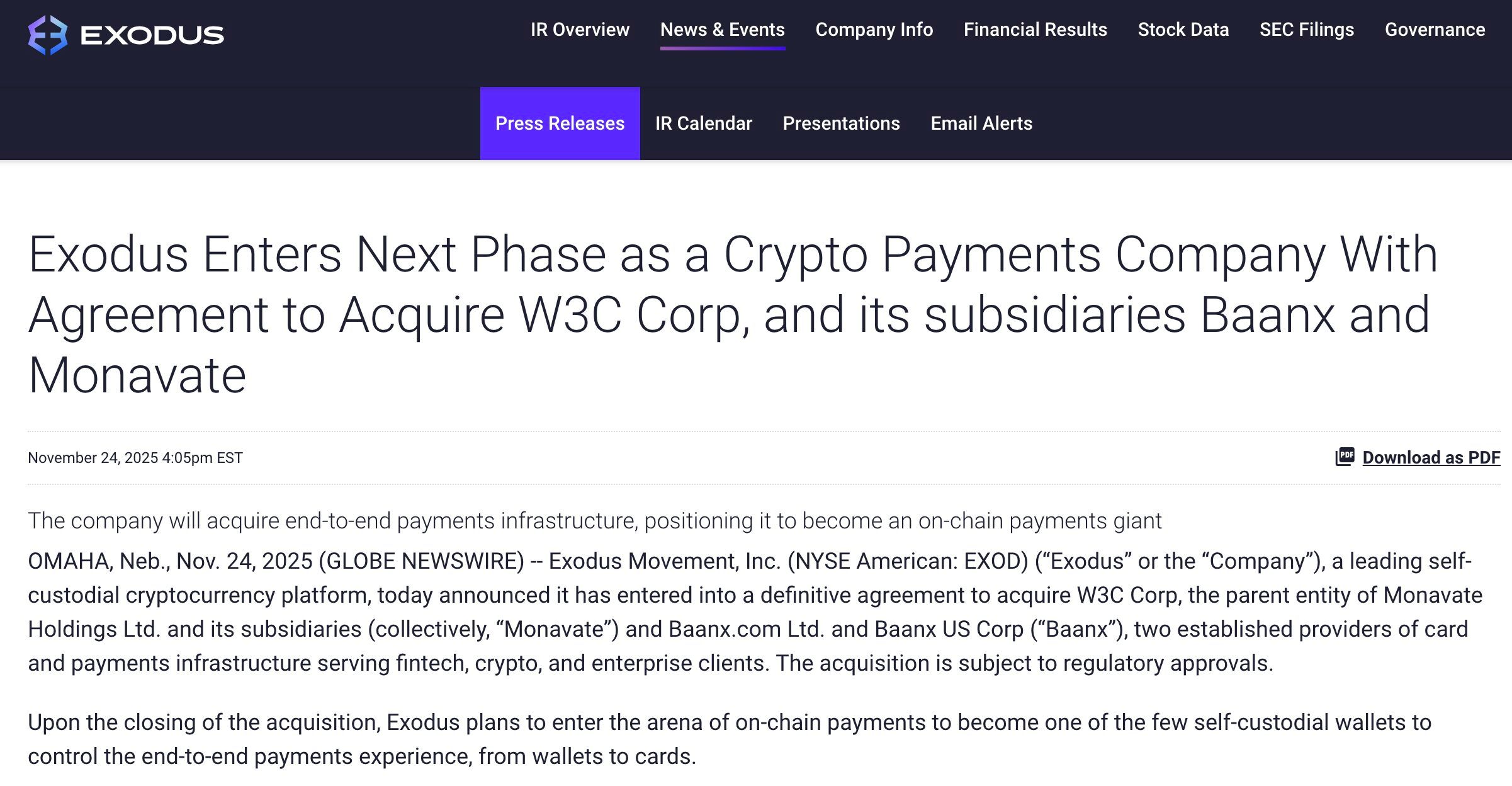
Crypto wallet provider Exodus is making a bold leap into onchain payments, revealing plans to acquire W3C Corp, the parent company of payment infrastructure firms Monavate and Baanx, in a $175 million deal.
A Bid to own the entire payments pipeline
Exodus CEO JP Richardson said the acquisition is aimed at closing the long-standing gap between holding crypto and actually spending it.
 Source:
Exodus
“By bringing card and payments infrastructure in-house, we are closing the gap between holding and spending, and positioning Exodus as the only platform you need for your money,”
he said.
By integrating Monavate and Baanx directly into its ecosystem, Exodus plans to internalize card issuance, processing and compliance tools. This reduces dependence on external vendors and expands the company’s capacity to support more payment assets, including popular stablecoins.
The move also gives Exodus the ability to issue cards through Visa, Mastercard and Discover.
Deal financed with Bitcoin-backed credit
To fund the $175 million acquisition, Exodus will combine cash reserves with borrowing from its credit line with Galaxy Digital, which is backed by the company’s Bitcoin holdings.
So far, Exodus has loaned $58.8 million to W3C to support its acquisitions of Monavate and Baanx, with the option to provide an additional $10 million in working capital. The whole transaction is expected to close in 2026.
Exodus CFO James Gernetzke said revenue streams from interchange, processing and program fees will form a key pillar of the company’s future payments business.
Integrations to boost XO swap and consumer tools
The company’s onchain aggregator XO Swap will gain access to Monavate and Baanx technologies for programmable payouts and turnkey card issuance. The investment follows Exodus’s recent purchase of Grateful, a LATAM-focused stablecoin payments platform.
Exodus’s expansion comes as global payment systems increasingly embrace stablecoins and blockchain settlement.
In September, Visa began piloting a system that enables banks to pre-fund cross-border transactions in USDC and EURC, offering faster settlement. Earlier, Swift announced a collaboration with Consensys and over 30 institutions to test a blockchain-based settlement layer designed for 24/7 global transfers.
Take control of your crypto portfolio with MARKETS PRO, DeFi Planet’s suite of analytics tools.”
Disclaimer: The content of this article solely reflects the author's opinion and does not represent the platform in any capacity. This article is not intended to serve as a reference for making investment decisions.
You may also like
Bitcoin Miners Are Fleeing to AI: So Why Is the Hash Rate Surging?

Once frenzied buying, now the "ammunition warehouse" shrinks by 51 trillion KRW! Korean retail investors can no longer afford to buy
In four months, Korean retail investors' "ammunition stockpile" has dropped by 36.5%, returning to levels seen at the beginning of the year. Although retail investors have collectively made net purchases exceeding 75 trillion won, they are still absorbing the sell-off, but the influx of new funds has dried up, and the replenishment rate lags far behind the consumption rate. Combined with the KOSPI plunging nearly 20% this month, continued net selling by foreign investors, and concerns over AI-related credit risks, the Korean stock market may find it difficult to see a sustained rebound in the short term without support from private investors' funds.
Apple Prints TD Sequential Sell 9 — Last Two Led to 15.66% and 13.63% Corrections

The Collapse of "Consensus Trading" and the Birth of a New Consensus! Goldman Sachs Explains: Why Institutions Are Currently Significantly Reducing AI Holdings
The extremely crowded trade of "going long on AI, short on everything else" is undergoing a painful unwinding—markets are no longer satisfied with the "burn rate narrative." Mega-scale cloud providers must deliver real, visible revenue conversions alongside $1.1 trillion in capital expenditures. A power gap of 40-50 gigawatts, rising capital costs, and a macro paradigm shift from an era of "overspending" are turning AI trades from a matter of faith into a harsh test of monetization.

Crypto prices
More


