
HyperVault raises rug pull fears after $3.6m vanishes

Suspicious withdrawals from Hypervault have set off fears of a rug pull, with millions in crypto assets rapidly moved out of the platform.
- Hypervault sparks rug pull fears with $3.6 million drained and funneled through Tornado Cash.
- The protocol’s official X account vanished after the withdrawals, fueling fears that the team has abandoned the project.
- Rugpulls in 2025 remain costly, with cases like MetaYield Farm and Mantra causing multi-billion-dollar investor losses.
Hypervault Finance is facing rug pull allegations after about $3.6 million in crypto was drained from the project in a series of suspicious transactions. According to on-chain data , the funds were first bridged from Hyperliquid to Ethereum, then converted into ETH.
Roughly 752 ETH was later deposited into Tornado Cash, a mixing service commonly used to obscure transaction trails.
The unusual activity mirrors a pattern often linked to rug pulls in decentralized finance, with sudden, unexplained withdrawals routed through privacy tools. For users still holding funds tied to the project, the move has fueled fears of an exit scam.
What is Hypervault?
Hypervault Finance promoted itself as a decentralized vault protocol offering cross-chain liquidity and flexible yield opportunities. The project marketed itself as a safer way to manage assets across networks, targeting investors looking for passive income streams.
“Hypervault is the premier hub for yield on HyperEVM,” it claimed. Its connection to Hyperliquid , a rising player in the perpetuals exchange space, had given it added visibility in the market. However, those promotions may have been a facade, as the abrupt disappearance of funds is now calling that credibility into question.
Adding another layer of suspicion, Hypervault’s official X account vanished alongside the funds, and no statement has been issued at the time of writing.
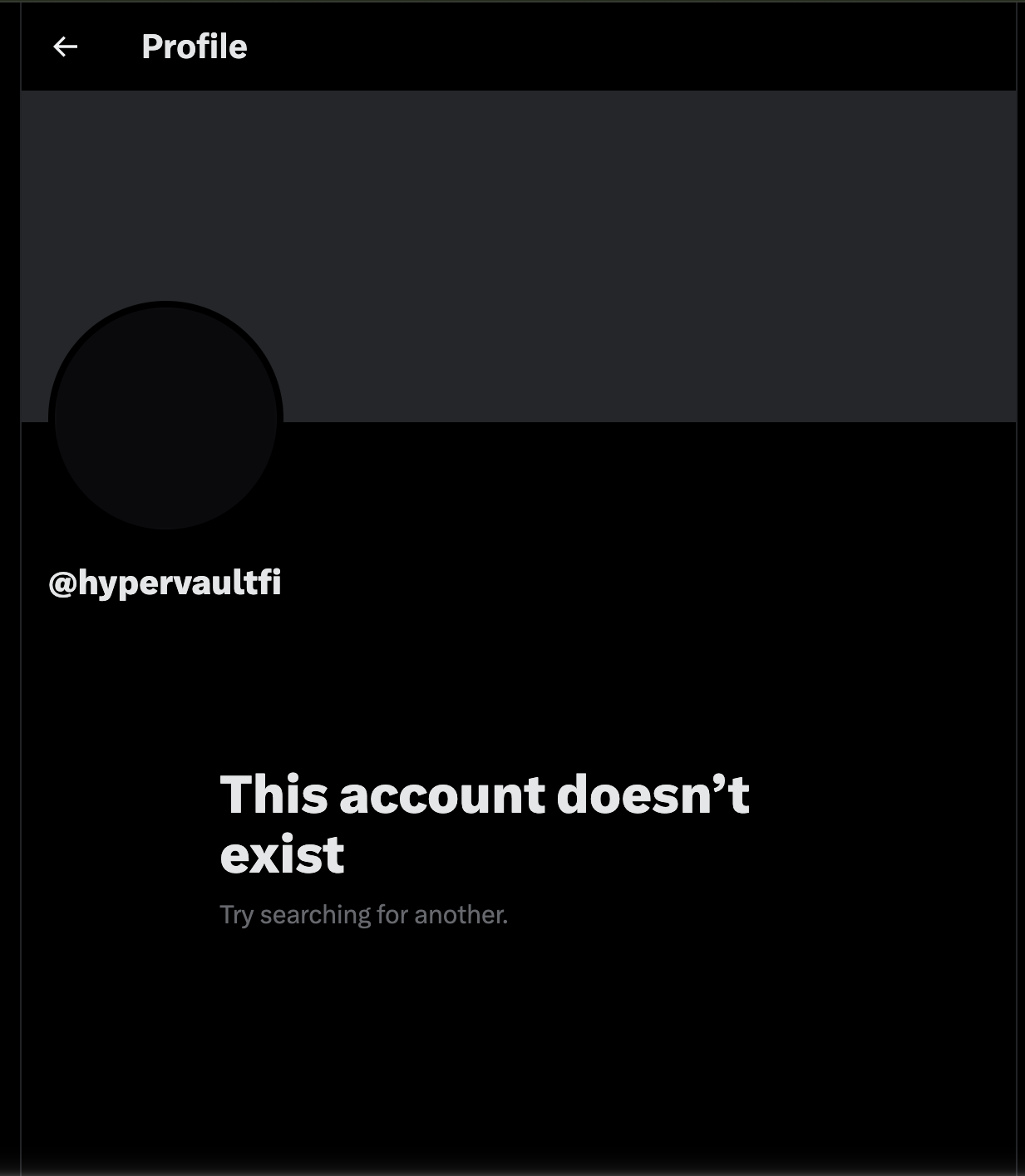 Screenshot of Hypervault’s profile amid rug pull concerns | Source: X
Rugpulls remain a risk in DeFi
Incidents like this highlight the persistent risks in decentralized finance. Rug pulls are a common exploit in the industry, where developers drain liquidity and abandon a project.
This trend has cost investors billions over the years. In some cases, even celebrity-backed or influencer-promoted projects have ended the same way, marketed as legitimate opportunities to attract retail investors, only for founders or promoters to quietly exit once liquidity peaks. These tactics often leave ordinary investors empty-handed, while those behind the schemes walk away with the proceeds.
So far this year, several cases have been recorded . The most significant to date came in February with MetaYield Farm, which drained $290 million from investors before vanishing.
Another such major incident was the fall of Mantra (OM), a DeFi protocol that collapsed in early 2025. In this event, insider wallets quickly moved $227 million in tokens, crashing OM’s price by over 90% and resulting in total investor losses of $5.5 billion. Founders denied wrongdoing, but wallet evidence and the rapid shutdown signaled classic rugpull patterns.
Until there is clarity from HyperVault’s team, the situation remains unresolved. The use of Tornado Cash, while not definitive proof, is a common tactic in cases where teams attempt to hide transactions after pulling funds, adding weight to speculation that the protocol’s operators may have walked away with users’ funds.
For now, the unusual activity suggests that Hypervault may be the latest rug pull in the DeFi sector.
Disclaimer: The content of this article solely reflects the author's opinion and does not represent the platform in any capacity. This article is not intended to serve as a reference for making investment decisions.
You may also like
Once frenzied buying, now the "ammunition warehouse" shrinks by 51 trillion KRW! Korean retail investors can no longer afford to buy
In four months, Korean retail investors' "ammunition stockpile" has dropped by 36.5%, returning to levels seen at the beginning of the year. Although retail investors have collectively made net purchases exceeding 75 trillion won, they are still absorbing the sell-off, but the influx of new funds has dried up, and the replenishment rate lags far behind the consumption rate. Combined with the KOSPI plunging nearly 20% this month, continued net selling by foreign investors, and concerns over AI-related credit risks, the Korean stock market may find it difficult to see a sustained rebound in the short term without support from private investors' funds.
Apple Prints TD Sequential Sell 9 — Last Two Led to 15.66% and 13.63% Corrections

The Collapse of "Consensus Trading" and the Birth of a New Consensus! Goldman Sachs Explains: Why Institutions Are Currently Significantly Reducing AI Holdings
The extremely crowded trade of "going long on AI, short on everything else" is undergoing a painful unwinding—markets are no longer satisfied with the "burn rate narrative." Mega-scale cloud providers must deliver real, visible revenue conversions alongside $1.1 trillion in capital expenditures. A power gap of 40-50 gigawatts, rising capital costs, and a macro paradigm shift from an era of "overspending" are turning AI trades from a matter of faith into a harsh test of monetization.

Starknet TVL crashes 3.7x to $42M after getting 93% vote to become L1
Crypto prices
More


