
Fintech: Poetry and Distance in the Crypto Space

In the near future of the crypto market, it may take only a few weeks for companies to go from fundraising to launching a product and reaching $1 million in daily revenue.
In the near future of the crypto market, it may take only a few weeks for a company to go from fundraising to product launch to $1 million in daily revenue.
Written by: @airtightfish
Translated by: AididiaoJP, Foresight News
The North Star is the fixed celestial body sailors use to keep their bearings. In the bubble-filled crypto market, what is the "North Star"?
Although BTC is near its all-time high, "fintech" is the real key to breaking out of the circle.
It's hard to attract people to university crypto clubs because nihilism is everywhere in this industry. People have seen through the predatory speculative games and are tired of them, and the outside world's view is even worse.
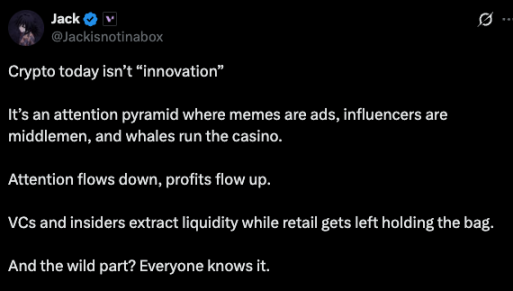
But this misaligned perception creates a huge opportunity: people overemphasize short-term speculation and underestimate long-term structural trends, which may be one of the greatest opportunities of our time.
Predatory Market Structures Are the Problem, Not the Future
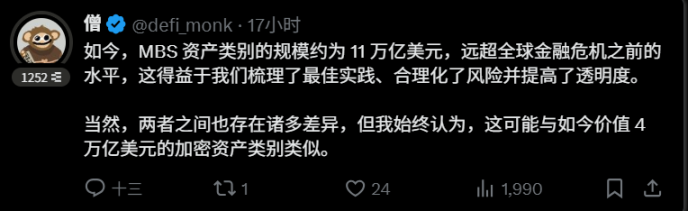
Memecoins reward influence, not cognition. When the market is driven by speculation, those with influence control the narrative. When no external funds are entering (a PvP environment), over time, those closely tied to influence have a sustained advantage, and extreme wealth disparity emerges. Trump allowed dozens of wallets to each make over $10 million, while thousands of small wallets lost money. This happens on a small scale in the "trenches" every day. By design, it's a zero-sum game and unsustainable in the long run. The days of frequent PvE markets are gone, and this is not just a Memecoins problem.

High FDV, low float games are even worse. High FDV, low circulating supply listings, structured market making, exchange listings, paid KOLs, teams selling OTC at steep discounts, supply control, and now "DATs"...
In too many cases, the token is the revenue source, and retail investors become the exit liquidity. If a project has no revenue (or no revenue path), then the token is likely just that.
This nihilism stems from the market model in crypto; people have figured out the game and are tired of it. It's not anyone's "fault," just the result of market evolution over time. This structure is unsustainable, and as the industry continues to mature, predatory behavior will play a smaller and smaller role as the market improves.
"In the short run, the market is a voting machine; but in the long run, it is a weighing machine."
Revenue Trends
Narratives still drive prices up, but participants now see it as trading, not investing. Speculative premiums are compressed as wealth shifts from outsiders to insiders, and prices keep falling. For projects with no fundamentals, the bottom is essentially zero.
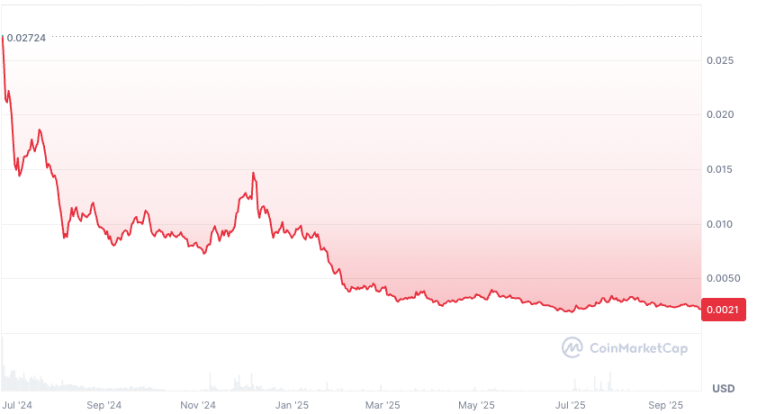
BLAST token price chart
Revenue is the baseline. In traditional finance, if a company makes money and the return on equity exceeds the internal rate of return, they can and are motivated to do buybacks (at a certain valuation, this holds true, and as growth occurs, that valuation grows). In crypto, it's more nuanced because you have to consider the structure of labs and foundations, and dig deep to ensure no one is faking key performance indicators. Nevertheless, cash flow is king.
The Crypto Market Won't Be Only PVP, Scaling Is Imminent
The market will expand at a faster pace
Replacing analyst reports are Twitter authors, liquidity funds, and proprietary traders, who will become the main marketing roles in the market.
Companies can be built in weeks, revenue can grow 10x in months, and I wouldn't be surprised to see a fundamentals-focused liquidity fund post 1000% returns in a year.
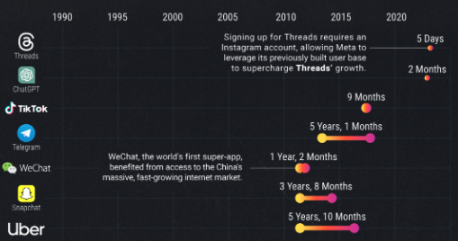
Social media continues to shorten the time needed to reach 100 million users
Internet-native dissemination
Social platforms have eliminated market entry friction, and people spend more time online than ever. We've already seen apps reach 100 million users in weeks (ChatGPT, Threads). Remini's AI avatar app surpassed tens of millions of downloads in about 30 days. Crypto is even more so: programmable incentives to reward users, creators, and referrers. Small teams with good products can scale faster than ever before.
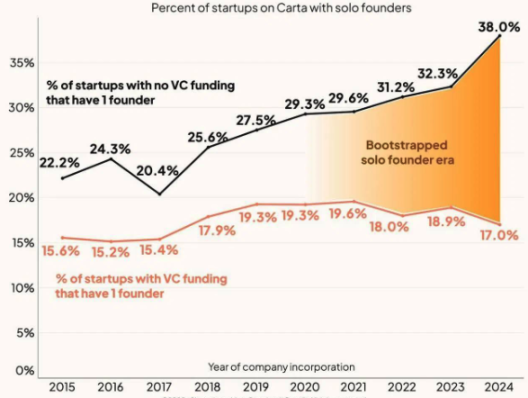
Fewer resources and less capital are needed to start a business, leading to more independent founders
AI Accelerates Startup Building
AI has changed the production possibility frontier. "Vibe coders" can build very complex businesses. Agents handle coding, marketing, support, analytics, and even some operations. These tools accelerate changes in market structure, and over 60% of adults say they want to build something of their own. Tools lower the threshold; ambition fills the gap. The long tail of startups is growing rapidly, and crypto can help solve the early capital formation problem for this new group of entrepreneurs. There are more ideas entering the market than ever, and smaller teams can scale.
Crypto Is the Cornerstone of Scaling
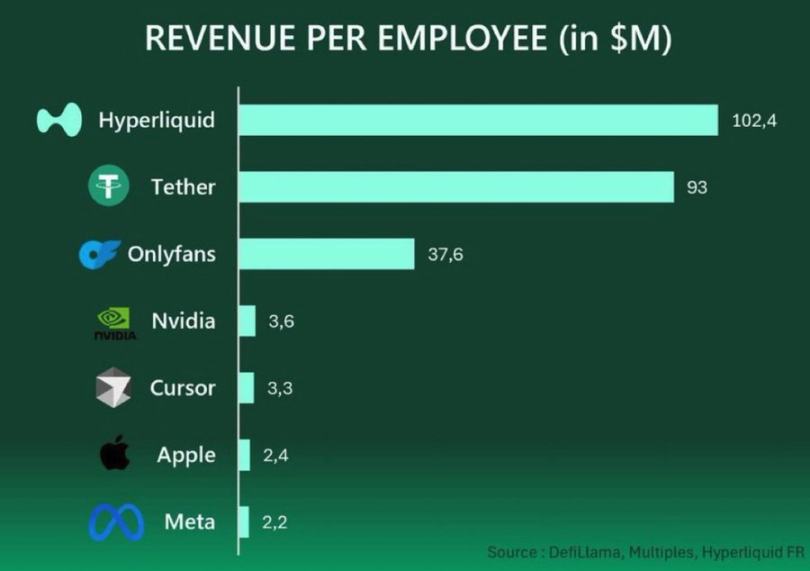
The companies with the highest per capita income in the world are Tether and Hyperliquid (both with per capita income exceeding $100 million), with others like PUMP and Axiom also in the top ten. Compared to other industries, the crypto market is still relatively small, and I expect to see more crypto companies on this list in the coming years. Crypto infrastructure enables trustless, scalable automation; it is composable and globally borderless. Teams can be small but still scale, and with early capital formation advantages and incentive mechanisms, you see companies like this: from fundraising (optional) to product to $1 million in daily revenue in just a few weeks. This trend will only accelerate, and in the next decade, hundreds or even thousands of unicorns will be created on-chain.
Internet Capital Markets (ICM)
The first wave of ICM led by Believe had the right direction but poor execution. The mechanism design was bad, and more importantly, the "companies" launched were closer to Memecoins than real businesses. Nevertheless, ICM is inevitable.
If you were to design a market from scratch, you would build a single universal layer for native issuance, trading, and settlement of any asset on a public chain, accessible to anyone in the world. I firmly believe this is the market's end state, and crypto gives us a clear path to achieve it. Coupled with internet dissemination, faster business expansion, and lower startup costs, you can envision this: millions of internet-native businesses can be built and invested in on-chain. It may take time to achieve, but I truly believe people underestimate the scale of opportunity here.
"We tend to overestimate the impact of a technology in the short run and underestimate its long-term effects." — Amara's Law
Disclaimer: The content of this article solely reflects the author's opinion and does not represent the platform in any capacity. This article is not intended to serve as a reference for making investment decisions.
You may also like
Wall Street sets a positive tone for the long-term prospects of AI; the Fed's interest rate path for October remains uncertain! Cooling US Treasury yields open a window for tech sector rebound?
Waller’s series of speeches at the IMF reinforced the view that cutting-edge AI technology will fundamentally reshape the economy in the long term, but he did not commit to a pause in rate hikes in October. For global semiconductor stocks, which have recently experienced heavy sell-offs and entered a correction phase, the positive aspect is that he did not further intensify short-term rate hike expectations.

Tesla's sports car can really fly!
Tesla's second-generation Roadster was unveiled at the SpaceX test site, marking a significant debut nine years after pre-orders first began in 2017. Mass production is scheduled for 2028. The new vehicle features a fan suction system and compressed air thrusters, enabling genuine "flight." Elon Musk confirmed that this will be Tesla's last model to support manual driving. Analysts predict that sales of 7,000 units in the first year could generate nearly $2 billion in revenue, with extremely high profit margins being its core commercial value.
Earnings season is here! Citadel Securities: The next few weeks will be the real stress test for U.S. stock fundamentals
The US stock market enters Q3 earnings season, with market expectations for S&P 500 earnings per share to grow 27% year-over-year, marking the third highest threshold ahead of earnings seasons since 2010. However, the growth is highly concentrated—Micron and Nvidia alone contribute 36% of expected gains. Retail investors’ weekly net buying surged to $9.1 billion, with semiconductor purchases reaching a historic peak. Citadel Securities warns that index volatility has fallen to its calmest range in nearly 30 years, while individual stock risks are quietly rising, making stock picking preferable to simply increasing index allocations.
Dangerous signal? CoreWeave founders cash out $3.3 billion after IPO
The founder's sell-off objectively avoided a 60% drop in share price, and some have already liquidated nearly 40% of their wealth. Behind this stark contrast, the company is burdened with a massive $52 billion debt, with a five-year default probability exceeding 60%. The current debt stands at $52 billion, and the cumulative negative free cash flow for 2026-2028 is projected to reach $71 billion. Its model of "borrowing at 9% interest to earn a 1% return" has been harshly criticized as the "subprime crisis" of the AI industry. The high-leverage computing power financing game is now facing the market's ultimate test.

Crypto prices
More


