
El Salvador Opens Door to More Bitcoin as Bukele’s Presidency Is Extended

El Salvador’s elimination of presidential term limits boosts Nayib Bukele’s ability to continue Bitcoin accumulation and shape the nation’s crypto future, despite transparency concerns.
The El Salvadorian legislative assembly voted to eliminate presidential term limits, a bold step toward consolidating political power.
The implications for crypto go beyond politics, as the move signals potential for more Bitcoin (BTC) accumulation.
El Salvador Expands Nayib Bukele’s Staying Power
The August 1 constitutional reforms, passed 57–3, allow President Nayib Bukele to seek re-election indefinitely. They also extend presidential terms from five to six years and postpone the next election to 2027.
Bukele is literally the most popular democratically-elected leader in the world.He took El Salvador from the murder capital of the world to the safest country in the Western hemisphere.When you get a once-in-a-century leader, you let him keep running for reelection.
— Geiger Capital August 1, 2025
The legislative overhaul comes at a moment when Bukele enjoys some of the highest approval ratings in the region, largely due to his iron-fisted crackdown on gang violence.
Yet critics, including human rights organizations and Western governments, argue that dismantling democratic checks could have long-term consequences.
Still, for the global crypto community, the implications go beyond politics. Bukele’s extended grip on power signals a continuation, and possibly expansion, of El Salvador’s Bitcoin-centric economic policy.
Since declaring Bitcoin legal tender in 2021, Bukele has positioned the nation as a symbol of financial sovereignty, even in the face of global skepticism.
Despite IMF pressure tied to a $1.4 billion credit program, which explicitly calls for a halt to further Bitcoin purchases, Bukele’s administration has continued to frame itself as an active Bitcoin accumulator publicly.
In late July, the government announced the acquisition of eight more BTC, purchased at an average price of $118,500 per coin. This brought the country’s total reported holdings to approximately 6,248 BTC, worth over $740 million.
EL SALVADOR JUST BOUGHT MORE BITCOIN
— The Bitcoin Office July 24, 2025

Data on Arkham Intelligence corroborates the report, showing that the El Salvador government holds 6,255 BTC worth $719.9 million at current rates.
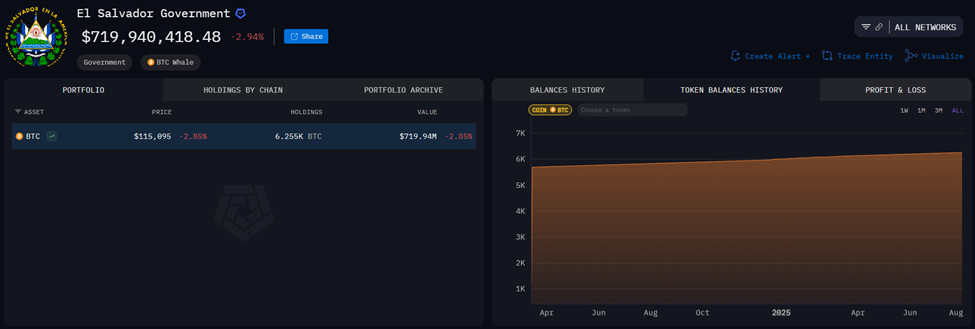 El Salvador BTC Holdings. Source:
Disclaimer: The content of this article solely reflects the author's opinion and does not represent the platform in any capacity. This article is not intended to serve as a reference for making investment decisions.
You may also like
How big is CoreWeave's funding gap? Goldman Sachs: Only $23 billion, buy! Bernstein: $76 billion, risky!
Bernstein points out that the Goldman Sachs model contains optimistic assumptions, while Goldman Sachs' own cash flow statement shows that it will incur $46.6 billion in new debt over the next two years—twice the headline figure of $23 billion. More importantly, Goldman Sachs holds over 1% equity in CoreWeave and serves as its underwriter. Currently, CoreWeave's unsecured bond yields have reached 15%, with the first DDTL repayment due right now, and losses are expected to continue until 2029.

JPMorgan says crypto regulatory moves partly offset Clarity Act failure, but risks remain
AI bubble concerns hit Asia-Pacific stock markets, South Korean stocks plunge 4% at one point, SK Hynix turns positive, gold drops below 4000 intraday
Samsung Electronics and SK Hynix both once fell over 4%. Later, SK Hynix turned positive, while Samsung Electronics remained down more than 2%. The Nikkei 225 Index dropped nearly 2%. The yield on Japan’s 10-year government bonds fell by 10 basis points to 2.78%. Safe-haven currencies such as the yen and Swiss franc strengthened, with the yen up 0.2% and the Swiss franc gaining 0.1%. Gold fell as much as 0.7% intraday, while spot silver dropped as much as 2% during trading. Brent crude climbed to a five-month high of $114 per barrel.
Crypto prices
More


