
Meme Coin Mirage: Research Shows Over 76% of Influencer-Endorsed Tokens Fail to Deliver

A recent study reveals the risks of investing in influencer-promoted meme coins, with most losing value rapidly. Experts stress due diligence and risk management.
Recent research by CoinWire highlights the risks of investing in meme coins, especially those promoted by influencers on X (formerly Twitter).
While they promise big profits, the study shows that most of these tokens end up causing major losses for investors.
Influencer-Promoted Meme Coins: The Grim Reality
The promise of quick riches is often tempting, but most investors end up chasing a mirage. A recent CoinWire report analyzed 1,567 meme coins endorsed by 377 influencers over the last three months. The findings are startling: 76% of influencers promote dead meme coins — tokens that have lost over 90% of their value.
Additional findings include that two-thirds (around 67%) of meme coins promoted by influencers are now worthless. The report also established that after three months, 86% of influencer-promoted meme coins experienced a 10X drop in value. Further, only 1% of influencers have successfully promoted a memecoin that achieved a tenfold gain.
The short-term performance is equally disheartening. After just one week, 80% of promoted meme coins lose 70% of their value. By the one-month mark, losses escalate to 80%.
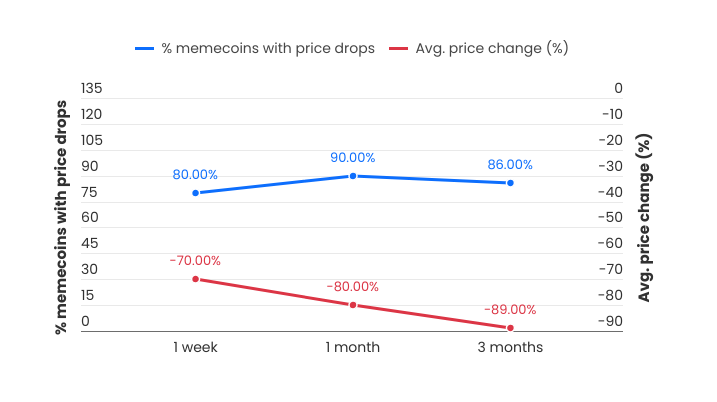 Influencer-backed Meme Coins Success Rate. Source:
CoinWire Research
Promotions by influencers often promise exponential gains, creating hype that draws in even inexperienced investors. Yet the data indicates that most of these campaigns prioritize influencer earnings over the quality of the projects promoted.
Influencers with over 200,000 followers perform the worst, with an average negative return of 89% after three months. Meanwhile, smaller influencers with less than 50,000 followers offer slightly better outcomes, with some even achieving positive returns over time.
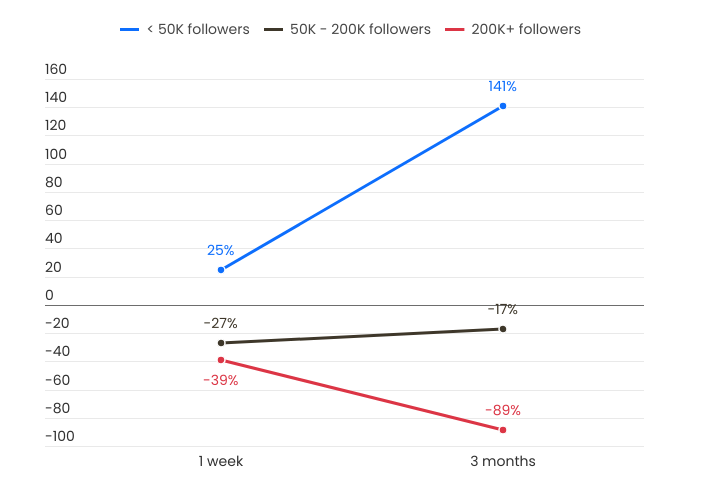 Success Rate of Influencer Predictions based on Followership. Source:
CoinWire Research
On average, influencers earn $399 per promotional tweet, incentivizing them to endorse meme coins regardless of their viability. This financial dynamic often leaves their audiences bearing the brunt of the losses.
The Role of X in the Meme Coin Boom
The challenges with influencer-backed tokens are not isolated incidents. BeInCrypto recently reported that 97% of all meme coins fail, with only 15 out of 1.7 million achieving sustained success. The reasons are multifaceted, ranging from lack of utility to poor project management.
The meme coin ecosystem is also rife with controversies. Blockchain investigator ZachXBT recently exposed 16 influencer accounts on X that coordinated pump-and-dump schemes, leaving their followers to absorb the losses. This has fueled debates about the ethical responsibilities of influencers in crypto markets.
Meanwhile, X remains a key platform for promoting meme coins among influencers. The platform’s ability to amplify hype makes it an effective vehicle for meme coin promotions but also a breeding ground for financial risks.
Despite the grim statistics, however, some traders still find opportunities in this volatile market. Crypto personalities like Justin Sun, founder of TRON, suggest evaluating meme coins based on community size, narrative strength, and utility.
Meanwhile, crypto influencer Miles Deutscher recently shared a four-step meme coin trading plan: focus on market timing, analyze tokenomics, understand project fundamentals, and manage risk through stop-loss strategies. Taken together, these approaches reflect the importance of caution and due diligence.
While the hype surrounding meme coins is undeniable, this context highlights the need for caution. Influencer endorsements, though enticing, are not reliable indicators of a token’s potential. Investors should scrutinize projects, considering factors like utility, community engagement, and long-term viability.
Disclaimer: The content of this article solely reflects the author's opinion and does not represent the platform in any capacity. This article is not intended to serve as a reference for making investment decisions.
You may also like
AI bubble alarm rings across Wall Street! Oaktree Capital's Marks disagrees: The market hasn't reached its most dangerous moment yet, and investors are not completely oblivious to risks.
Although investors are displaying typical FOMO (fear of missing out) sentiment regarding further gains in tech stocks, the market continues to draw comparisons between the current situation and past bubbles, indicating that investors are not unaware of the risks.

Barclays: Dual restrictions of physical and capital, data center growth will slow significantly in 2027!
Barclays' latest report reveals that the global data center construction boom is approaching a turning point—the year-on-year growth rate of new capacity will plummet from over 100% in 2026 to about 35% in 2027, and stabilize by 2028. Facing both physical constraints and tightened financing, hyperscale cloud providers will absorb more than 60% of new capacity, while the risk of project suspension for small and medium developers will sharply increase.

Bitcoin and Solana test key support as NEAR and HYPE face selling pressure
AI Capital Flow Chart: Nvidia Takes 690 Billion, Remaining 499 Companies Share 340 Billion
Morgan Stanley has released its first comprehensive overview of AI capital expenditure: In 2027, among $1.58 trillion in spending by hyperscale cloud service providers, Nvidia alone will take 67%, while the remaining 499 S&P component companies will collectively receive only $339 billion. A more hidden risk lies in over $1.1 trillion of "off-balance-sheet leases," which are essentially disguised debt. 2027 is predicted to have the largest free cash flow shortfall, and the risks of both volume and price declines are being severely underestimated by the market.

Crypto prices
More


