
La demande en IA reste forte, ASML prévoit un taux de croissance moyen des ventes de 8 % à 14 % au cours des cinq prochaines années

 Parallèlement, ASML s'est fixé un objectif :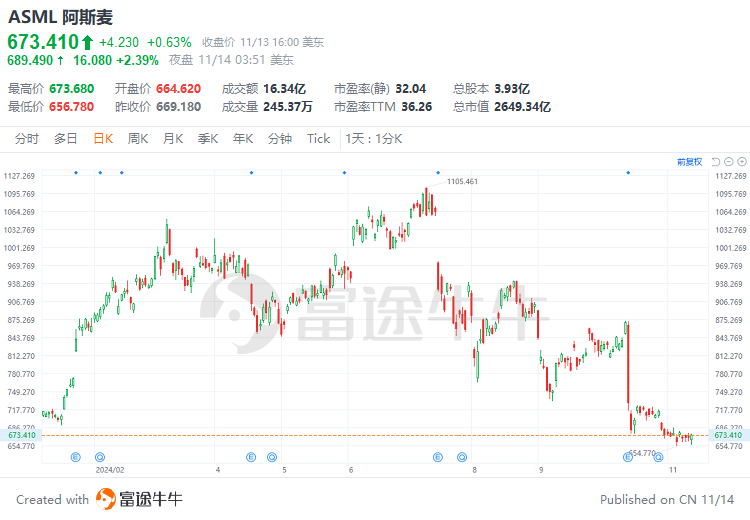
Source: Wall Street See
ASML reiterated its long-term growth prospects, announcing its sales target to reach 44 billion to 60 billion euros by 2030 unchanged, and committing to increasing dividends and share buybacks.
On Thursday, the Netherlands $ASML Holding (ASML.US)$ company reiterated its long-term growth prospects at the Investor Day, expecting global semiconductor sales to exceed $1 trillion by 2030, with a compound annual growth rate of about 9% from 2025 to 2030.
 At the same time, ASML has set its own target: keeping the sales target unchanged at €44 billion to €60 billion by 2030, with a gross margin of about 56% to 60% at that time. It is expected that in the next five years, the average sales growth rate will be between 8% and 14%, and a commitment to increase dividends and share buybacks.
Benefiting from the vigorous development of AI, the market has increased its strong demand for ASML's most advanced lithography machines.
ASML, as the world's only lithography machine manufacturer, holds a significant position in the semiconductor supply chain. Its lithography machines are essential tools for manufacturing advanced chips, used by apple, $NVIDIA (NVDA.US)$ Wait for the company's AI accelerator to provide support.
Therefore, ASML's performance is often seen as a benchmark for the entire semiconductor industry, and its long-term growth prospects also reflect the increasing global demand for advanced chips.
ASML's Chief Financial Officer, Roger Dassen, stated:
"We have reaffirmed our capital allocation strategy and expect to continue returning significant cash to shareholders through a combination of increasing dividends and share buybacks."
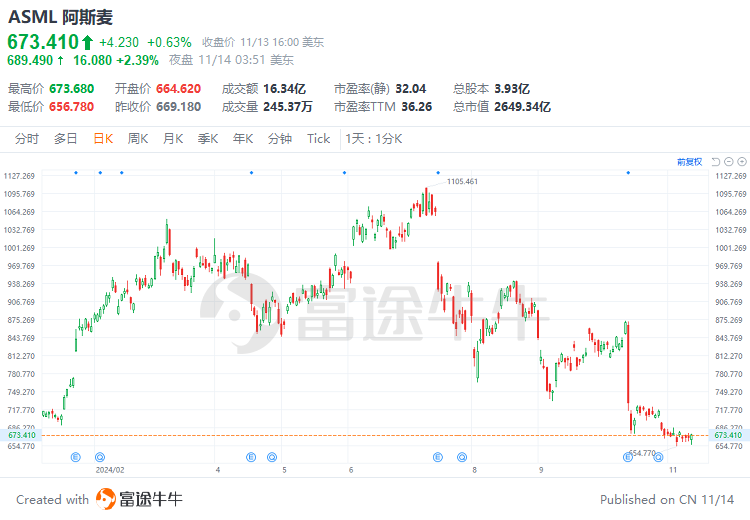
In October this year, ASML's third-quarter performance was disappointing, with orders only half of market expectations, causing the stock price to plummet by 17% on the same day. So far this year, the company's stock price has fallen by more than 5%.
The third-quarter financial report shows that China's sales were 2.79 billion euros, accounting for nearly half of ASML's total sales. The company expects that next year, Chinese sales will represent around 20% of total revenue.
Company CEO Christophe Fouquet previously stated in October that the slow recovery of the chip market will continue 'until 2025'. However, next year and 2026 will be the 'years of overall growth' for the industry and ASML.
Editor / jayden
Avertissement : le contenu de cet article reflète uniquement le point de vue de l'auteur et ne représente en aucun cas la plateforme. Cet article n'est pas destiné à servir de référence pour prendre des décisions d'investissement.
Vous pourriez également aimer
Des responsables de la Réserve fédérale émettent intensivement des signaux hawkish ! Le “numéro trois” affirme qu’une nouvelle hausse des taux pourrait avoir lieu cette année ; Goolsbee avertit que le maintien de l’inflation au-dessus de l’objectif, c’est “jouer avec le feu”.
Plusieurs responsables de la Réserve fédérale se sont exprimés sur les perspectives d'inflation et de taux d'intérêt.
OpenAI défie Meta : lancement de l’assistant personnel d’IA Dots, abonnement premium à 500 dollars par mois, soit 5 fois le tarif de la version avancée de Muse
Pour concurrencer Muse de Meta et gagner des parts de marché, OpenAI a lancé Dots, un agent d’IA « toujours en ligne ». Dots fonctionne grâce au modèle Astra de version GPT-6, capable de gérer de manière proactive des tâches telles que la recherche, la programmation ou la rédaction de documents pour le compte des utilisateurs. Le même jour, OpenAI a également lancé le modèle GPT-6.1 Sol, dont les performances s’approchent de celles d’Astra, mais dont le prix standard par token ne représente qu'un cinquième de celui d’Astra. Après l’annonce de Dots, le cours de Meta a connu une brève baisse avant de repartir à la hausse et de clôturer en hausse de 3,24 %.
Prix des cryptos
Plus


