Gold Trading Reminder: Middle East Missile Attack Hits Saudi Aramco, Gold Prices Under Pressure Awaiting US CPI Data Test
Huitong Network, October 14—Gold prices fell slightly on Tuesday as escalating Middle East tensions and the attack on Saudi Aramco boosted oil prices and inflation concerns, while statements by Federal Reserve officials suggested another potential rate hike by year-end, with high interest rates dampening the appeal of gold. The decline of the US dollar, combined with geopolitical risks, has put short-term pressure on gold prices. The future direction depends on the balance between data and policy signals.
On Tuesday (October 13), spot gold prices edged down to around $4,160 per ounce, with December gold futures also closing lower, as trading in the overall market appeared relatively calm. Beneath this surface tranquility, however, lies a hidden struggle between multiple forces. The Saudi Aramco headquarters complex was hit by a missile attack, leading international oil prices to surge to two-week highs, intensifying inflation concerns and supporting expectations for at least one more Fed rate hike this year, thus weighing on gold prices. However, the retreat of the US dollar from its high levels has provided some support for gold, with investors fixated on key US inflation data to be released later this week, as well as the latest statements from Federal Reserve leaders. Gold, as a traditional safe-haven and interest rate-sensitive asset, is currently being pulled by geopolitical strife, divergent monetary policy expectations, and fluctuations in energy prices. In the coming days, economic data and Fed communications are likely to be the key variables determining the short-term direction of gold prices. On Wednesday (October 14) during the Asian session, spot gold continues to face pressure, currently trading around $4,155 per ounce.
Renewed Middle East Conflict: Saudi Aramco Headquarters Attack Rattles Oil Markets and Inflation Expectations
Geopolitical tensions remain the most difficult yet unavoidable factor to quantify in today’s gold market. The conflict between Yemen’s Houthi forces and the Saudi-led coalition has escalated significantly, with a ballistic missile directly striking the headquarters of Saudi Aramco in Dhahran. The top three floors of the building were damaged and caught fire, with news spreading rapidly. As the world’s largest oil company, Saudi Aramco’s operational center manages vast onshore and offshore production networks. Any attack on its core facilities immediately sparks concerns over the security of oil supply.
Previously, Houthi forces had launched multiple missiles and drones at critical Saudi facilities, with Riyadh International Airport also under attack several times. At the same time, the Saudi-led coalition has retaliated against targets in Yemen, with the conflict now focused along the Red Sea coast and near the Bab-el-Mandeb Strait. With the Strait of Hormuz obstructed, Bab-el-Mandeb has become an even more crucial energy corridor, and its security directly affects global oil transport costs. As a result, international oil prices once surged sharply, with both US crude and Brent crude reaching new two-week highs. Rising oil prices are transmitted downstream through refined products, jet fuel, and diesel, intensifying concerns over persistent inflation.
For gold, such geopolitical shocks have dual effects. On one hand, war risks increase safe-haven demand, theoretically supporting gold prices. On the other hand, the inflationary pressure from surging oil prices reinforces the Fed’s need to maintain or even tighten monetary policy further, pushing real interest rate expectations higher and putting pressure on the non-yielding gold. Currently, the market’s focus is more on the latter, as short-term inflation data has a more immediate impact on the Fed’s policy path. Analysts at Commerzbank point out that rate hikes are increasingly becoming a double-edged sword for gold: higher rates raise the opportunity cost of holding gold, but also increase the fiscal burden for many governments, potentially heightening concerns about debt sustainability—which, in the long term, might actually support gold.
Diverging Fed Officials’ Statements Lead Market to Bet on Slower Rate Hikes
Monetary policy expectations are the core driver of the current gold price trend. In September, the Fed raised its policy rate to the 3.75%-4.00% range, and the market previously expected further aggressive actions. However, recent statements by several Fed officials have dampened such expectations. Boston Fed President Collins clearly stated that she supported the September rate hike and considered another modest hike by year-end appropriate to ensure inflation returns to the 2% target in a timely manner. She also emphasized the solid performance of the economy and job market, saying the Fed can focus more on controlling inflation, though AI infrastructure investment, tariffs, and the energy cost surge from Middle East tensions may complicate disinflation efforts.
New York Fed President Williams, however, takes a more cautious view. He reiterated the potential need for another rate hike in 2026, but sees no reason currently to believe further action will be required in 2027. Williams noted that anti-inflationary forces are at work, expecting overall inflation to fall sharply next year and approach the 2% target, adding that tariff issues will gradually fade and energy prices will not remain a persistent pressure. He emphasized that the current economy is not overheating and, aside from specific shocks, will not generate extra inflation pressure. These comments echo those of Fed Governor Waller: the recent rise in US Treasury yields reflects stronger economic growth and massive AI investment, rather than runaway inflation expectations, which remain “firmly under control.”
CME FedWatch tools show traders currently see only a roughly 20% chance of a Fed hike this month, while the probability for a December hike is as high as 88%. The overall market tends to believe there is no urgent need for the Fed to act before more data is available. This expectation gap has somewhat alleviated gold’s pressure in a high interest rate environment. While high interest rates do undermine gold’s relative appeal, signs of a slower pace of hikes or peaking real rates would also reduce gold’s opportunity cost pressure.
Bond and Forex Market Linkages: Dollar Weakness Provides Gold a Breather
The US bond market and dollar trends also play crucial roles in gold pricing. On Tuesday, long-term Treasury yields edged slightly lower in tandem with European bond markets, while two-year short-term yields rose slightly ahead of inflation data releases. Ten-year Treasury yields pulled back from previous highs but remain elevated. Volatility in the French bond market was one catalyst for the global yield pullback, as some investors switched to government bonds as a safe haven following selloffs in Asian technology stocks, further depressing long-end yields.
The US dollar index has retreated from its 18-month peak. Growing skepticism over the sustainability of AI-related stock valuations has stifled some capital inflows into US financial markets. At the same time, comments from New York Fed President Williams also accelerated the dollar’s decline. A weaker dollar usually benefits dollar-denominated gold, providing some support to gold prices. However, whether this support can persist depends on whether upcoming inflation data is sufficient to change the market’s pricing of the Fed’s policy path.
The International Monetary Fund also warned that the risks posed by high public debt and rising bond yields should not be overlooked, and that inflation pressures stemming from war could drive yields even higher. Such macro-level concerns mean the value of gold as a long-term hedge hasn’t disappeared—only that it is temporarily suppressed by the market’s wait-and-see attitude toward data.
Awaiting Key Data: The Future Direction of Gold Hinges on the Battle Between Inflation and Policy Signals
In summary, the current slight decline in gold prices reflects market caution ahead of major events rather than a shift in trend. The volatility in oil prices and inflation worries triggered by Middle East conflict, the Fed officials’ prudent stance on rate hike pace, and the dollar’s retreat from highs together form a web of forces impacting gold. The upcoming releases of the Consumer Price Index (CPI), Producer Price Index (PPI), and the Fed Chair’s speech later this week will be key to breaking the impasse. Should inflation data remain sticky—especially if it rises again on higher energy costs—the market may reprice for a more persistent high-rate environment, thus pressuring gold. Conversely, if data show signs of cooling inflation alongside persistent geopolitical risks, gold’s safe-haven and hedging qualities could regain market favor.
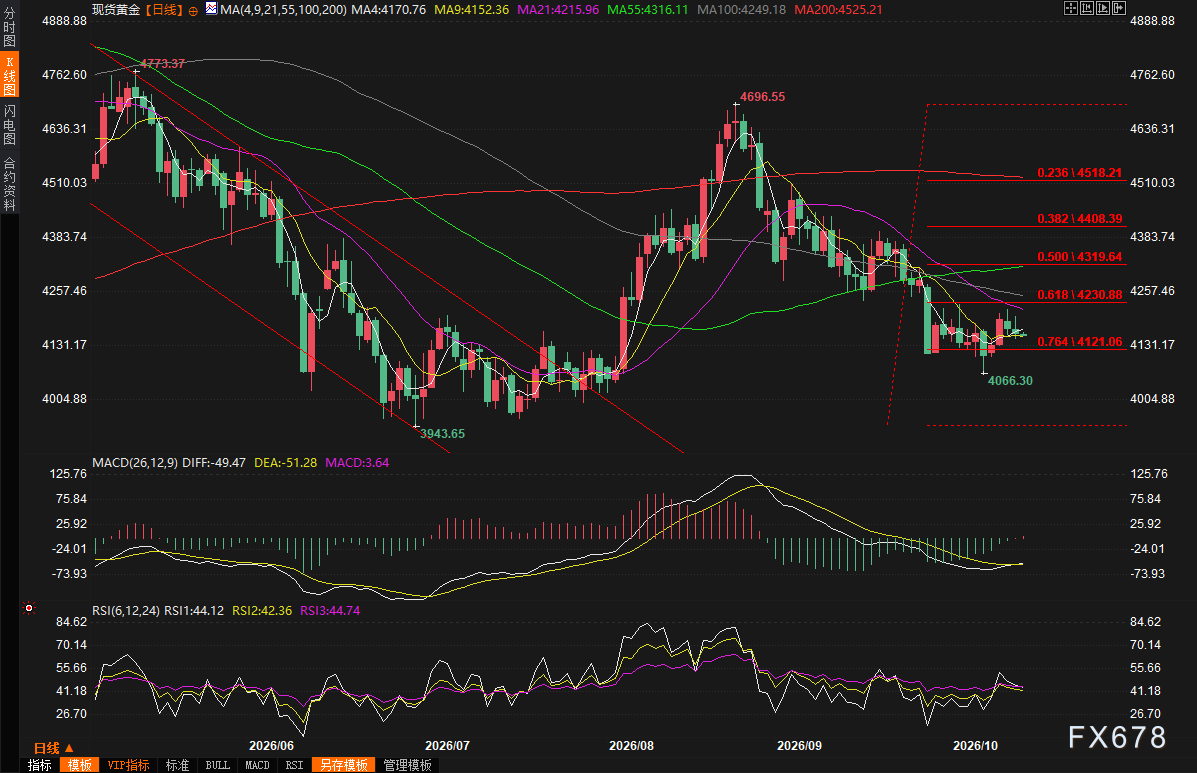
(Spot gold daily chart, source: EasyExchange)
07:24 (GMT+8), spot gold is quoted at $4,155.94 per ounce.





