
Morgan Stanley's Wilson: Stock market correction is nearing its end! Prepare for new strategies! (In-depth analysis)

Morgan Stanley's Chief Equity Strategist Michael Wilson believes thatthe months-long internal adjustment in the US stock market is nearing its end, and investors should prepare to increase risk exposure.With quality factors reaching new highs, earnings revisions diverging further, and cyclical stocks experiencing valuation compression, a mid-cycle rotation signal is emerging. As S&P 500 earnings prospects remain strong, Wilson recommendsprioritizing high-quality stocks and focusing on capital goods sectors with improving earnings and more attractive valuations.

The core value of Michael Wilson’s report is not the bullish directional conclusion, but his assessment of the nature of the current US stock market correction: This is not the prelude to a cyclical bear market, but rather an “internal cleansing” beneath the calm surface of the indices, marking a transition from early to mid-cycle.The drop in equal-weighted indices, valuation compression in cyclicals, and new highs in quality factors all point to a structural fact—the “pain” of adjustment is focused on low-quality and rate-sensitive assets, while market pricing is systematically shifting towards high-quality assets. Understanding this distinction is a prerequisite to understanding Wilson’s “preparation for positioning” advice.
I. Divergence Hidden by Indices: The True Form of the Adjustment
The S&P 500 market cap-weighted index is only about 2% below its historical high, but its equal-weighted version has fallen nearly 4% since its August 14 peak. Sectors such as financials, industrials, and consumer discretionary—cyclicals—have borne most of the valuation compression shock. The gap between the “calm” of index levels and the “deterioration” in internal breadth is itself evidence that adjustment is underway—but it is taking the form of structural repricing, not a broad-based decline.
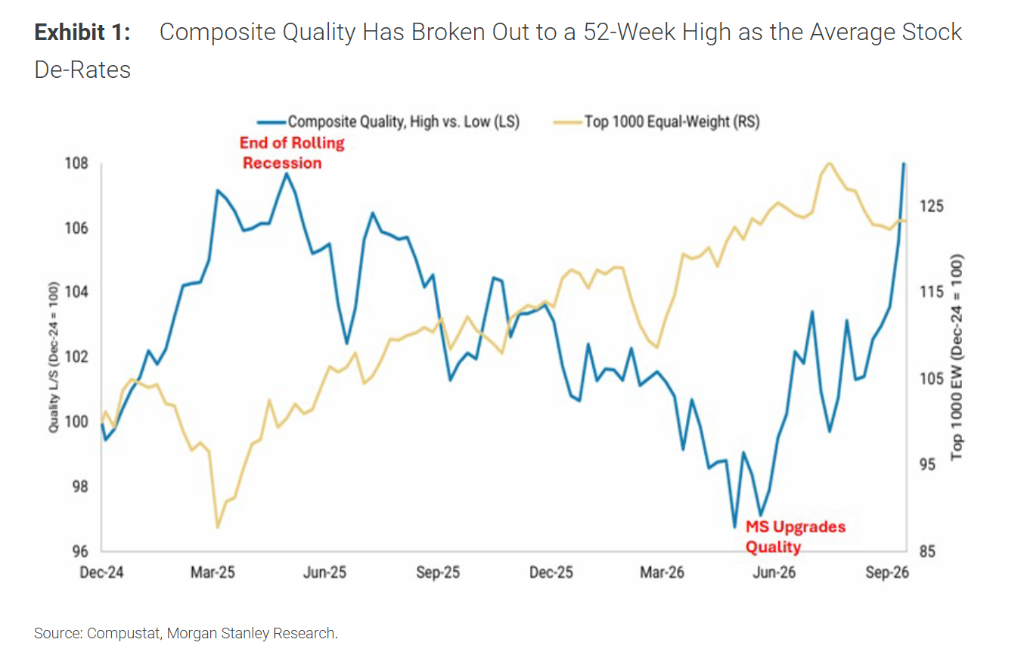
This divergence is even more pronounced on a factor basis: The Morgan Stanley Quality Factor Composite Index has hit a 52-week high, rising about 6% since mid-August, clearly diverging from the equal-weighted S&P 500.Wilson interprets this as a clear signal of the market rotation from early-cycle low-quality leaders to mid-cycle high-quality leadership. In other words,capital hasn’t left US equities, but has reallocated internally from “cyclical elasticity” to “earnings quality” prioritization.
The timing anchor for this judgment can be traced back to “Liberation Day” in April 2025. Wilson believes that the tariff shock then marked the bottom of the rolling recession starting in 2022, opening a new economic cycle; by June 2026, the rate of change in earnings revision breadth for low-quality, early-cycle leaders (semiconductors, consumer discretionary, and financials) peaked, and with Fed Chairman Warsh’s more hawkish policy stance, the mid-cycle transition was confirmed.What is happening now is thefinal digestion stageof this transition in terms of price.
II. Earnings Revision Gap: Quality Premium Pricing Has Yet to Fully Unfold
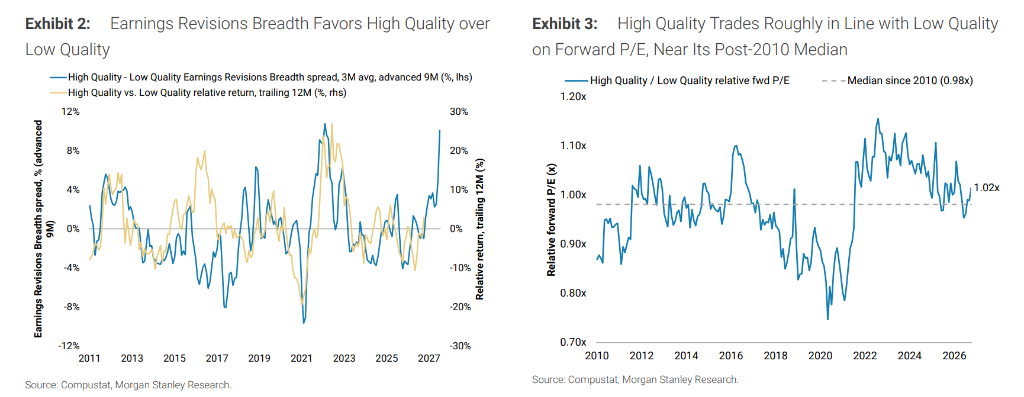
Earnings revision data offers a more fundamental basis for the “quality rotation” than price action. The breadth gap in earnings revisions between high- and low-quality stocks has widened to about 10%, the second highest since 2010. Historical back-testing provides a key reference: When this gap is at its highest quintile, high-quality stocks have, on average, outperformed low-quality peers by about 8% over the next 12 months, versus an average outperformance of only about 1% across all periods.
Valuation conditions are even more noteworthy. High-quality stocks’relativeforward PE ratios remain near their historical median, which means investors have yet to pay an extra premium for this earnings advantage.In Wilson’s framework, this is an asymmetric opportunity structure: The direction of earnings revision clearly favors quality, but prices have not fully reflected this trend.The judgment that the correction is nearing its end is, in essence, a confirmation of “pricing lagging fundamentals” rather than a simple contrarian sentiment play.
III. “Proxy Tightening” in Financial Conditions: A Constraint Not Yet Officially Acknowledged by the Fed
Another main thread in the current adjustment is the independent shock to cyclicals from tightening financial conditions. The Morgan Stanley Financial Conditions Index—composed of rates, the dollar, and energy prices—has tightened to about 1.4 standard deviations, the highest since the aggressive hiking cycle in 2022; the 10-year US Treasury yield has broken above 5.3%, the dollar is at a cycle high, and oil prices remain elevated.On an equal-weighted basis, financials, materials, consumer discretionary, and industrials have notably underperformed the market since mid-August.
Wilson’s key insight is that:the market has to a significant extent performed the tightening work on the Fed’s behalf.Rising long-term yields, a strengthening dollar, and high energy prices have collectively imposed tangible restraints on rate-sensitive assets. Whether Warsh recognizes this tightening becomes a near-term key variable: If he acknowledges the market’s partial substitution of Fed tightening, pressure on rate-sensitive assets could ease; if he continues to prioritize inflation risks and ignores the ongoing tightening, long-term yields and cyclicals could remain under pressure.Warsh provided no new guidance at the IMF meeting, and markets interpreted this as in line with previous pricing; Morgan Stanley economists expect rates will be held steady in October.
The significance of this variable is not in forecasting the Fed’s next move, but in identifying anasymmetric risk structure: Financial conditions have tightened to levels comparable with only a few historical periods, so the scope for further tightening is limited, and any recognition of the reality of tightening could trigger a release of pressure on rate-sensitive assets.
IV. Structural Earnings Resilience: Why This Adjustment Is Not a Recession Signal
Wilson’s confidence that the adjustment is nearing its end is ultimately based on earnings, not valuations or sentiment. S&P 500 Q3 earnings are expected to grow year on year by about 24.6%–27% (depending on data sources), with 2026 and 2027 EPS growth forecasts of 33% and 16%, respectively.More crucially, the structural source of earnings growth: AI-related capex is forming a clearly multiplicative transmission chain.
Morgan Stanley estimates that in 2027, hyperscale and emerging cloud service providers’ AI capex will total $1.58 trillion, with about 65% flowing into S&P 500 companies, directly contributing about 5% of S&P 500 revenues and about 25% of revenue growth; AI-related companies’ 2027 earnings growth is expected to reach 25%, compared to only 4% for non-AI companies.This structural gap means thatthe “center of gravity” of earnings growth is shifting from broad cyclical recovery to AI infrastructure and its adoption ecosystem.Early earnings season signals (with about 10% of companies reporting, median next-day stock price reaction is -0.4%, and only 41% registering positive reactions) show market tolerance for performance has diminished somewhat, but this is more a normalization after expectations were raised, not a reversal of the earnings trend.
V. Positioning Framework: Quality as the Foundation, Capital Goods Delivering Cyclical Elasticity
Wilson's allocation advice is not as simple as “switching from defense to offense,” but rather an extension of the meaning of “quality” under a mid-cycle framework.
The core positions remain anchored in high-quality stocks, with screening criteria including the top 1,000 by market cap, top quartile in quality composite score, recent upgrades to NTM EPS, and rated as Overweight by Morgan Stanley. Representative names highlighted include Alphabet, Apple, Broadcom, Micron, Visa, Mastercard, Costco, Trane Technologies, and Vertiv, spanning information technology, payments, consumer, and industrial sectors.This portfolio is characterized by: upward earnings revisions, valuations remaining near historical medians, and “entry costs” for the quality premium still manageable.
Tactical elasticity comes from the capital goods sector. As early as October, Wilson noted that the capital goods sector led in earnings revision breadth among industries; after valuation corrections, the “heavy asset sectors are starting to look more attractive.”The October 19 report further refines this: improvement in earnings revision breadth for capital goods coincides with a broader trend of manufacturing order backlogs, making it the most cyclically elastic segment within the quality framework.The significance of capital goods lies in their meeting both the “quality” (upward earnings revision) and “cyclical exposure” (manufacturing activity sensitivity) criteria, rather than forcing a choice between them.
Wilson summarizes three indicators for judging whether the adjustment is truly over: whether financials’ relative performance can stabilize during earnings season, whether bond volatility keeps declining, and what Warsh says about financial conditions tightening.All three point to the same underlying question—whether the “self-fulfilling” cycle of financial conditions tightening is approaching its limit.
VI. Conditionality Must Be Maintained
This judgment is highly contingent on two conditions, and is not an outright bullish stance.
First, financial conditions must not continue tightening systemically from current levels.If long-term yields rise further under a hawkish Warsh, valuation compression in cyclicals could shift from “nearing its end” to “repricing anew.” Wilson’s base case is for long-end yields to stabilize and earnings to return as the main driver of returns; but under a risk scenario, the historical relative protection of quality stocks is still a defensive option, not an unconditional broad risk extension.
Second, the transmission chain of AI capital expenditures must not break.By 2027, S&P 500 earnings growth’s dependence on AI-related capex is highly concentrated in forecasts. If hyperscale cloud providers significantly slow their capex pace, the structural support for earnings fundamentals would need reassessment, and the mid-cycle rotation narrative would require adjustment.
Wilson’s report is a view on the internal structural rotation within US stocks, not a uniform bullish signal for all global risk assets.
Wilson’s conclusion can be summed up in one sentence:The adjustment is nearing its end not because the decline has been deep enough, but because the decline has been “right”—it has precisely targeted low-quality and rate-sensitive assets, and the direction of earnings revision, quality factor price behavior, and the historic extremes of financial conditions together point to a narrowing window for positioning.But this window calls for selective risk exposure, not indiscriminate chasing of the cycle. Quality as a base, capital goods delivering elasticity, and using three key indicators for timing is the more disciplined way to express this framework.
Disclaimer: The content of this article solely reflects the author's opinion and does not represent the platform in any capacity. This article is not intended to serve as a reference for making investment decisions.
You may also like
Netflix (NFLX.US) Q3 revenue up 12% year-on-year; full-year advertising revenue forecast downgraded; stock price falls over 5% after hours
Driven by growth in subscribed users, higher membership prices, and increased advertising revenue, Netflix's Q3 revenue increased by nearly 12% year-on-year, net profit surged by 44%, and operating profit margin further expanded.
AI trading is expected to make a comeback after the US midterm elections! Citadel Securities: Investors are waiting for the right time to re-enter the market
Scott Rubner, Head of Stock and Derivatives Strategy at Castle Securities, stated that with the US midterm elections approaching, investors are temporarily avoiding stocks related to artificial intelligence. However, this situation may reverse after the elections conclude in November.

United Airlines (UAL.US) Achieves Record High Revenue in Q3, Up Over 17% Year-on-Year to Nearly $17.9 Billion
Benefiting from strong passenger demand, rising ticket prices, and growth in premium cabin business, United Airlines' Q3 revenue increased by 17.4% year-on-year, reaching a historic high.

Anthropic prepares for epic IPO! Future computing power expenditures may reach $750 billion, net loss of $80.7 billion in the first half of the year
According to reports citing the draft prospectus for the initial public offering of artificial intelligence startup Anthropic, as the company prepares to go public in the US stock market, it may need to invest up to $750 billion in additional computing power over the next few years.


