Are U.S. Treasury Yields Related to Oil Prices? Understanding Oil Price Movements Through 3 Historical Data Sets
When U.S. Treasury yields remain elevated, with some maturities approaching or moving above 5%, the market is usually sending a clear message: investors expect U.S. interest rates to stay higher for longer.
At the same time, geopolitical risks in the Middle East, concerns over shipping disruptions, OPEC+ supply policies, and inventory changes can all push oil prices higher.
For traders, however, the key takeaway is this: rising oil prices usually add upward pressure on U.S. Treasury yields. But if oil surges because of war or supply disruptions, Treasuries may strengthen on safe-haven demand, causing yields to fall.
In other words, crude oil and U.S. Treasury yields often move in the same direction, but they can diverge sharply when geopolitical risks escalate.
1. What Do Historical Data Tell Us?
Long-term historical data for WTI crude oil and the U.S. 10-year Treasury yield offer several straightforward conclusions.
Conclusion 1: Over the Long Term, Oil Prices and 10-Year Treasury Yields Tend to Be Positively Correlated
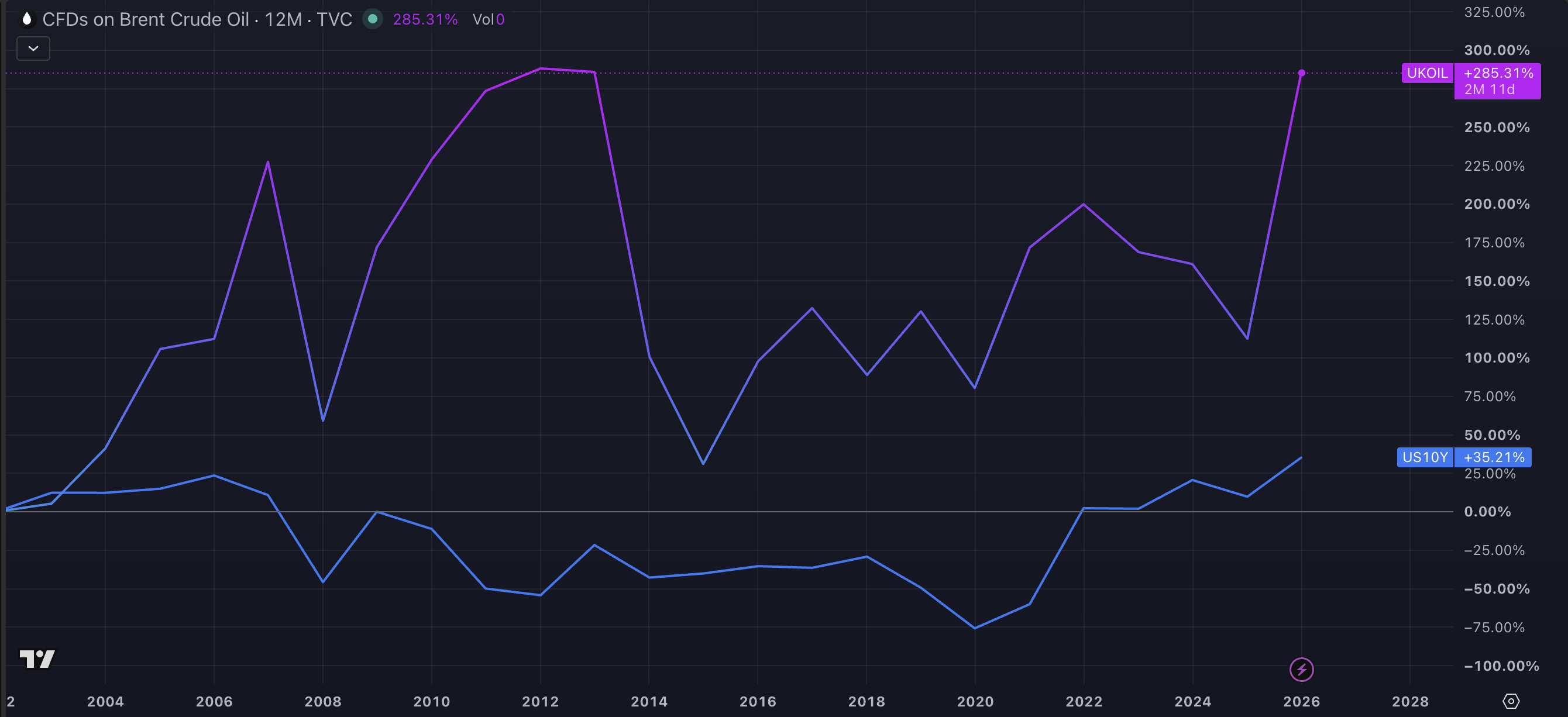
Based on monthly data since 2000, changes in WTI crude oil prices and changes in the U.S. 10-year Treasury yield have generally shown a weak-to-moderate positive correlation.
Put simply:
-
When oil prices rise, Treasury yields are more likely to rise;
-
When oil prices fall, Treasury yields are more likely to decline;
-
However, this does not happen every day and is not accurate 100% of the time.
Historically, their monthly correlation has generally been in the positive 0.2 to 0.4 range.
This means the two markets are related, but oil prices alone cannot be used to predict Treasury yields.
Conclusion 2: When Rising Oil Prices Reflect Strong Economic Growth, Yields Are More Likely to Rise
When oil prices rise because global demand is strong, U.S. economic data beat expectations, or industrial activity improves, markets usually interpret this as a sign that:
-
Inflation may be harder to bring down;
-
The Federal Reserve may be in no hurry to cut rates;
-
Higher interest rates may remain in place for longer.
In this environment, oil prices and Treasury yields often rise together.
Example: 2022
| Item |
Early 2022 |
Near 2022 Highs |
Change |
| WTI Crude Oil |
Around USD 75–85 |
Exceeded USD 120 at one point |
Peak gain of more than 50% |
| U.S. 10-Year Treasury Yield |
Around 1.5% |
Approached 4.3% at one point |
Rose by around 280 basis points |
| U.S. 2-Year Treasury Yield |
Around 0.7% |
Exceeded 4.7% at one point |
Rose by around 400 basis points |
2022 was a classic example. The Russia-Ukraine war triggered concerns over energy supply, while U.S. inflation surged. Markets quickly repriced expectations for Federal Reserve rate hikes.
Oil was not the only reason yields rose, but it reinforced market expectations that inflation could remain elevated for longer.
Conclusion 3: When Oil Surges Because of War, Oil and Yields May Diverge in the Short Term
If conflict in the Middle East escalates, shipping routes are disrupted, or oil production facilities are at risk, crude prices may rise rapidly.
At the same time, capital may flow into U.S. Treasuries for safety. This can create the following market setup:
| Asset |
Possible Movement |
| Crude Oil |
Rises |
| Gold |
Rises |
| U.S. Dollar |
Rises |
| U.S. Treasury Prices |
Rise |
| U.S. Treasury Yields |
Fall |
This happens because investors may be doing two things at once:
1. Buying oil to hedge against supply disruptions;
2. Buying U.S. Treasuries to hedge against rising market risks and potential economic damage.
Therefore, a surge in oil prices does not automatically mean Treasury yields will continue to rise.
2. Three Historical Periods Retail Traders Should Understand
2003–2007: Oil Prices and Treasury Yields Rose Together
During a period of global economic expansion and rapidly rising demand from China:
-
WTI crude oil rose from around USD 30 to nearly USD 100;
-
The U.S. 10-year Treasury yield increased from around 3.1% to about 5.2%.
This was a classic “strong economy, strong energy demand, rising rates” environment.
Market Logic at the Time
Strong economic growth
→ Higher oil demand
→ Rising oil prices
→ More inflation pressure
→ Higher Treasury yields
2008 Financial Crisis: Oil Prices and Treasury Yields Fell Together
In the first half of 2008, WTI crude oil climbed to around USD 147. However, as the financial crisis intensified and the global economy entered recession, oil prices fell to around USD 30 by the end of the year.
Over the same period, the U.S. 10-year Treasury yield dropped sharply from around 4% to near 2%.
| Item |
Near 2008 Highs |
Near the End of 2008 |
| WTI Crude Oil |
Around USD 147 |
Around USD 30–40 |
| U.S. 10-Year Treasury Yield |
Around 4% |
Around 2% |
This period shows that when markets fear recession, falling oil prices and falling Treasury yields often occur at the same time.
The reason is not that oil alone drives Treasuries. Instead, both markets are responding to weaker demand and stronger safe-haven sentiment.
2022–2023: Inflation, Rate Hikes, and a Higher-for-Longer Environment
In 2022, oil prices were supported by the Russia-Ukraine war and concerns over energy supply. At the same time, U.S. inflation reached multi-decade highs, prompting the Federal Reserve to raise rates aggressively.
By 2023, markets faced a different combination of factors:
-
The U.S. economy remained more resilient than expected;
-
Inflation declined more slowly than markets expected;
-
The Federal Reserve maintained high interest rates;
-
U.S. Treasury issuance increased;
-
The U.S. 10-year Treasury yield approached 5% at one point.
Key Figures for 2023
| Item |
Early 2023 |
Around October 2023 |
| U.S. 10-Year Treasury Yield |
Around 3.9% |
Approached 5.0% at one point |
| WTI Crude Oil |
Around USD 78–80 |
Approached USD 90 at one point |
| U.S. 2-Year Treasury Yield |
Around 4.4% |
Around 5.0% |
This period shows that even if oil prices are not surging sharply, Treasury yields can remain elevated if markets believe inflation will be difficult to reduce and rate cuts may be delayed.
3. The Most Important Interpretation for the Current Market
If the market is seeing the following conditions at the same time:
-
U.S. Treasury yields remain elevated;
-
Oil prices are supported by Middle East developments;
-
Expectations for Federal Reserve rate cuts are pushed back;
-
U.S. inflation remains sticky;
-
The U.S. dollar stays strong;
then the oil market is being affected by two opposing forces.
Factors Supporting Oil Prices
-
Middle East supply risks;
-
Red Sea and shipping route disruptions;
-
OPEC+ production cuts;
-
Falling U.S. crude inventories;
-
Stronger-than-expected global demand.
Factors Pressuring Oil Prices
-
High interest rates can reduce consumer spending and business investment;
-
A stronger U.S. dollar makes oil more expensive for non-dollar buyers;
-
Rising Treasury yields may pull capital away from risk assets;
-
High oil prices can eventually hurt global demand;
-
If recession risks rise, oil demand expectations may be revised lower.
For oil traders, a high-yield environment is therefore not simply bullish or bearish. Instead, it often means that volatility may increase.
4. A Simple Framework for Retail Traders
There is no need for a complicated model. Traders can monitor the following market signals:
| Market Signal |
Possible Implication for Oil |
| U.S. 10-year yield rises and the U.S. dollar strengthens |
Generally pressures oil prices |
| U.S. 10-year yield rises and inflation expectations also rise |
Oil may be supported by inflation trading |
| Oil rises, gold rises, and Treasury yields fall |
Geopolitical risk and safe-haven demand are likely driving markets |
| Oil rises, yields rise, and equities are also strong |
Economic growth and inflation expectations are likely driving markets |
| Oil falls, yields fall, and the U.S. dollar strengthens |
Markets may be pricing in recession risk |
| Brent outperforms WTI |
Middle East and global supply risks may be increasing |
5. Three Scenarios Investors Should Watch
Scenario 1: Oil Rises and Treasury Yields Also Rise
Impact on Oil: Generally Bullish, but Volatility May Increase
This usually means markets are focused on inflation and economic resilience.
If U.S. inflation data come in above expectations and the Federal Reserve remains hawkish, oil may be supported by both inflation concerns and supply risks. However, an excessively strong U.S. dollar may limit oil’s upside.
Scenario 2: Oil Rises While Treasury Yields Fall
Impact on Oil: Geopolitical Risk Is Dominating
This usually signals rising safe-haven demand.
If gold, the U.S. dollar, and Treasury prices are all rising at the same time, markets may be concerned that conflict could expand. In this scenario, oil may rise quickly, but sharp volatility and sudden reversals are also more likely.
Scenario 3: Oil Falls and Treasury Yields Also Fall
Impact on Oil: A More Clearly Bearish Signal
This usually suggests that markets are becoming concerned about slower economic growth or weaker demand.
If this is accompanied by rising oil inventories, a stronger U.S. dollar, and falling equity markets, pressure on oil prices may become even greater.
Conclusion: Oil Trading Is Not Just About War Headlines
U.S. Treasury yields and oil prices do not move in the same direction every day. However, historical data show that:
-
During periods of strong economic growth and rising inflation, both often rise together;
-
When recession risks increase, both often fall together;
-
During wars or supply disruptions, oil may rise while Treasury yields do not necessarily increase;
-
When yields are high, a strong U.S. dollar and high-rate pressure may limit oil’s upside;
-
When geopolitical risks escalate, oil can still rise rapidly on supply concerns.
The key question for traders is not simply whether oil prices are rising. It is this: Is oil rising because demand is improving, inflation is increasing, or geopolitical risk is escalating?
Each of these drivers can have a different impact on Treasury yields, the U.S. dollar, and the outlook for crude oil.
Capture Opportunities in Oil Market Volatility
Middle East developments, U.S. inflation data, Treasury yields, and U.S. dollar movements can all create significant volatility in the oil market. Traders can follow and trade UKOUSD on Bitget to capture potential upside and downside opportunities in international oil prices.
Before trading, be sure to understand leverage, margin requirements, overnight fees, and risk-management measures. Always use sensible stop-loss levels and position sizing.
All trading education provided by Bitget is for educational purposes only and should not be considered financial advice. The strategies and examples shared are for reference only and may not reflect actual market conditions. CFD trading involves significant risk, including the potential loss of capital. Past performance does not guarantee future results. Please conduct thorough research and ensure that you understand the risks involved. Bitget is not responsible for any trading decisions made by users.


- 1. What Do Historical Data Tell Us?
- 2. Three Historical Periods Retail Traders Should Understand
- 3. The Most Important Interpretation for the Current Market
- 4. A Simple Framework for Retail Traders
- 5. Three Scenarios Investors Should Watch
- Conclusion: Oil Trading Is Not Just About War Headlines